Pioneering and sustainable ‘ riothermal ’ technology heats flats (Belgium)
BAM Belgium, 2025
The Keerdok project in Mechelen (Belgium) marks a European breakthrough by combining sewage heat recovery and geothermal energy to provide sustainable heating for 358 homes, offices and commercial premises in the DOK+ district.
This unique synergy, led by Aquafin and Noven, provides a 100 per cent green energy supply all year round, with the potential for expansion to the future Keerdokpark.
Wastewater heat recovery, still in its infancy in Flanders, harnesses residual heat from showers or washing machines via a heat exchanger in the sewers, whilst geothermal energy provides a stable backup, even in the event of climatic variations.
This pioneering model forms part of Mechelen’s strategy to phase out fossil fuels by 2050, illustrating an innovative collaboration between public and private sector stakeholders.
The Keerdok site in Mechelen is currently being developed into a new sustainable urban neighbourhood featuring residential units, offices and retail premises. The infrastructure required to heat the buildings sustainably without using fossil fuels is currently being installed. Sewage, that is to say the heat from wastewater, plays the leading role in this regard and is supplemented by geothermal energy, that is to say heat from the ground. The combination of these two technologies on this scale is unique in Europe.
Once the buildings in the two projects currently under construction (D’Île Malines and DOK+) are operational, the energy required for heating will be sourced from wastewater. In total, this covers the heating requirements for 358 homes, offices and public spaces, with the Keerdokpark project – which has not yet been developed – also able to be connected at a later date.
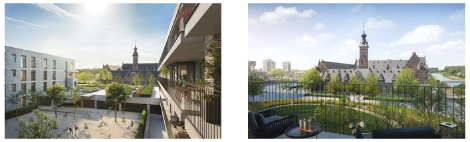
Waste heat from sources such as showers
Wastewater heat recovery is an innovative technique that is not yet widely used in Flanders. For the wastewater treatment company Aquafin, this is the third application, following its own office in Aartselaar and the new swimming pool in Sint-Niklaas. Mechelen is the first site to implement this in a project that also includes residential units.
{“With wastewater heat, we use the heat from wastewater generated by showers, washing machines, dishwashers, etc. as an energy source to supply a local heating network,” explains Maarten Raemdonck, Director of Innovation at Aquafin. “We install a heat exchanger in the wastewater pipe to extract heat from the wastewater and bring a heat-transfer fluid up to the desired temperature. The heat-transfer fluid is then fed to a heat pump in the building.”
Geothermal energy as a backup
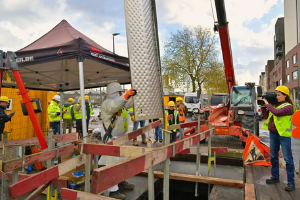
As the main source of heat for the buildings at the Keerdok site, heat from wastewater is a sustainable, easy-to-implement and financially attractive choice. It is also a stable source of heat, as wastewater flows continuously through the sewer. In order to meet the demand for heat even during snowmelt, for example, when the temperature of the sewer network drops, a combination with geothermal energy was chosen. Geothermal wells that extract heat from the ground were drilled for this purpose beneath Place de la Croix-Rouge and beneath the new construction projects. Geothermal energy also provides passive cooling for residents during the hottest summer months, thereby warming the ground. The synergy between the two heat sources effectively creates an underground heat storage system and enables the site to be supplied with 100 per cent green heat throughout the year.
“Noven aims to provide sustainable heating and air conditioning to as many buildings as possible in Belgium and, in doing so, to minimise the burden on customers,” said Jeroen Rabaey, CEO of Noven. “We are very grateful for the trust placed in us by Aquafin, the city and the project partners Global Estate Group, DCA, Kairos-Montréal, Vanderstraeten, ION and NEW. We still need more projects like this one.”
Fossil-free Mechelen
Patrick Princen, alderman for public works:
“The combination of sewer-based heating and geothermal energy on this scale is unique in Europe. Furthermore, the project fits perfectly with the city’s heating strategy, which aims to heat Mechelen without fossil fuels by 2050. Last spring, Aquafin and some 25 other stakeholders co-signed the Mechelen Heat Coalition charter. With this project, Aquafin perfectly illustrates how, through collaboration between the city and various sectors, we can take major steps towards a fossil-fuel-free future at a local level. It serves as an example for the many organisations, companies and countries currently discussing a climate agreement in Baku ”.
“ The scale on which we are combining wastewater heat and geothermal energy at Keerdok is a first and makes our city a pioneer in sustainable urban development. The technology we are deploying here demonstrates how renewable energy sources can be utilised to the full. It is impressive to see that a relatively unknown energy source such as waste water has such potential to heat an entire neighbourhood. This project shows that in Mechelen, we are not afraid to push the boundaries of urban development. The Keerdok site is therefore more than just a residential area; it is a model for the cities of tomorrow ”,
said Greet Geypen, alderwoman for urban development.
Renovated collector prior to
Before the heat exchanger could be installed in the Winketkaai collector, Aquafin had to renovate it. This was carried out very recently using a technique known as ‘lining’, in which a resin-impregnated sleeve is pulled through the pipe. As it passes through the hot water, the sleeve hardens and seals against the inner wall of the pipe. This procedure significantly extends the service life of the sewer network and ensures the continued supply of heat from wastewater for years to come. As the pipe was renovated from the inside, no excavation or breaking-up work was required, and this significantly reduced the time taken to complete the work.
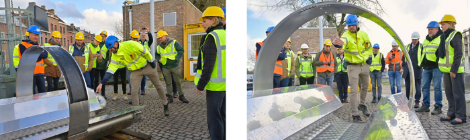
Construction work at the Keerdok site is proceeding as planned. The buildings could be commissioned in autumn 2025.
Referencias
BAM Belgium website: www.bambelgium.be/fr/riothermie/
Para ir más allá
Companies :