Renewable Energy Procurement: A guide to buying off-site renewable electricity
The Melbourne Experience – Australia
C40 Cities Climate Leadership Group, Nordic Sustainability, 2019
Local authorities and large organisations play a key role in the energy transition by stimulating investment in renewable energy through collective procurement contracts.
The Melbourne Renewable Energy Project (MREP) is a prime example: in 2018, 14 institutions joined forces to finance an 80 MW wind farm, covering more than a third of its energy production. This model, which can be replicated on a large scale, helps to secure stable prices, reduce energy costs and accelerate decarbonisation.
Melbourne’s Renewable Energy Procurement guide sets out the key steps to help cities and businesses embark on ambitious renewable energy projects.
A collective approach that combines environmental impact, economic resilience and local leadership.
Large organisations such as city councils, universities, stadiums and corporations use a substantial amount of electricity and represent a large portion of the energy companies’ consumer base. They can drive investment into large-scale, off-site renewable energy projects such as wind farms and solar parks by signing power purchase agreements (PPA) with an electricity generator – especially when they work together. Their leadership can kickstart the renewable energy market in their city-region, and help to provide stable electricity prices and lower energy costs for themselves and other consumers.
In November 2017, the City of Melbourne in Australia led the creation of the Melbourne Renewable Energy Project, a collective PPA which enabled the construction of the 80MW Crosslands Wind Farm in Western Victoria in 2018. The PPA was signed by 14 public and private institutions, including universities, banks and local councils, who collectively committed to purchasing 88GWh of electricity per year – over a third of the wind farm’s total capacity, and equivalent to the annual power use of 17,600 households. The city of Melbourne switched all its operations to energy from Crosslands on 1 January 2019, becoming the first city in Australia to have all council-owned buildings and infrastructure – such as street lights, municipal buildings, libraries and other service centres – entirely powered by renewable energy. The other partners also switched on the same day.
Recognising that there is huge potential for the MREP to be replicated around the world, the City of Melbourne produced Renewable Energy Procurement as a detailed, clear and practical guide to help other city governments and organisations invest in large-scale, long-term renewable energy projects. It presents the lessons learnt from the MREP and, based on experience, it explains:
-
The opportunities.
-
How to make the business case.
-
The data information you need to have, and how to get started.
-
The contract options for renewable energy.
-
How to plan the procurement process and manage the project.
How the city of Melbourne led Melbourne Renewable Energy Project
As the project lead, City of Melbourne formed a senior-level steering committee, comprised of directors responsible for sustainability strategy, operations and electricity purchasing, as well as heads of governance, finance and legal services. The steering committee received reports on project direction and timeframes, reviewed risks and provided direction on strategic challenges. A project working group was formed with a project manager and procurement, legal and finance specialists. The project team managed relationships with partner organisations, researched issues, developed options (together with internal and external advisors) and recommended actions.
Watch the 2 minute video below for an introduction to the project.
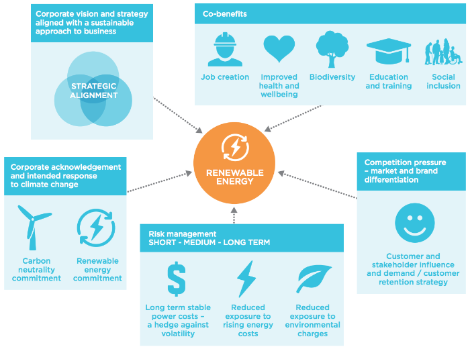
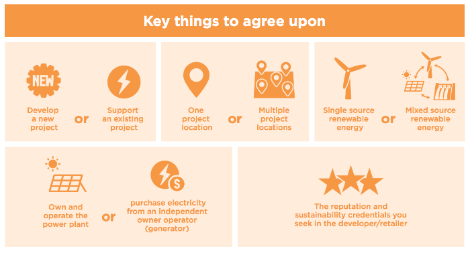
The report includes a series of infographics, examples of which are given below. Further resources including the MREP tender documents are available on the City of Melbourne website.
Corporate drivers for pursuing renewable energy
Referencias
Para ir más allá
For further guidance on this topic you can also read How cities can create demand for large-scale clean energy generation.
Website: www.c40.org/