‘ Sponge City ’ in Shenzhen (China)
Circular and resilient water management in urban areas
agosto 2025
ICLEI-Local Governments for Sustainability
Shenzhen, a rapidly expanding Chinese megacity, has adopted a visionary approach with its ‘ Sponge City ’ programme, incorporating nature-based solutions to build resilience against flooding and drought.
This pilot project, combining wetlands, canals and infiltration systems, demonstrates how a city can absorb, store and reuse rainwater to adapt to climate challenges, whilst supporting its urban development.
Driven by collaboration between local authorities and experts, this programme illustrates how ecological innovation can transform challenges into opportunities for modern cities.
This factsheet summarises one of the 12 case studies in the document: Circular and Resilient Urban Water Management
Shenzhen, a Chinese megacity with a population of over 12 million, faces growing risks of flooding due to its rapid urbanisation and soil sealing. Its humid subtropical climate, with heavy rainfall (around 1,900 mm per year), exacerbates these challenges, requiring innovative solutions for sustainable stormwater management. The city, which has experienced rapid economic growth since the 1980s, must now balance urban development with climate resilience, whilst preserving its natural resources.
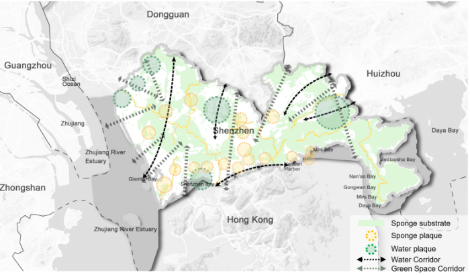
Shenzhen’s ‘Sponge City’ programme, launched in the 2010s, aims to transform the city into a resilient urban ecosystem capable of absorbing, storing, infiltrating and reusing rainwater. This pilot project, inspired by nature-based solutions, incorporates green infrastructure to enhance resilience to flooding and drought, whilst supporting sustainable urban development. The aim is to create a city where rainwater is managed in a natural and sustainable way, thereby reducing pressure on traditional drainage systems and improving residents’ quality of life.
Solutions implemented
-
Artificial wetlands : These ecosystems are designed to filter and store rainwater whilst providing habitats for local flora and fauna. They play a key role in reducing runoff and improving water quality.
-
Drainage channels : A network of channels designed to redirect rainwater towards retention basins or infiltration areas, thereby reducing the risk of flooding.
-
Infiltration systems : These help to recharge groundwater by encouraging water to seep into the ground, rather than running off the surface.
-
Green roofs : Incorporated into new buildings to absorb rainwater, improve thermal insulation and reduce the urban heat island effect.
-
Parks and green spaces : Designed to absorb and store rainwater, whilst providing recreational spaces for residents.
Key results
-
Reduced flood risk : Thanks to improved rainwater absorption, the city has been able to limit the damage caused by heavy rainfall, thereby protecting infrastructure and homes.
-
Improved groundwater recharge :
-
Infiltration systems have helped to increase underground reserves, which are essential for long-term water security.
-
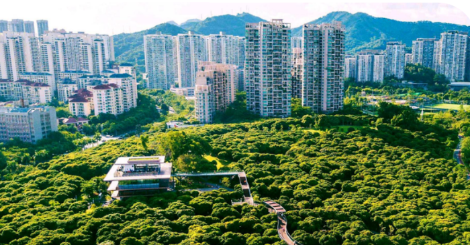
Creation of green spaces : Parks and artificial wetlands contribute to biodiversity and urban wellbeing, whilst playing a key role in rainwater management.
-
Replicable model : The success of the ‘Sponge City’ programme in Shenzhen has inspired other Chinese cities, such as Beijing and Shanghai, as well as similar projects internationally.
Climate and environmental impacts
-
Climate change mitigation : Green infrastructure (green roofs, wetlands) helps to reduce the urban heat island effect, thereby lowering energy consumption associated with air conditioning. Furthermore, by reducing the need to pump and transport water over long distances, the programme cuts associated CO₂ emissions.
-
Climate adaptation and resilience :
- Stormwater management : Systems for collecting, storing and infiltrating water enable the city to better withstand extreme weather events, such as torrential rain or prolonged droughts.
- Flood mitigation : Wetlands and retention basins act as natural buffers, absorbing excess water and thereby reducing the risk of flooding.
-
Biodiversity : Artificial wetlands and parks provide habitats for a diverse range of flora and fauna, contributing to the restoration of urban ecosystems.
Success factors
-
Values :
- Recognition of the importance of nature-based solutions for urban resilience and environmental sustainability.
- Integration of water management as a central element of urban planning.
-
Connections :
- Physical connections : Green and blue infrastructure is integrated into the existing urban fabric, creating a coherent network for stormwater management.
- Social connections : Collaboration between local authorities, urban planners, environmental experts and residents to design solutions tailored to local needs.
-
Investments :
- Public funding : The project received significant government support as part of national sustainable development policies.
- Partnerships with local experts : Collaboration with universities and research institutes to design solutions tailored to the local context.
Replicability in Morocco
The Shenzhen model could inspire Moroccan cities such as Casablanca or Tangier, where rapid urbanisation and flood risks call for innovative solutions. Incorporating artificial wetlands, drainage channels and green roofs into new urban projects would help improve climate resilience and residents’ quality of life.
For example, in Casablanca, where urban flooding is a recurring problem, adopting this model could help reduce risks whilst creating green spaces for residents. Similarly, in coastal areas such as Tangier, green infrastructure could help manage stormwater whilst enhancing biodiversity and the living environment.
Referencias
Online document, see pages 67 to 81: Gestion circulaire et résiliente de l’eau en milieu urbain - Circular and resilient water management in urban areas
Para ir más allá
Websites : iclei.org/ & iclei-europe.org/
Bibliography
1. Feng, Y. (11 juillet 2024). How China’s most ‘futuristic’ city restored its mangrove (Comment la ville la plus « futuriste » de Chine a restauré ses mangroves). New Security Beat. www.newsecuritybeat.org/2024/07/how-chinas-most-futuristic-city-restored-its-mangroves/
2. Gouvernement du district de Guangming. (29 octobre 2020). Ville éponge. www.szgm.gov.cn/english/topic/SpongeCity/index.html.
3. Association internationale de l’eau. (Décembre 2016). City Water Stories : Shenzhen – Solutions to Shenzhen’s Resource Shortages (Solutions aux pénuries de ressources à Shenzhen) [PDF]. www.iwa-network.org/wp-content/uploads/2016/12/IWA_City_Stories_Shenzhen.pdf
4. Jenkins, M. (2 avril 2020). Sponge City: Shenzhen explores the benefits of designing with nature. Ville éponge : Shenzhen explore les avantages d’une conception en harmonie avec la nature). Lincoln Institute of Land Policy. www.lincolninst.edu/publications/articles/sponge-city-shenzhen-explores-benefits-designing-with-nature
5. Jenkins, M. (2 avril 2020). Sponge City: Shenzhen explores the benefits of designing with nature. Ville éponge : Shenzhen explore les avantages d’une conception en harmonie avec la nature). Lincoln Institute of Land Policy. www.lincolninst.edu/publications/articles/sponge-city-shenzhen-explores-benefits-designing-with-nature
6. Jiang, Y., & Shan, S. (11 décembre 2021). Shenzhen’s next nickname: The big sponge. (Le prochain surnom de Shenzhen : la grande éponge.) www.urbanwateratlas.com/2021/12/11/shenzhens-next-nickname-the-big-sponge/ en.wikipedia.org+8
7. Landscape China. (s.d.). 一方/未名新作首发 I 深圳岸线与候⻦共栖-基于NbS 的福田红树林国家级自然保护 区⻦类生境修复 [Coexister avec les oiseaux migrateurs le long du littoral de Shenzhen : restauration de l’habitat des oiseaux dans la réserve naturelle nationale de Futian Mangrove grâce à des solutions fondées sur la nature]. www.landscape.cn/landscape/12375.html
8. Landscape Performance Series. (2011). Shenzhen Bay Coastal Park Phase 1. (Parc côtier de Shenzhen Bay, phase 1.) www.landscapeperformance.org/case-study-briefs/shenzhen-bay-coastal-park-phase-1.
9. MLA+. (n.d.). Biodiverse Xiangmi Park (Le Parc Xiangmi et sa biodiversité). mlaplus.com/website/biodiverse-xiangmi-park/
10. Qiang, V., & Yu, X. (22 mars 2020). The Green Cloud: A rooftop story from Shenzhen—a living sponge space inside an urban village. (Le nuage vert : une histoire de toit à Shenzhen, un espace éponge vivant au cœur d’un village urbain). The Nature of Cities. www.thenatureofcities.com/2020/03/22/the-green-cloud-a-rooftop-story-from-shenzhen-a-living-sponge-space-inside-an-urban-village/
11. municipale Shenzhen d’inspection Municipaldisciplinaire Discipline Inspection et bureau Commission de supervision & Supervisory de Shenzhen). Bureau. (s.d.). (Commission 深圳划定27 个海绵城市 建设重点片区 到 2030 年建成区80% 以上的面积将达到海绵城市要求 [Shenzhen désigne 27 zones clés pour le développement de villes-éponges. D’ici 2030, plus de 80 % des zones bâties répondront aux exigences des villes-éponges]. www.szszfw.gov.cn/szsd/content/post_582530.html
12. Gouvernement municipal de Shenzhen. (24 février 2018). Guangming New Area Sponge City PPP project starts the year with good news (Le projet PPP de la ville éponge de la nouvelle zone de Guangming commence l’année avec de bonnes nouvelles). Shenzhen Special Zone Daily. www.sz.gov.cn/cn/xxgk/zfxxgj/zwdt/content/post_1454836.html
13. Gouvernement municipal de Shenzhen. (8 octobre 2024). Regulations of Shenzhen Municipality on the Administration of Building Sponge City. (Règlement de la municipalité de Shenzhen sur l’administration de la construction de la ville éponge). Shenzhen Municipal Bureau of Justice (Bureau municipal de la justice de Shenzhen). sf.sz.gov.cn/fggzywyb/content/post_11584273.html
14. Gouvernement municipal de Shenzhen. (s.d.). Sponge City. (Ville éponge). www.szgm.gov.cn/english/topic/SpongeCity/index.html
15. Sina News. (21 février 2024). 這條 2400 公里的綠道讓「深圳藍」背後的「深圳綠」迅速圈粉,住在森 林… k.sina.cn/article_1895096900_70f4e244034002oja.html
16. Thornett, R. C. (18 janvier 2023). Becoming a ‘Sponge City’ at Shenzhen speed (Devenir une « ville éponge » à la vitesse de Shenzhen). The Diplomat. thediplomat.com/2023/01/becoming-a-sponge-city-at-shenzhen-speed/
17. United Nations Economic and Social Commission for Asia and the Pacific. (Commission économique et sociale des Nations Unies pour l’Asie et le Pacifique). (2020). Session 8.1: Shenzhen Sponge City Programme in Guangming District (Session 8.1 : Programme « ville éponge » de Shenzhen dans le district de Guangming) [PDF]. www.unescap.org/sites/default/d8files/event-documents/Session 8_1. Shenzhen Sponge City Programme in Guangming District.pdf
18. United Nations Economic and Social Commission for Asia and the Pacific (Commission économique et sociale des Nations Unies pour l’Asie et le Pacifique). (Septembre 2021). Session 8.1: Shenzhen Sponge City Programme in Guangming District (Session 8.1 : Programme « Shenzhen Sponge City » dans le district de Guangming) [PDF]. www.unescap.org/sites/default/d8files/event-documents/Session 8_1. Shenzhen Sponge City Programme in Guangming District.pdf
19. Urban Nature Atlas. (Atlas de la nature urbaine). (Octobre 2021). Le projet Green Cloud (The Green Cloud Project) – Gangxia 1980, Shenzhen. una.city/nbs/shenzhen/green-cloud-project-gangxia-1980
20. Wang, Y., Jiang, Z., & Zhang, L. (2021). Sponge city policy and sustainable city development: The case of Shenzhen (Politique des villes éponges et développement urbain durable : le cas de Shenzhen). Frontiers in Environmental Science, 9, 772490. doi.org/10.3389/fenvs.2021.772490
21. Wang, Y., Jiang, Z., & Zhang, L. (2022). Sponge city policy and sustainable city development: The case of Shenzhen (Politique de la ville éponge et développement urbain durable : le cas de Shenzhen). Frontiers in Environmental Science, 9, 772490. doi.org/10.3389/fenvs.2021.772490
22. Xu, D., Ouyang, Z., Wu, T., & Han, B. (2020). Dynamic trends of urban flooding mitigation services in Shenzhen, China (Tendances dynamiques des services d’atténuation des inondations urbaines à Shenzhen, en Chine). Sustainability, 12(11), 4799. doi.org/10.3390/su12114799
23. Zhu, Y., Xu, C., Yin, D., Xu, J., Wu, Y., & Jia, H. (2022). Environmental and economic cost-benefit comparison of sponge city construction in different urban functional regions. Journal of Environmental Management, (Comparaison des coûts et avantages environnementaux et économiques de la construction de villes-éponges dans différentes régions urbaines fonctionnelles). Journal of Environmental Management, 304, 114230. doi.org/10.1016/j.jenvman.2021.114230