State of Zero Waste Municipalities Report
Jack McQuibban,, 2025
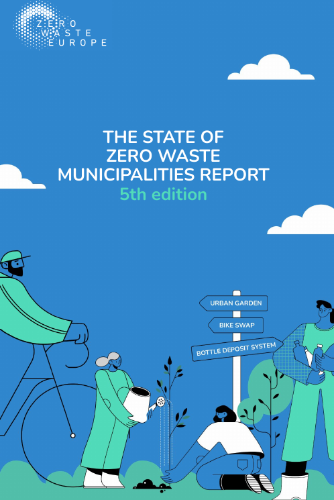
The “State of Zero Waste Municipalities Report” reveals a quiet revolution: that of towns and cities, large and small, which are transforming their approach to waste.
In a world marked by climate crises, geopolitical tensions and the depletion of resources, these towns and cities are proving that zero waste is no longer a utopian dream, but a reality in the making. From Viladecans in Catalonia, where residents are involved in repair and composting projects, to Lutsk and Khmelnytskyi in Ukraine, which, despite the war, are pressing ahead with their transition, and including cities such as Lyon and Brussels, where ambitious public policies are redefining resource management, this report paints a picture of a global movement. These cities do not merely comply with standards: they go beyond them, using zero waste as a driver for resilience, social innovation and environmental justice.
Para descargar: zwe_2025_state-of-zero-waste-municipalities-report-5th-edition_en.pdf (32 MiB)
Towards zero-waste cities : when local innovation meets legislative ambition
A rapidly expanding movement : from pioneers to global networks
It all began in 2007 with Cappanori, a small Italian town that dared to dream of a zero-waste future. Today, that dream has become a reality shared by hundreds of local authorities around the world. The ‘ State of Zero Waste Municipalities Report ’ chronicles this transformation : what was once a fringe idea, championed by environmental activists, is now an approach adopted by cities, capitals and villages, from Europe to Asia, via Africa and Latin America.
The figures speak for themselves: in 2024, Zero Waste Europe and its subsidiary Mission Zero Academy (MiZA) are supporting 86 European municipalities across 18 countries, representing 18 million people. The ‘Zero Waste Cities certification’ programme, launched just three years ago, already has 19 certified cities and 29 candidate cities, not to mention the 40 accredited mentors who are guiding local authorities through their transition. Among the year’s most notable successes are the commitment of Lutsk and Khmelnytskyi in Ukraine, which, despite the conflict, have joined the movement, and that of the island of Krk in Croatia, which has become the first certified island in Europe thanks to a collective waste management scheme involving its seven municipalities.
But beyond the figures, a philosophy is emerging: cities are no longer content merely to manage waste; they are tackling its root causes. Through sustainable procurement policies, awareness-raising campaigns and partnerships with local stakeholders, they are reducing waste generation at source, rather than merely treating it downstream. This holistic approach, which incorporates prevention, reuse and recycling, shows that zero waste is much more than a technical issue : it is a cultural and economic shift.
An ecosystem for prevention and reuse
To accelerate this transition, Zero Waste Europe has built a collaborative ecosystem bringing together cities, governments, businesses and civil society. The “ Elevating Reuse in Cities ” (ERIC) project, for example, has enabled 30 European cities — from Lyon to Nantes, via Brussels, Zagreb and Villadecans — to develop plastic prevention plans.
These plans are based on practical tools: action plan templates, performance indicators and data collection strategies tailored to local circumstances.
In Lyon, the metropolitan authority has adopted an ambitious plan to reduce plastic waste, covering 1.4 million residents. In Brussels, the initiative to use reusable nappies in nurseries has prevented 1,400 tonnes of CO₂ emissions over a period of 4 to 6 years, whilst saving €80,000 a year on waste collection. These examples illustrate how local solutions can have a global impact, inspiring other cities to follow suit.
Bio-waste management: an under-recognised climate lever
Bio-waste represents one of the most urgent — and most underestimated — challenges of the ecological transition. In Europe, only 26 per cent of food waste is currently collected (compared with 18 per cent in 2020), whilst 74 per cent still ends up in landfill or is incinerated, releasing methane, a greenhouse gas 28 times more potent than CO₂. However, significant progress was made in 2024: thanks to projects carried out in 12 local authorities (in France, Portugal, Poland, etc.), 300 tonnes of bio-waste were diverted from landfill to be composted.
The #ForkToFarm project, for example, has raised awareness amongst local authorities of the importance of separate collection and composting, whilst providing practical guides to help municipalities improve their systems. These tools include a guide on governance and economic incentives for separate collection, country factsheets on best practices in communication, and policy recommendations for the EU. These resources demonstrate that bio-waste management is not merely a technical issue, but also a lever for climate action and the creation of local jobs.
Textiles : a complex and urgent challenge
With the Waste Framework Directive (WFD)1 coming into force in 2025, EU Member States must now collect textiles separately and put in place extended producer responsibility (EPR) schemes by 2028. However, the reality is alarming : less than 1 per cent of textiles are currently recycled into new textiles globally, and 90 per cent of discarded clothing in London ends up being incinerated.
In light of this, cities such as London have launched ambitious action plans to make the textile industry more circular. The “London Textiles Action Plan2”, developed in collaboration with ReLondon, the Greater London Authority and the Ellen MacArthur Foundation, aims to reduce fashion-related emissions by 30 per cent by acting on several levers:
-
extending the lifespan of textiles,
-
promoting reuse and repair,
-
and improving collection and recycling.
In Amsterdam, a pioneering study revealed that 69 per cent of discarded textiles end up in residual waste, and that 70 per cent of collected textiles are incinerated — whilst 28 per cent could be reused and 51 per cent recycled. These figures highlight the urgency of taking action, but also the enormous potential of reuse to reduce fashion’s environmental footprint.
When cities become role models for the EU
The ‘ State of Zero Waste Municipalities Report ’ highlights a paradigm shift : ‘ zero-waste models ’ are no longer merely local initiatives, but drivers for achieving the legislative targets of the European Union and its Member States. Municipalities are increasingly adopting zero-waste strategies to comply with mandatory recycling targets, waste reduction objectives and circular economy directives.
The Waste Framework Directive (WFD), amended in early 2025, illustrates this trend. It now requires Member States to collect textiles separately and to introduce extended producer responsibility (EPR) schemes by 2028. Cities are rising to this challenge by designing local systems that prioritise prevention, reuse and recycling, whilst reducing greenhouse gas emissions and generating cost savings. For example, the separate collection of bio-waste, now mandatory across the EU, has prompted local authorities to innovate, as seen in Lyon and Brussels, where ambitious plans have been put in place to meet these requirements.
What is striking is that ‘zero-waste cities’ do not merely comply with standards: they exceed them, proving that legal compliance and sustainability can go hand in hand. By incorporating zero-waste principles into their policies, they are inspiring systemic change, not only in Europe but also around the world.
Conclusion : zero waste, a revolution in the making
The ‘ State of Zero Waste Municipalities Report ’ does more than simply take stock of the current situation : it tells a story – that of a movement which has managed to move from utopia to reality, from isolation to international cooperation. Zero-waste towns are no longer exceptions, but key players in the ecological transition, driven by committed communities, visionary public policies and local innovations.
What is striking about this report is the diversity of approaches : some cities focus on prevention (such as Viladecans, with its repair workshops), others on reuse (such as Brussels, with its washable nappies), and others still on bio-waste management (such as Lyon or San Fernando). But they all share a fierce determination to reduce their ecological footprint, whilst creating jobs, strengthening social cohesion and inspiring other regions.
The message is clear: zero waste is no longer a question of ‘why’ but of ‘how’. The tools exist, the models are tried and tested, and the benefits — environmental, economic and social — are tangible. There are, of course, still many challenges: resistance from polluting industries, a lack of funding, and legislative complexity. But the successes are there, concrete and replicable, and they prove that the transition to a circular economy is not only necessary, but also possible.
“The stories and data compiled in these pages are not just isolated successes — they chart a roadmap for sustainable impact, adaptable to various contexts across Europe and around the world. As we navigate an increasingly complex environmental landscape, the leadership shown by these pioneering municipalities offers hope and practical lessons for building truly circular and resilient communities.” (Jack McQuibban, State of Zero Waste Municipalities Report, 5th edition, 2025, p. 7)
1 The Waste Framework Directive (WFD) (originally laid down by Directive 2008/98/EC) is the European Union’s key piece of legislation establishing the principles and basic rules for waste management, pollution prevention and the transition to a circular economy. The fundamental principles: Waste hierarchy: a priority order must be followed: prevention, preparation for reuse, recycling, other recovery (particularly energy recovery), and finally disposal (landfilling) as a last resort. The ‘polluter pays’ principle: the cost of waste management must be borne by the original producer of the waste or by the current or previous holders. Extended Producer Responsibility (EPR): manufacturers and those placing products on the market are financially and/or organisationally responsible for managing the end-of-life of their products.
2 The London Textiles Action Plan sets out a programme of actions aimed at accelerating the transition to a zero-waste, low-carbon circular economy for fashion and textiles in London.
Referencias
Para ir más allá
Websites :
-
Zero Waste Europe : zerowasteeurope.eu/
-
Mission Zero Academy : www.missionzeroacademy.eu/
-
ReLondon : relondon.gov.uk/
-
Greater London Authority : www.london.gov.uk/
-
Fondation Ellen MacArthur : www.ellenmacarthurfoundation.org/