How the carbon calculator translates zero waste strategies into climate benefits : the case of Barcelona
marzo 2025
At the heart of European climate action, Barcelona is establishing itself as a model of innovation, demonstrating that waste management is not just an environmental issue, but also a powerful lever for reducing carbon emissions.
This case study explores how the city’s zero-waste strategies, quantified using a revolutionary carbon calculator, reveal untapped potential for reducing emissions whilst aligning with ambitious climate targets.
By translating waste prevention, reuse and recycling into measurable climate benefits, Barcelona demonstrates how urban centres can transform waste into a resource – both environmental and economic. The findings offer a replicable model for cities around the world, encouraging them to rethink their relationship with waste and accelerate their transition to a circular economy.
Para descargar: en-zwe-case-study-translating-zero-waste-strategies-into-climate-benefits-the-case-of-barcelona_.pdf (2,6 MiB)
Background and issues : Barcelona, a committed city facing challenges
Barcelona, the capital of Catalonia, has long been recognised for its commitment to sustainability and innovation. Its 2018–2030 Climate Plan aims to reduce greenhouse gas emissions by 45 per cent by 2030 (compared with 2005 levels) and achieve carbon neutrality by 2050. However, like many other cities, Barcelona is struggling to fully integrate its waste management strategies with its broader climate objectives.
The challenge lies not only in improving recycling rates, but in a fundamental rethink of resource use and waste generation. Traditional waste management focuses primarily on end-of-pipe solutions, treating waste after it has been generated. However, the most significant carbon savings lie in prevention and reuse strategies, which prevent waste from being generated in the first place.
It is against this backdrop that Barcelona’s 2021–2027 Zero Waste Plan, developed with the expertise of Rezero1, introduces innovative measures to address the climate emergency through the efficient use of resources and smart waste management. As Alba Cabrera of Rezero explains :
“ Barcelona City Council has drawn on Rezero’s expertise to develop the city’s Zero Waste Plan. This plan, which aims to transition towards a waste-free future, introduces innovative measures that address the climate emergency through the efficient use of resources and smart waste management. It actively involves the local community and key stakeholders to ensure a successful transition. With this initiative, Barcelona has become a model for other major European cities embarking on the path to zero waste. By using the emissions calculator, the city is paving the way for the use of metrics that assess both emissions from waste management and strategies for reduction and reuse.” (page 4)
The Carbon Calculator : a revolutionary tool
Developed by Zero Waste Europe in collaboration with the Catalan consultancy Inédit and implemented by the Mission Zero Academy, the Carbon Calculator is an innovative tool that not only calculates the emissions savings associated with improved waste separation and recycling, but also incorporates the impact of prevention and reuse activities.
For a city like Barcelona, this comprehensive approach highlights the actual carbon footprint of its waste management systems and the potential savings achievable through zero-waste strategies. The tool’s methodology is based on life-cycle analysis principles, taking into account emissions across the entire waste management chain: from collection and transport to treatment and final disposal. It incorporates data on various waste streams, including organic waste, paper, cardboard, glass, plastics and residual waste.
What sets this tool apart is its ability to model various zero-waste scenarios. Users can input potential changes in waste prevention, reuse initiatives and improved recycling rates to see the resulting reductions in emissions. This functionality enables cities to test different strategies and quantify their potential impact before implementation, thereby facilitating data-driven decision-making on urban waste management policy.
Application in Barcelona : concrete results
Barcelona, a city of 1.6 million inhabitants and a major tourist destination, faces significant challenges in managing its municipal waste. In 2021, the city generated approximately 42,431 tonnes of waste, equivalent to 1.23 kg per person per day. The separate collection rate stands at 41.65 per cent, which, although higher than the Spanish average, remains below the EU’s 55 per cent recycling target for 2025 and far from Barcelona’s ambitious target of 67 per cent by 2027.
Applying the carbon calculator to Barcelona’s current waste management system reveals a significant climate impact: baseline emissions linked to waste management amount to approximately 172,770 tonnes of CO₂ equivalent per year, equivalent to the annual emissions of 30,000 Europeans. Organic waste and residual waste are the main contributors, accounting for 40 per cent and 35 per cent of total emissions respectively.
The proposed zero-waste strategy for Barcelona
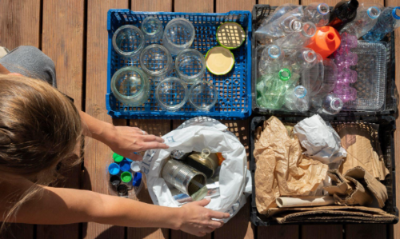
To address these challenges and significantly reduce carbon emissions, the carbon calculator was used to model seven concrete actions within Barcelona’s zero-waste strategy. This targeted strategy, aligned with the principles of the waste hierarchy and the city’s climate targets, comprises the following key components :
-
Waste prevention : implementation of a city-wide campaign to reduce food waste, introduction of a ban on single-use plastics, and promotion of reusable packaging systems in the retail and hospitality sectors.
-
Reuse and repair : creation of a network of repair workshops and second-hand shops, a municipal reuse centre for furniture and household items, and the development of a digital platform for sharing and exchanging goods.
-
Improved separate collection : expansion of door-to-door collection schemes to cover 80 per cent of the city; introduction of pay-as-you-throw schemes to encourage waste reduction; and implementation of a deposit-return scheme for beverage containers.
-
Optimised organic waste management : increasing the separate collection of organic waste to capture 80 per cent of what is generated, modernising composting facilities to produce high-quality compost, and promoting home and community composting.
-
Optimised recycling : investment in advanced sorting technologies at recycling centres, development of local markets for recycled materials, and implementation of extended producer responsibility schemes.
-
Reduction of residual waste : phasing out incineration and landfill, investing in mechanical and biological treatment facilities, and introducing strict controls on commercial and industrial waste.
-
Education and community engagement : Launch of a comprehensive zero-waste education programme in schools, organisation of community events and workshops on waste reduction, and development of a mobile app providing information on waste sorting and recycling.
Results and potential impact
By implementing these seven actions, the carbon calculator projects that Barcelona could massively reduce its waste-related carbon emissions, bringing them down from 172,770 tonnes of CO₂ equivalent per year to a net reduction of 14,641 tonnes of CO₂ equivalent per year by 2026. This is equivalent to the average annual emissions of 32,000 Europeans or the carbon absorption capacity of 28 million trees.
This reduction would be achieved through a combination of reducing total waste generation, increasing recycling rates and more efficient treatment of organic and residual waste.
If these measures are applied over a 10-year period, the implementation of this zero-waste strategy could prevent the emission of up to 2 million tonnes of CO₂ equivalent.
Overall impact and wider benefits
Such a level of reduction would contribute significantly to Barcelona’s climate targets. It would represent around 15 per cent of the total emissions reduction required for the city to achieve its target of a 45 per cent reduction by 2030 compared with 2005 levels.
The impact extends far beyond carbon emissions alone. The zero-waste strategy would also lead to :
-
A reduction in air and water pollution from waste treatment facilities.
-
The conservation of natural resources through increased recycling and reuse.
-
The replacement of synthetic fertilisers with compost, a natural soil improver.
-
The creation of green jobs in the recycling and repair sectors.
-
An improvement in urban cleanliness and quality of life for residents.
-
Cost savings for the local authority thanks to reduced waste treatment requirements.
Monetising carbon savings
A ‘carbon price’ concept involves assigning a monetary value to reductions or avoidance of carbon emissions achieved through zero-waste strategies. This approach enables cities to quantify the climate impact of their waste management decisions in financial terms, thereby making it easier to justify investment in sustainable practices.
For Barcelona, using the current price under the EU Emissions Trading Scheme (ETS) of around €80 per tonne of CO₂ (in 2024), the annual reduction in emissions of 187,000 tonnes would be equivalent to a carbon price of around €15 million per year. Over a 10-year period, this would represent a potential cumulative value of €150 million in avoided carbon costs – a significant sum that could finance a large proportion of the investments needed to implement all the proposed changes.
However, it is important to note that this figure likely underestimates the true value of carbon reduction. Many experts estimate that the social cost of carbon (which includes broader environmental and health impacts) is much higher, potentially in the region of €150 to €200 per tonne. Using these higher estimates, the value of Barcelona’s emissions reductions could reach up to €37.5 million per year (or €375 million over 10 years).
Conclusion : a powerful tool for the cities of tomorrow
The carbon calculator is a powerful tool that enables cities to assess the climate impact of their zero-waste initiatives. The case of Barcelona highlights how significant emissions savings, particularly in the areas of prevention and reuse, underscore the importance of these strategies.
If the city succeeds in monetising the emissions savings linked to zero-waste strategies, this could be a game-changer, setting a strong precedent for many other local authorities to radically change their relationship with resources and phase out waste.
At the time of writing this case study, other European cities are already using the tool to understand the climate impact and benefits of their zero-waste strategies. Zero Waste Europe will continue to develop case studies highlighting the potential for carbon emissions savings in other cities, made possible by the carbon calculator.
1 Founded in 2005, the Rezero association is based in Barcelona and Manacor. Its geographical scope of action covers mainly Catalonia and the Balearic Islands, but also extends to Spain and Europe. Rezero works to transform consumption and production models and to establish a ‘zero-waste’ society. To this end, it promotes initiatives and policies that encourage responsible consumption and waste prevention, in collaboration with economic and social stakeholders.
Referencias
-
Document : Plan Residuo Cero Barcelona - Barcelona Zero Waste Plan
Para ir más allá
Websites:
-
Zero Waste Europe : zerowasteeurope.eu/
-
Inèdit : ineditinnova.com/en/
-
Mission Zero Academy : www.missionzeroacademy.eu/