Gusinje, or how a small Montenegrin municipality is challenging preconceptions about zero waste
diciembre 2023
Deep in the mountains of Montenegro, where the concept of ‘zero waste’ was still unknown just 30 months ago, the small municipality of Gusinje has undergone a remarkable transformation. With a population of just 1,673 and limited resources, this rural community has, thanks to the commitment of its residents, its local leaders and the support of Zero Waste Montenegro, managed to reduce its waste, improve waste sorting and achieve results that have exceeded all expectations.
Its story is one of a quiet revolution, where collective will, education and tailored solutions have made it possible to overcome structural challenges, turning Gusinje into an inspiring example for Montenegro and beyond.
Para descargar: the-story-of-gusinje-eng.pdf (3,4 MiB)
An idyllic setting, immense challenges
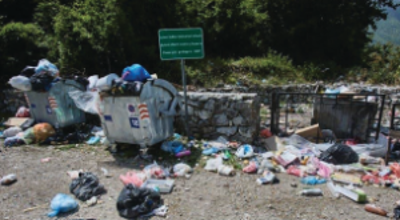
Nestled at an altitude of 920 metres, on the Albanian border, Gusinje is a rural municipality in Montenegro, surrounded by the imposing Prokletije mountain range and crossed by the rivers Vruje and Grnčara. Although ranked among the country’s least developed regions, it nevertheless serves as a testing ground for innovation in waste management. In a country where fly-tipping, a lack of infrastructure and low public awareness of environmental issues are commonplace, Gusinje has dared to completely overhaul its system.
Before the project, the situation was alarming: 99 kg of waste per inhabitant per year (excluding bulky, tourist or commercial waste), virtually no separate collection, and total reliance on landfill sites. Waste was simply piled up unsorted, and the few awareness-raising campaigns were driven by isolated citizen initiatives. Yet, despite these obstacles, a desire for change emerged, driven by an unprecedented collaboration between the municipality, the Regional Development Agency (RDA) and the NGO Zero Waste Montenegro.
A project born of a collective determination
It all began in February 2021, with the launch of the ‘Montenegro and Albania Towards Zero Waste’ project, funded by the European Union under the ‘IPA Cross-Border Cooperation Programme’1. Gusinje, Montenegro’s third-smallest municipality, was chosen for its enthusiasm and commitment to becoming a model for other local authorities. The aim ? To reduce overall waste through prevention measures and to minimise residual waste through reuse and recycling.
To achieve this, an in-depth survey was carried out in 2021. The results were encouraging :
-
99 per cent of residents considered recycling and waste reduction to be important.
-
83 per cent felt there was too much unnecessary packaging.
-
77 per cent were willing to actively contribute to transforming their municipality into a zero-waste town.
This rare consensus enabled the project to be launched on a solid footing.
An Advisory Board to embed the change
To ensure that the proposed measures reflect local realities, a Zero Waste Advisory Board (ZWAB) was set up, bringing together around twenty local decision-makers, business leaders, teachers, representatives of community organisations and farmers. The aim ? To understand local attitudes, plan tailored awareness-raising campaigns and select the **waste management models best suited to Gusinje.
Despite political differences and initial scepticism (notably mistrust of the capabilities of local and national governments), this Council has succeeded in uniting efforts and creating an inclusive momentum.
A first victory: the implementation of an ambitious zero-waste plan, including:
-
The switch from a single-bin collection system to a five-bin system (paper, glass, plastic/metal, bio-waste, residual waste).
-
The creation of a materials recovery facility (MRF) equipped with a hydraulic press and a manual conveyor belt to facilitate the processing of sorted waste.
-
The distribution of 150 domestic compost bins to encourage composting at source.
Practical tools for sustainable management
The key to Gusinje’s success lies in a combination of appropriate infrastructure and seamless educational support.
Recycling bins for everyone
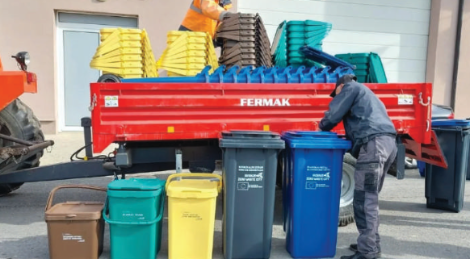
Following a thorough needs assessment (amount of waste per household, collection capacity, etc.), 2,765 recycling bins and 55,500 biodegradable bags were distributed to residents. Complex logistics : it was necessary to adapt to local constraints (only one collection lorry available) by organising a collection schedule spread over five days for the town centre, and once a month for outlying areas.
A materials recovery facility to process waste locally
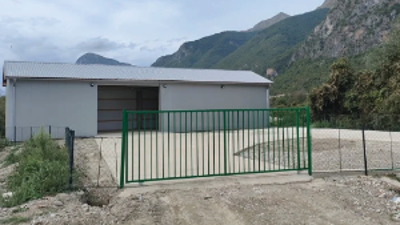
The Gusinje Materials Recovery Facility (MRF), built in 2023, is a 120 m² prefabricated structure designed for the storage and partial processing of recyclable waste. A 120 m² concrete platform has also been set up for the composting of bio-waste, protected by a fence. Thanks to a hydraulic press (with a force of 12 tonnes) and a manual conveyor belt, waste can now be compressed and stored for longer, thereby reducing transport costs to recycling centres.
Education: the cornerstone of success
Without public awareness, even the best infrastructure fails. Gusinje has taken this on board: 20 educational workshops were organised for adults, schoolchildren and local institutions to explain the zero-waste hierarchy and their role in implementing it. Eleven community assistants were recruited to visit households, answer their questions and hand out explanatory leaflets. The result: 10 per cent of the population took part directly in the workshops, and an 18 per cent reduction in residual waste was observed.
Encouraging results, despite the challenges
The initial findings are promising:
-
Per capita waste has risen from 99 kg/year in 2021 to 129 kg/year in 2023 (an increase attributable to the inclusion of new types of waste in the measurements, such as ash and wood waste, which were previously not counted).
-
61 per cent of waste is now sorted (compared with almost 0 per cent before the project), with a dramatic reduction in bio-waste within residual waste (falling from 21 per cent to 4 per cent).
-
50 per cent of local businesses now report being familiar with the principles of zero waste (compared with 23 per cent at the start of the project).
However, challenges remain :
-
The rise in plastic waste (from 16 per cent to 37 per cent of residual waste), likely linked to increased purchasing power (minimum wages have doubled) and improved collection (residents now dispose of their plastics in bins rather than in the natural environment).
-
The lack of reliable data on the costs of the new system, which makes it difficult to assess its long-term financial viability.
Complementary initiatives to consolidate the momentum
Gusinje does not merely sort its waste : it takes action upstream to reduce it at source.
-
Home composting : 150 compost bins were distributed free of charge to interested households and restaurants. A leaflet in Montenegrin and Albanian was produced to explain best practice.
-
Reuse of packaging : local milk and juice producers were provided with returnable glass bottles, thereby reducing packaging waste.
-
Community clean-ups : three major clean-up campaigns were organised in 2022, involving schools, businesses, NGOs and sports clubs.
To motivate residents, a rewards scheme was introduced : 40 brush cutters were given to the residents most committed to reducing and sorting waste.
A model for Montenegro and beyond
Today, Gusinje is undergoing a major transformation. With its five-bin collection system, its operational waste sorting facility and an increasingly engaged community, the municipality is leading the way. 98.6 per cent of households and businesses say they support the decision to become a certified Zero Waste municipality.
Its example has already inspired other Montenegrin towns: Kotor has expressed an interest in launching its own zero-waste initiative, whilst Bar and Tuzi have begun to set up door-to-door collection systems.
As this journey illustrates, zero waste is not a question of size or resources, but of determination and collaboration. Gusinje has proven it: even in the most challenging circumstances, change is possible.
1 Programme IPA de coopération transfrontalière (ou IAP, Instrument d’aide de pré-adhésion) est un dispositif financier de l’Union européenne. Il aide les pays candidats ou potentiellement candidats à l’adhésion à l’UE à coopérer avec des régions voisines d’États membres ou d’autres pays candidats frontaliers. Ces objectifs principaux : Il prépare les pays concernés à la gestion des fonds de cohésion européens et du FEDER ; il favorise le développement économique, social et environnemental des zones frontalières. Les fonds financent des projets liés aux transports, à l’environnement, à l’emploi et à la culture locale.
Referencias
Case study carried out by Ramsdem D.O.O. for the NGO Zero Waste Montenegro
Document: The story of Gusinje
Para ir más allá
Zero Waste Europe : www.zerowasteeurope.eu