Zubieta: or when waste incineration poisons the environment
A. Arkenbout, K.J.A.M. Bouman, marzo 2025
In the Spanish Basque Country, a few kilometres from Donostia-San Sebastián, the Zubieta incinerator was supposed to be a modern solution for waste management. However, since it came into operation in 2020, persistent organic pollutants (POPs) — dioxins, PFAS and heavy metals — have been contaminating the soil, water and even the eggs of local residents’ hens. This report by ToxicoWatch, based on five years of biomonitoring, reveals alarming levels of pollution: record levels of dioxins in eggs, PFAS exceeding European limits in drinking water, and heavy metals accumulating in mosses and sediments.
This investigation highlights the health risks and the urgent need for action to protect ecosystems and local communities.
Para descargar: zwe_tw_annex1_april25_the-true-toxic-toll-biomonitoring-research-zubieta-spain.pdf (8,1 MiB)
An incinerator under close scrutiny
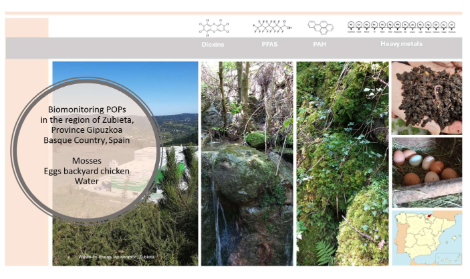
In 2019, even before the Zubieta incinerator began operating, the NGO ToxicoWatch, in collaboration with the local Zubieta-Lantzen collective, launched a biomonitoring study to assess the environmental impact of the facility. The aim? To measure the presence of persistent organic pollutants (POPs) — toxic, bioaccumulative substances that are difficult to break down — in the environment surrounding the plant. Over a five-year period, samples were collected: eggs from free-range hens, mosses (bryophytes), soil, sediments and surface water. The results, published in March 2025, are revealing: waste incineration releases alarming quantities of dioxins, PFAS and heavy metals, causing long-term contamination of the local ecosystem.
This interim report (a full study is planned) highlights invisible but very real pollution, which far exceeds European standards and threatens the health of local residents. This warning demonstrates the urgent need to rethink waste management, particularly in favour of zero-waste solutions that are less polluting and safer.
Dioxins at record levels
Among the most concerning pollutants, dioxins (PCDD/F) and dioxin-like PCBs (dl-PCBs) feature prominently. These substances, ranked among the most toxic in the world, are undesirable by-products of waste incineration, as well as other industrial activities (cement works, aluminium smelters, wood processing).
Analyses carried out on eggs from hens reared near the incinerator reveal alarming concentrations :
-
In Hernani, located 3.5 km from the plant, a sample recorded a record level of 38 pg TEQ/g of fat — the highest ever measured in Europe by ToxicoWatch in 13 years of monitoring.
-
At the ‘Press’ site, just 1.69 km from the incinerator, dioxin levels have risen steadily since 2020, with a 1,130 per cent increase in dl-PCBs compared with 2019.
-
In 2024, 4 out of 7 sites exceeded European limits (1.7 pg BEQ/g for PCDD/F and 3.3 pg BEQ/g for the sum of dioxins and dl-PCBs).
Mosses, used as bioindicators due to their ability to absorb atmospheric pollutants, confirm this trend. In 2022, a peak of 29.8 pg TEQ/g was detected 500 metres from the incinerator — a level 30 times higher than that recorded in 2019. Although concentrations fell slightly in 2024, they remain 8 to 28 times higher than before the plant came into operation.
These findings raise questions: why such a sharp increase**? Could the frequent shutdowns and restarts of the incinerator in 2022 be the cause? A thorough investigation of the plant’s (semi-continuous) emissions measurement data is required to identify the exact sources of this pollution.
PFAS: the ‘ forever chemicals ’ that seep into everything
Per- and polyfluoroalkyl substances (PFAS), nicknamed ‘ forever chemicals ’ due to their extreme persistence in the environment, are another major cause for concern. Used in many industrial products (stain-resistant coatings, fire-fighting foams, waterproof textiles), they accumulate in soil, water and living organisms.
Analyses carried out on chicken eggs revealed high concentrations:
-
In Hernani, PFAS levels doubled between 2023 and 2024, reaching 10.91 µg/kg (compared with 5.92 µg/kg in 2023).
-
In Andoain, levels fell in 2024 (0.31 µg/kg), but remain a cause for concern in light of European limits.
-
PFOS (a type of PFAS banned in Europe) was detected at levels 7.3 times higher than the permitted limit in eggs from Hernani.
Worse still: in 2024, PFAS were found in a drinking water source located on a hill near Andoain, a site that is otherwise considered to be unspoilt. With 150 ng/L of PFOA (perfluorooctanoic acid), this water far exceeds the Dutch threshold (0.3 ng/L), one of the strictest in Europe.
Mosses and sediments confirm this widespread contamination. In 2020, PFAS levels of 1,500 to 5,000 ng/g were measured in mosses – extremely high values indicating chronic exposure to these substances.
Heavy metals: a silent accumulation
Heavy metals (arsenic, cadmium, lead, nickel, cobalt, etc.) complete this worrying picture. These pollutants, originating from incineration as well as other industrial activities, accumulate in soil, water and plants, with toxic effects on ecosystems and human health.
Analyses have revealed :
-
In the water of the Arkaitz Erreka stream, pollution peaks were recorded in 2020 and 2022, coinciding with mass eel die-offs. Chromium concentrations were 2,580 times higher than normal, nickel concentrations 132.8 times higher, and lead concentrations 78 times higher.
-
In the soil, significant increases in cadmium, silver, manganese and mercury were observed, particularly near industrial areas.
-
In mosses, high levels of arsenic, barium, nickel and tin were detected, with exceedance factors of up to 7.9 times the reference values.
These results indicate widespread contamination that exceeds regulatory thresholds and threatens local biodiversity. Lead, for example, was detected at levels close to European limits for drinking water, whilst no safe intake level has been established for this metal (EFSA, 2010).
Conclusions calling for action
The conclusions of this interim report are unequivocal :
-
Dioxins, PFAS and heavy metals are present in alarming quantities in the environment around the Zubieta incinerator.
-
Waste incineration is a major source of pollution, but other industrial activities (cement works, foundries) also contribute to this contamination.
-
European standards are regularly exceeded, particularly for PFAS and dioxins, posing a health risk to local populations.
-
A thorough investigation is needed to identify the precise sources of these emissions and assess their impact on human health.
This report raises a fundamental question: should we continue to incinerate waste, at the risk of causing long-term contamination of the environment and the population, or should we prioritise alternatives such as zero waste, which eliminate these pollutants at source?
For ToxicoWatch, the answer is clear: urgent action is needed. Incineration technologies, even the most modern ones, do not guarantee the complete elimination of POPs. Only a drastic reduction in waste and more sustainable management (reuse, recycling, composting) can protect the environment and public health.
This report serves as a warning to policy-makers, industry leaders and the public. It demonstrates that incineration is not a neutral solution, but a source of persistent pollution that threatens ecosystems and future generations. Essential reading for understanding the health and environmental issues linked to waste management.
Referencias
Para ir más allá
Zero Waste Europe : www.zerowasteeurope.eu
ToxicoWaste : toxicowatch.org/