Experiences of regions in transition: the Albigeois and Bastides PETR
mayo 2021
Territoires à Energie Positive (TEPOS)
The Pôle d’Équilibre Territorial et Rural (PETR) of Albigeois and the Bastides (58,000 residents) illustrates how a region without a strong historical identity can become a key player in the transition through cooperation and resource sharing.
As early as 2007, this region launched a voluntary climate plan and then structured its approach around five coordinated intermunicipal PCAETs, aiming for energy self-sufficiency by 2040. Its uniqueness lies in its ability to bring together dispersed stakeholders (elected officials, citizens, businesses) through participatory methods (Destination TEPOS, citizen consultations).
Despite limited resources, the PETR has successfully capitalized on opportunities (TEPCV, regional contracts) to implement projects such as an energy renovation platform and studies on renewable energy potential. This demonstrates that the energy transition can emerge through coordination and collective intelligence, even in the absence of direct authority.
Para descargar: porter-un-projet-de-territoire-en-transition-2021_fr.pdf (4,3 MiB)
The Albigeois and Bastides Territorial and Rural Balance Cluster (PETR) covers an area with 58,000 residents, forming an arc around the Albi metropolitan area. As a space for collaboration and solidarity, it does not possess a specific historical territorial identity. For the past 20 years, it has been responsible for preparing, coordinating, and monitoring territorial development programs and other initiatives of territorial interest on behalf of the communities of municipalities. To this end, the territory has benefited in particular from long-standing support from the European Union through the Leader program.
What is the appropriate scale for developing and implementing the territorial climate-air-energy plan ?
The Albigeois and Bastides Territorial Cluster has been engaged in an action program addressing climate challenges since 2007. Developed in 2009, the first climate plan provided a comprehensive assessment of the situation and helped mobilize a wider range of stakeholders across the region. Ten years later, the PETR offered a mixed assessment of this initiative. It identified limitations stemming from its lack of legal authority, human and financial resources, and challenges in implementing certain actions. For example, its shared energy advisory service—which proved effective for the municipalities it supported (about twenty)—never managed to expand widely and ultimately ceased operations in 2018 due to a lack of widespread interest from municipalities and a failure by intermunicipal bodies to provide the necessary financial backing.
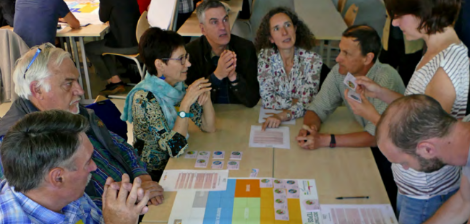
Drawing on this experience, the PETR decided to develop a new climate plan in collaboration with the five communities of municipalities and all local stakeholders, while stipulating that each community of municipalities would also implement its own PCAET—with only one of them being “ required ” to do so. As the winner of the ADEME and Regional Government’s call for projects titled “ Territories Committed to an Ambitious Energy and Ecological Transition in Occitanie ,” the territorial cluster received their financial and technical support to carry out this strategic work in 2018. A consortium of consulting firms—comprising Solagro, Inddigo, Hespul, and Artiflex—supported the region for nearly a year. Between conducting the assessment and jointly developing the action plan, a major consultation event bringing together elected officials, stakeholders, and citizens drew more than a hundred participants. Facilitated using the Destination TEPOS method, the participatory workshop helped shape the strategy and develop various forward-looking scenarios. As a result of this work, each community of municipalities now has its own PCAET. Together, these five PCAETs form a comprehensive development plan aimed at achieving energy self-sufficiency by 2040 across the entire Albigeois and Bastides region.
Contractual mechanisms that trigger the drafting of the regional development plan and then reinforce it
In 2014, two opportunities for contractual agreements prompted the PETR to formulate a regional development plan. These were the single regional contract with the Occitanie Region (2015–2017), focused on enhancing the region’s appeal and creating jobs, and the 2014–2020 LEADER program, for which the region was selected by the Occitanie Region and received funding of over 2 million euros. Although not specifically focused on the energy transition, these agreements nevertheless co-financed several initiatives in this area: the establishment of the energy renovation platform, sustainable mobility initiatives, and support for the development of certain renewable energy projects. The Albigeois and Bastides PETR ultimately developed its territorial project for the 2015–2020 period, in alignment with the development projects of the communities of municipalities and as part of a participatory process involving thematic committees working with the development council. One of its four priority objectives is to “commit to the energy transition for green growth.”
The guidelines of the territorial plan have therefore shaped and facilitated the development and implementation of the following territorial contracts. In 2015, the PETR was selected as a winner of the Ministry of Ecology’s “Positive Energy Territory for Green Growth” (TEPCV) call for projects, through which it received 2 million euros to co-finance numerous investments in transition projects. The rural development contract signed in 2017 enabled the PETR to strengthen the coordination of its development policies with the national government, the Region, and the Department. It provided access to funding for energy retrofits and the installation of renewable energy systems on public buildings. Finally, the Albigeois and Bastides Territorial Cluster signed a new territorial contract with the Occitanie Region and the Tarn Department for the 2018–2021 period.
Toward a New Territorial Project and the Affirmation of a Territorial Identity
The ambiguity of a PETR leading a territorial project lies in the fact that it addresses—as is its role—numerous issues while having few direct levers and resources to implement them. Creating a dynamic partnership is therefore essential, as is clarifying the responsibilities of all parties involved. The PETR sought to ensure that the new regional development plan currently being drafted for this term is anchored at the intermunicipal level and identifies specific objectives linked to sub-issues within the region. Accordingly, this process has helped identify several areas where joint action at the PETR level makes sense and enjoys political consensus.
On the other hand, placing the new territorial project on the agenda has highlighted the need to establish a more distinct strategic positioning—a shared vision of where stakeholders want to go together in the medium and long term—moving beyond the mere compilation of a list of actions and funding opportunities.
To this end, the PETR sought support from La Fabrique des transitions to create some breathing room, challenge established habits, and assess the region’s situation in light of guiding principles drawn from the experience of pilot regions undergoing systemic transition. Approximately fifty interviews were conducted with elected officials, public servants, economic stakeholders, and citizens of the region. The results of these discussions were shared with the presidents of the intermunicipal associations and then with all those who had been consulted. Peer workshops were then organized to identify practical courses of action. This process of listening and analysis brought to light lessons that were sometimes known but often overlooked by all parties, as everyone was absorbed in day-to-day business. It will certainly help forge and mobilize a local community of stakeholders. Previously, “citizen consultations” conducted with about fifty residents by the development council, with support from Unadel, had already spurred the creation of the “Bouge Ton Climat” network: volunteers support and map initiatives related to the energy and ecological transition to create a ripple effect across the entire region.
Key Benefits of the Initiative :
-
The power of collaboration to carry out and fund actions that promote regional development
-
The coordinated implementation of voluntary and ambitious PCAETs at the intermunicipal and PETR levels
-
The growing momentum of stakeholder engagement and mobilization to “ build the region ”
Timeline of Key Milestones :
-
In 2004, the Pays was established.
-
In 2005, a housing and environment project manager (ADEME / Region, Prélude program) led awareness-raising efforts and provided support for diagnostic assessments.
-
In 2007, the role shifted to focus on climate issues, and the first actions were taken.
-
In 2009, a voluntary climate plan was adopted.
-
In 2012, shared energy consulting (ADEME) : a shared energy advisor worked on energy management for municipal properties.
-
In 2014, a single territorial contract (Region / Department, 3 years) and the LEADER program (Europe, 6 years) were launched. Energy Renovation Platform (ADEME, 4 years) : Two energy renovation advisors lead the REHAB platform and organize “Thermography Nights.” Territorial Objective Contract (ADEME, 3 years) : Co-funding of project managers.
-
In 2015, territorial project. TEPCV (State) : renovation of private housing (grants for renovation work), renovation of public buildings, sustainable mobility initiatives, renewable energy potential studies, support for citizen-led renewable energy cooperatives.
-
In 2017, Rural Development Contract. Territorial Food Plan. Mobility Plan.
-
2017–2020: Single Territorial Contract (Region, with the Department and the EU, 3 years).
-
2018: Collaborative PCAET + 5 intermunicipal PCAETs (ADEME / Region, call for projects “ Territories Committed to an Ambitious Transition ”): an external engineering consortium (Solagro, Inddigo, Hespul, Artiflex) supports the territory. Citizen consultations and creation of the “ Bouge ton climat ” network. End of the shared energy advisory service.
-
In 2020, the climate and energy project manager was promoted to director (position replacement).
-
In 2021, a new regional project was launched. Regional assessment conducted by La Fabrique des transitions. Economic Recovery and Ecological Transition Contract.
Referencias
Tepos Document : Leading a Regional Transition Project (French version) ; excerpt from pages 40–43
Para ir más allá
(French version)