Experiences from regions in transition : the Cœur Haute Lande Community of Municipalities
mayo 2021
Territoires à Energie Positive (TEPOS)
The Cœur Haute Lande Community of Municipalities (16,000 residents, 26 municipalities) turned a crisis into an opportunity.
After Storm Klaus in 2009, which devastated the Landes forest, elected officials refused to let private developers take advantage of local resources.
Inspired by German models (Wörrstadt, Morbach), the region jointly established a local energy operator—SEM TEPOS de la Haute Lande—bringing together local governments, citizens, and businesses. Thanks to this innovative governance model, the region has moved beyond the energy sector to incorporate climate adaptation and a comprehensive vision for ecological transition.
With a voluntary PCAET and an ecological transition contract, Cœur Haute Lande demonstrates that the transition can emerge from a crisis and be built on public-private-citizen partnerships.
Para descargar: porter-un-projet-de-territoire-en-transition-2021_fr.pdf (4,3 MiB)
The Cœur Haute Lande Community of Municipalities was formed in 2017 through the merger of three intermunicipal associations. Located in the heart of the Landes Forest and largely within the Landes de Gascogne Regional Nature Park, it comprises 26 municipalities and has a population of 16,000. “ Above all, this is a region defined by the forest, which profoundly shapes the rhythms and spatial organization of the area. The forest has shaped the landscapes, the ways in which space is used, and the models of habitation1 .”
Changing the Model: A Necessity After the Devastation of Storm Klauss
When Storm Klauss ravaged the forest in 2009, the region’s entire economy was brought to its knees. Soon, the damaged forest land began attracting private renewable energy developers looking to establish large wind farms there. The revenue promised to the municipalities was enticing (land leases, tax revenue). To gain some perspective on these proposals, elected officials from the municipality of Escource decided to see what was being done elsewhere. During a study trip to Wörrstadt and Morbach in Germany, they discovered a model of projects jointly led by local governments and citizens. This example finally convinced Mayor Patrick Sabin of the value of investing directly in the energy transition rather than letting the municipality’s renewable resources be captured by outside companies.
Building Partnerships and Co-Developing the TEPOS Model
With this development model in mind, Patrick Sabin reached out to several potential partners: the Haute Lande Community of Municipalities, the departmental council, and the regional council. The region quickly expressed strong interest. As part of this initiative, it also launched a TEPOS call for projects to support willing rural communities. Haute Lande was selected in 2012 and, as a result, received a grant of €70,000 to fund studies related to its project. That same year, it joined the national TEPOS network and spearheaded a local initiative to host the 4th edition of the national TEPOS meetings in collaboration with the Mimizan Community of Communes and the region. Exchanges at the regional and national levels with other territories engaged in similar initiatives have enabled the local government to consolidate and replicate its model.
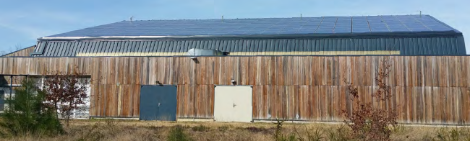
To bring his project for a local energy operator to fruition, Patrick Sabin reached out to private sector players based in the region. He convinced Valorem, a renewable energy project developer, and BASE Innovation, a company offering hybrid solar panels, to join the venture. Together, they created the local semi-public company (SEM) TEPOS de la Haute Lande in 2015. The company’s capital (200,000 euros) is held by the Haute Lande community of municipalities, the majority shareholder (50%); participating municipalities (0.05% per municipality); partner companies (15% Valorem, 12.5% BASE Innovation, and 2% Enercoop); and the local company Energie citoyenne Haute Lande.
The latter currently holds 7.5% of the capital, but a larger stake is reserved for it in the future. To stabilize its business model, the SEM must strengthen its self-financing capacity. This is why Patrick Sabin is meeting with the municipalities one by one to convince them to join the project and make their rooftops available for the SEM to install solar panels.
Strengthening the Project Through Collective Effort
The local government’s ambition goes beyond a simple public-private partnership: it aims to enable citizens to eventually hold a quarter of the SEM’s equity. To achieve this, two strategies are being implemented. First, the creation—in partnership with local banks—of a local renewable energy investment fund called FLIPER. Second, support is being provided to a group of citizens to help them establish a company that will acquire a stake in the SEM. Through the investment fund, residents can put their savings to work for the benefit of the region. Local governments leading these projects receive a loan (guaranteed by the Region) that they commit to repaying using revenue from renewable energy production. At the same time, efforts led by Enercoop and the CIRENA association helped form a group of volunteer citizens and led to the creation of the cooperative-style company (SAS) Energie citoyenne Haute Lande in 2017.
Expanding the Project, Scaling Up
The regional energy transition project was initially outlined using the TEPOS network charter, which was integrated into the land-use planning and sustainable development section of the regional coherence plan. This vision was translated into a detailed roadmap starting in 2015. The TEPCV grant received by the region co-finances several initiatives and, exceptionally, the creation of a position dedicated to the energy transition. The coordinator’s role has since evolved as the project has progressed to focus on managing the SEM and implementing the roadmap. The share of self-financing has increased over time and now stands at 50%. Pursuant to the NOTRe Act, the community of municipalities merged with two neighboring communities in 2017. The TEPOS initiative spread to the new intermunicipal entity, which decided to adopt a voluntary PCAET. In addition to rolling out renewable energy projects, the challenge now is to go beyond the energy transition to address climate change adaptation and, more broadly, the ecological transition. The local government hopes that the implementation of its projects and those of local stakeholders will be facilitated under the ecological transition contract signed with the national government in 2020.
Highlights of the Experience
-
A visionary elected official who is committed to the cause and succeeds in rallying support for his project
-
A local energy operator project that is now self-sustaining thanks to the diversity of stakeholders involved and the consolidation of its financial autonomy
-
A clear TEPOS ambition, quickly translated into concrete actions
Timeline of Key Milestones :
-
In 2010, a study tour to Germany (Wörrstadt, Morbach) laid the groundwork for the SEM project.
-
In 2012, the TEPOS network charter was signed. Call for TEPOS projects (Region, 3 years) : a TEPOS initiative coordinator was hired.
-
In 2015, TEPCV (Federal Government) : the TEPOS coordinator was retained to implement the roadmap. Actions : purchase of electric vehicles, thermovoltaic installations, a biomass valorization platform, and development of the renovation platform. Creation of the SEML TEPOS de la Haute Lande.
-
In 2016, the TEPOS charter was incorporated into the ScoT’s PADD.
-
In 2017, the Cœur Haute Lande Community of Communes was created. The PrécoRéno service (providing support to individuals for energy-efficient home renovations) was established in collaboration with the Mimizan Community of Communes. The SAS Energie citoyenne Haute Lande was created.
-
In 2018, TEPOS call for projects (Region, 3 years) : the TEPOS coordinator position is maintained (a shared position between the Cœur Haute Lande Community of Communes and the Mimizan Community of Communes). Actions : development of self-consumption solar power projects; study on hydrogen mobility.
-
In 2020, the Ecological Transition Contract was signed. Development of a voluntary PCAET (along with a PLUi-H). Actions to adapt to climate change.
1 Excerpt from the summary report of the SCoT assessment, adopted on October 1, 2018, by the PETR Haute Lande Intermunicipal Committee.
Referencias
Tepos Document : Leading a Regional Transition Project (French version) ; excerpt from pages 48–50