At the Center of the Storm
San Juan Mayor Carmen Yulín Cruz and the Response to Hurricane Maria
David W. Giles, Arnlod M. Howitt, Herman B., 2024
Bloomberg Harvard City Leadership Initiative
In the eye of Hurricane Maria, San Juan, the capital of Puerto Rico, becomes the scene of a fierce struggle between the forces of nature and human resilience. Carmen Yulín Cruz, the city’s mayor, finds herself thrust into the center of an unprecedented crisis, where every decision can save lives… or doom them.
Between despair and hope, this story takes us behind the scenes of a crisis management effort where humanity, politics, and survival intertwine. How did one woman, faced with federal inaction and total destruction, manage to become the voice of the forgotten? Immerse yourself in this poignant account, where every word resonates as a call for solidarity and justice.
Para descargar: 20240729-at-the-center-of-the-storm.pdf (680 KiB)
Puerto Rico Before Maria : An Island Under Strain
Puerto Rico, a Caribbean archipelago under U.S. sovereignty since 1898, is a land of contrasts. Its 3.3 million residents, although U.S. citizens, have neither a voice in Congress nor the right to vote in presidential elections. In 2017, the island was in the midst of a deep economic crisis: a persistent recession, a massive exodus of its population, and an abysmal public debt. The Puerto Rico Oversight, Management, and Economic Stability Act (PROMESA), imposed by Washington in 2016, placed the island under the supervision of a federal oversight board—a move perceived by many as a new form of colonization. Carmen Yulín Cruz, mayor of San Juan since 2012, embodies local resistance. A woman with a hands-on approach, she has built her reputation by defending the most vulnerable: students, women, the LGBTQ+ community, and labor unions. Her participatory approach, based on decentralizing power to the neighborhoods, earned her re-election in 2016.
Yet, despite her dynamism, San Juan has not been spared the aftermath of the crisis. Austerity measures have weakened public services, reducing the island’s capacity to cope with a disaster. When Hurricane Irma brushed past Puerto Rico in early September 2017, it offered a foretaste of the challenges to come. Local authorities, unaccustomed to large-scale disasters, improvised a response that would serve as a dress rehearsal for Maria.
Maria’s Arrival: Chaos and Isolation
On September 20, 2017, Maria struck Puerto Rico with unprecedented violence. Classified as a Category 4 hurricane, it swept across the island, leaving behind a landscape unrecognizable: uprooted trees, destroyed buildings, blocked roads, and, above all, a total power outage. The already fragile power grid collapsed, plunging the 3.3 million residents into darkness. Communications were cut off, isolating San Juan from the rest of the world.
I’ve never seen such devastation. — Carmen Yulín Cruz
Inside the Roberto Clemente Coliseum, which had been converted into a shelter and command center, Carmen Yulín Cruz and her team found themselves trapped by the elements. Howling winds shook the building, but it held firm. As soon as the hurricane moved away, the mayor made a radical decision: to go outside. Despite the risks, she and her staff opened the Coliseum’s doors to assess the damage. The scene is apocalyptic: flooded neighborhoods, roofs torn off, hospitals and critical infrastructure out of commission. Worse still, elderly people and patients, abandoned by their caregivers, are struggling to survive.
Cruz’s first mission is clear: to save lives. Without electricity or communications, information is passed on by word of mouth. Municipal teams, made up of civil servants and volunteers, are deployed through the flooded streets to distribute food, water, and medicine. The mayor, always on the front lines, insists:
There’s no substitute for seeing the look in people’s eyes when they’re suffering. […] You can’t do that from an air-conditioned bunker. — Carmen Yulín Cruz
An Improvised but Determined Response
The first few days after Maria were marked by improvisation. City employees, regardless of their positions, stepped up. Cooks prepared thousands of meals, gardeners helped organize relief distribution, and lawyers coordinated outside aid. Cruz established a military-style routine: daily meetings at 9 a.m. and 9 p.m. to set goals and assess progress.
She’s obsessed with numbers. Everyone had to report to her: ‘We’ve cleared this much debris, distributed this much food, helped this many people.’ — Gloriana Salgado, special assistant to the mayor
Yet the operation remains decentralized. Teams often operate without direct supervision, with Cruz placing complete trust in them: “In the end, you have to trust your team, even when you can’t see them.” This trust is crucial, as the challenges are immense. Employees, exhausted by Irma and then Maria, must also cope with their own distress. Cruz looks out for their well-being, making sure they eat, drink, and rest. She herself, having lived at the Coliseum for months, hides her moments of weakness: “I couldn’t [break down]. I didn’t have that luxury.”
The “Cubes of Hope”
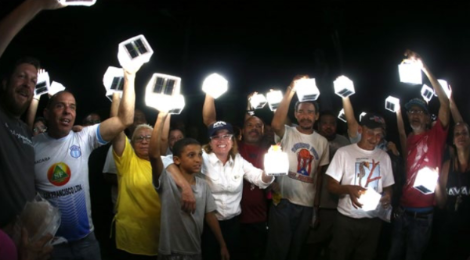
Mayor Cruz poses alongside residents, holding what she has dubbed the “cubes of hope”—self-inflating lamps donated by the charity Operation Blessing. These cubes not only helped light up a city of San Juan plunged into darkness, but also served as an emergency communication system in the months following Maria’s passage.
Outside Aid : Between Solidarity and Abandonment
Cruz quickly realized that local resources were insufficient. Regional aid was limited : All of Puerto Rico was devastated, and the Puerto Rico Emergency Management Agency (PREMA), overwhelmed, was unable to coordinate the response. Municipalities had to rely on outside assistance.
Some aid arrived quickly, such as that from New York. Mayor Bill de Blasio sent a crisis management team (NYCEM) less than a week after Maria. Their expertise was invaluable : they helped organize the distribution of relief supplies, take inventory of resources, and draw up logistical plans. For Héctor Rivera, an advisor to Cruz, their intervention was a turning point :
They were the ones who helped us navigate the waters of crisis management. […] They were the first to take inventory, line up the pallets, and count what we were receiving. — Héctor Rivera
The Coliseum became the central distribution hub, receiving donations from U.S. cities (Chicago, Miami) and private companies such as Goya Foods. Federal aid, however, was slow in coming. Despite President Trump’s declaration of a major disaster on September 21, relief supplies were slow to arrive.
The Conflict with Washington: A Battle of Narratives
A week after Maria, a gap widened between the reality on the ground and the Trump administration’s rhetoric. As San Juan and Puerto Rico struggled to survive, Elaine Duke, acting Secretary of Homeland Security, stated on September 28:
I am very satisfied. […] This is a success story in terms of our ability to reach people and the limited number of deaths. — Elaine Duke
These remarks sparked outrage in Cruz. Interviewed by CNN the next day, she responded with raw emotion :
Maybe from her perspective, it’s a success story. […] But when people are drinking from a stream, that’s not a success story. When there’s no food for a baby, that’s not a success story. When people have to be rescued from buildings… For heaven’s sake, that’s not a success story. It’s a story where people are dying. — Carmen Yulín Cruz
This moment marked a turning point. Until then, Cruz had tried to collaborate discreetly with Washington, hoping that patience would pay off. But faced with federal inaction and glaring inequalities in the response to hurricanes (Texas and Florida had received far more aid), she decided to break her silence. Her goal: to alert the world to Puerto Rico’s critical situation and force a response.
However, this strategy is not without risk. Some, including the governor of Puerto Rico, fear that public criticism might alienate Washington and make it even harder to secure relief. Cruz, for her part, embraces this role:
Some politicians here thought: “If I stay silent, it’ll be better, because I’ll get help.” But I couldn’t stay silent. — Carmen Yulín Cruz
Legacy and Lessons: A Struggle for Dignity
Hurricane Maria left deep scars in Puerto Rico: nearly 3,000 dead, destroyed infrastructure, and reconstruction still incomplete years later. Yet Carmen Yulín Cruz’s leadership left a lasting impression. Her refusal to submit to the official narrative, her unwavering commitment to her fellow citizens, and her ability to mobilize international aid have made her a symbol of resilience.
This story is not only one of a natural disaster, but also one of structural injustice. Puerto Rico, a second-class U.S. territory, paid the price for its political status. Maria exposed the flaws in a system where the lives of Puerto Ricans seemed to count for less than those of people on the mainland.
For Cruz, the lesson is clear :
We’re all in the same boat. And if we don’t help each other, we’ll all go down. — Carmen Yulín Cruz
Her fight continues, far beyond the hurricane. It’s about rebuilding, but also about demanding dignity for Puerto Rico.
Referencias
Read the full story: At the Center of the Storm
Para ir más allá
Bloombert Harvard City Leadership Initiative : www.cityleadership.harvard.edu/