City of Paris Sustainable Food Plan 2022–2027
City of Paris, febrero 2023
In Paris, food is no longer just a public health issue, but a key driver of the ecological and social transition. Faced with climate challenges, the loss of biodiversity and inequalities in access to healthy food, the City of Paris has adopted its 3rd Sustainable Food Plan 2022–2027, an ambitious roadmap to radically transform its collective catering sector.
With 30 million meals served annually across 1,300 establishments, this plan aims to make the capital a model of excellence, combining carbon neutrality, food resilience and social justice.
Driven by collaborative governance and practical innovations, it embodies the commitment to balancing enjoyment, health and respect for the planet, whilst strengthening the links between town and country.
This factsheet summarises the new ‘City of Paris Sustainable Food Plan 2022–2027’, available for download
Para descargar: plan-alimentation-durable-2022-2027-7-fevrier-2023.pdf (4,9 MiB)
Ambition and strategy
A transformative vision
The 2022–2027 Sustainable Food Plan forms part of a holistic approach, in which food becomes a catalyst for ecological, health and social transition. Its ambition is clear :
-
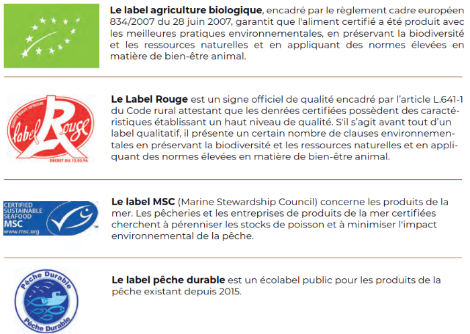
100 per cent sustainable food by 2027, with 75 per cent sourced from organic farming and 25 per cent from sustainable labels (Label Rouge, MSC, sustainable fishing, fair trade).
-
50 per cent local food (produced and processed within 250 km of Paris), to strengthen the region’s resilience and reduce the carbon footprint associated with transport.
-
40 per cent vegetarian meals served each week, with a daily vegetarian option from 2025 onwards, to reduce the climate impact of meat and fish.
-
Zero plastic in institutional catering, zero non-recycled waste, and a 50 per cent reduction in food waste.
These objectives are in line with Paris’s climate commitments (carbon neutrality by 2050) and the recommendations of the High Council for Public Health, whilst meeting Parisians’ growing expectations for healthy, local and responsible food.
A systemic and collaborative strategy
To achieve these ambitions, the City of Paris has developed a three-pronged strategy :
-
An integrated approach:
- The plan acts simultaneously across the entire value chain: from production (support for local supply chains via AgriParis) to consumption (raising awareness among diners), via procurement (responsible public procurement), logistics (optimisation of supply flows) and waste management (recycling of bio-waste).
- Example : The creation of AgriParis, a dedicated operator, aims to structure sustainable supply chains in the Île-de-France region, by reducing the number of intermediaries and ensuring fair remuneration for producers.
-
Participatory governance :
- The plan was developed in collaboration with all stakeholders :
- Citizens’ Conference (2021) : 100 residents of Paris and the Île-de-France region set out the priorities (e.g. : education on sustainable food from an early age).
- General Assembly on Sustainable Agriculture and Food (EGAAD) : 400 professionals worked on 12 themes, including institutional catering.
- Workshops with managers : 21 operators (Caisses des Écoles, CASVP, DFPE, ASPP, etc.) contributed to the development of the 24 action sheets.
- Scientific and Citizens’ Committee : set up to assess and guide the plan’s implementation.
-
A phased and evaluated implementation :
- 24 operational action sheets, led by municipal departments and managers, with monitoring indicators (e.g. : proportion of sustainable foodstuffs, volume of waste avoided).
- Annual review presented to the Paris City Council, supplemented by external evaluations to refine the strategy.
- Pilot schemes : before roll-out, initiatives are tested (e.g. : reusable containers in the Croq’Pouces, hot-line sector kitchens in the 18th arrondissement).
The plan’s 12 challenges
Eco-responsible canteens
-
Challenge 1 : 100% organic and/or sustainable sourcing (AB certification, Label Rouge, MSC, sustainable fishing, fair trade).
-
Challenge 2 : Eating local and seasonal produce (50% of food sourced from within 250 km, greater emphasis on seasonality).
-
Challenge 3 : Flexitarianism : 2 vegetarian meals per week from 2023, a daily vegetarian option by 2025 ; 100 per cent of meat, fish and eggs sourced from sustainable supply chains that respect animal welfare.
-
Challenge 4 : Zero waste : 50 per cent reduction in food waste, 100 per cent local recycling of bio-waste (composting, anaerobic digestion).
Healthy and tasty meals
-
Challenge 5 : Environmental health : elimination of endocrine disruptors (nitrites, palm oil, GMOs), reduction in sugar and salt.
-
Challenge 6 : Home-cooked meals : development of a dedicated label, elimination of ultra-processed products.
-
Challenge 7 : Zero plastic : complete ban on plastic containers and utensils (replaced by stainless steel, glass and porcelain).
-
Challenge 8 : Inclusion : adapting to specific needs (older people, children, those in precarious circumstances) and combating malnutrition.
A collective and supportive approach
-
Challenge 9 : Training : upskilling teams (cooking school, workshops on sustainable food).
-
Challenge 10 : Awareness-raising : involving diners (menus developed jointly with schools, educational highlights).
-
Challenge 11 : Sharing resources : pooling best practice, advocacy to remove regulatory barriers.
-
Challenge 12 : Solidarity : opening canteens to local neighbourhoods (local vegetable suppliers, partnerships with food aid organisations).
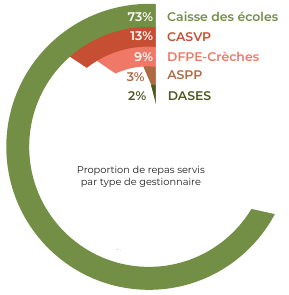
Thirty million meals are served each year by Paris’s collective catering sector, operated by 21 independent providers with different legal statuses, across 1,300 establishments:
-
706 school canteens managed by 17 Caisses des Écoles chaired by the district mayors
-
14 care homes for the elderly (EHPADs), 44 ‘Émeraudes’ restaurants and 12 ‘Solidaires’ restaurants, as well as home meal delivery services, are managed by the Solidarity Department through the City of Paris Social Action Centre (DSOL/CASVP)
-
450 nurseries managed by the City of Paris Department for Family and Early Childhood (DFPE)
-
15 staff canteens and 5 ‘Croq’pouces’ are managed by the Association for Social Action in Support of City of Paris Staff (ASPP)
-
13 public child welfare centres spread across 15 sites are managed by the City of Paris’s Directorate for Social Solidarity (DSOL)
Examples of flagship initiatives
-
AgriParis : An organisation set up to organise local supply chains (vegetables, cereals, meat) and facilitate the supply of sustainable produce to canteens.
-
Plastic Phase-Out Plan : 22 measures to eliminate all plastic containers (stainless steel trays in the 12th arrondissement, reusable containers in the Croq’Pouces).
-
100% organic nurseries by 2025 : already 71% organic in 2020, with a target of 100% for the 300 municipal nurseries.
-
Tackling food waste : food waste monitors, awareness-raising workshops (e.g. pre-cut fruit to reduce waste by 20–40 per cent in the 17th arrondissement), donations to charities.
-
Participatory menus : in the 6th arrondissement, school classes devise one menu per month, approved by dietitians.
-
Green logistics : optimisation of delivery routes, development of river and rail transport solutions, shared use of distribution centres.
AgriParis, a new operator promoting a sustainable agricultural and food model :
The preliminary work for this operator was launched in 2021 with the publication of the ‘Cahier des Enjeux’ (Issues Paper) produced by Les Greniers d’Abondance, followed by the organisation of a Citizens’ Conference in March 2021, which brought together 50 Parisians and 50 residents of the Île-de-France region.
A consultation process with partners (local authorities, public bodies, government departments, civil society organisations) and professionals from the agriculture and food sectors was then organised by the City between May and December 2021.
In total, this ‘États Généraux’ on Sustainable Agriculture and Food involved 12 working groups, 36 workshops, 177 organisations participating in the consultation, 973 cumulative participants in the workshops, and 243 contributions to the online consultation, which ran until 16 January 2022.
The debriefing on 15 February 2022 provided an opportunity to present the key lessons learnt from this consultation and the main priorities that the ecosystem considers essential for AgriParis. Work will now gather pace, notably with the creation of the AgriParis preparatory association and the implementation of the four cross-cutting tasks strongly supported by participants in this consultation: a trusted third party working to connect stakeholders and facilitate this network; an observatory monitoring supply and demand to identify missing links in the supply chains; a network coordinator to seek cross-funding; the management of complex projects; and a spokesperson responsible for advocating for agroecology and food resilience in our regions.
Conclusion
Paris’s 2022–2027 Sustainable Food Plan is far more than a catalogue of measures : it is a cultural and operational revolution designed to make what we eat a key driver of the ecological transition. By combining environmental standards, social innovation and a strong local focus, the City is setting an example of sustainable, accessible and desirable food. Driven by the commitment of everyone – elected representatives, staff, producers and diners – this plan charts the course towards exemplary collective catering, where every meal becomes a gesture for the planet and for health. A model to follow, in Paris and beyond.
Referencias
Online document : Plan Alimentation Durable 2022-2027 de la Ville de Paris
Para ir más allá
Website: www.paris.fr/