Large solar thermal power plant in the city of Narbonne (11)
June 2026
Agence pour l’Environnement et la Maîtrise de l’Energie (ADEME)
In 2018, the city of Narbonne began exploring options for upgrading its 3-km-long district heating network, which was built in the 1970s. Since 2008, the network had been powered by a 2.5-MW biomass boiler plant, supplemented and backed up by a 6.4-MW gas-fired boiler plant.
In this context, the city sought to increase the share of renewable energy in the network, which was then approximately 60%. Given the area’s specific geographical characteristics, the discussions focused on installing a solar thermal system directly connected to the district heating network.
In agreement with the City of Narbonne and the Société Narbonnaise de Chauffage (SNDC), the concessionaire of the city’s district heating network, Newheat (an energy company) developed a technical and financial proposal to increase the share of renewable energy in the network to 76% by adding 17% solar thermal capacity.
This fact sheet presents the project, the technical and economic data, the updated results for 2026, and the conditions for replicating such a project.
To download : rex_solaire_narbosol_narbonne_013243_fr.pdf (1.2 MiB)
Why Take Action ?
As early as 2018, the city of Narbonne began exploring options for upgrading its 3-km-long district heating network, which was built in the 1970s. Since 2008, the network had been powered by a 2.5-MW biomass boiler plant, supplemented and backed up by a 6.4-MW gas-fired boiler plant.
In this context, the city sought to increase the share of renewable energy in the network, which was then approximately 60%. Given the area’s specific geographical characteristics, the discussions focused on installing a solar thermal system directly connected to the district heating network.
In agreement with the City of Narbonne and the Société Narbonnaise de Chauffage (SNDC), the concessionaire of the city’s district heating network, Newheat (an energy company) developed a technical and financial proposal to increase the share of renewable energy in the network to 76% by adding 17% solar thermal capacity. On this basis, discussions led to the signing of a tripartite contract for the supply of solar heat to the network over a 25-year period. This district heating network supplies residential buildings (85%) and public buildings (15%) with heating (approximately 85% of the capacity) and domestic hot water (approximately 15% of the capacity). The decree of February 12, 2026, on the Multi-Year Energy Plan sets a target of 32% renewable heat in France’s final energy consumption by 2035.
This target requires efforts across all sectors, particularly solar thermal energy, whose installed capacity must increase sevenfold by 2035. To achieve this goal, plans include installing one million square meters of collectors per year, primarily through large-scale installations in industry or on district heating networks.
Solar thermal heat production from large-scale installations is particularly well-suited to meeting the needs of district heating networks, especially during the summer months for domestic hot water.
The City of Narbonne’s large-scale solar thermal power plant project received support from ADEME through the national call for projects “Large-Scale Solar Thermal Installations,” without which the project would not have been possible. ADEME played a decisive role in its implementation.
Overview and Results
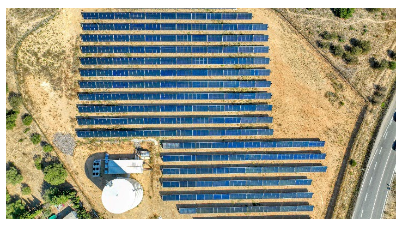
The solar thermal power plant consists of a total surface area of 3,200 m² of collectors, capable of delivering 2.8 MWth under maximum sunlight conditions.
Heat storage, in the form of a 1,000 m³ hot water tank, helps manage the time lag between solar heat production and grid consumption. The energy stored in this tank corresponds to approximately 3 to 4 days of summer grid consumption. This storage allows the biomass boiler plant to be shut down for part of the summer.
A control system operates the solar power plant 100% automatically. Its operation is remotely monitored by Newheat teams based in Bordeaux, in close collaboration with the district heating network’s operations teams, with the goal of continuously improving the overall system’s performance.
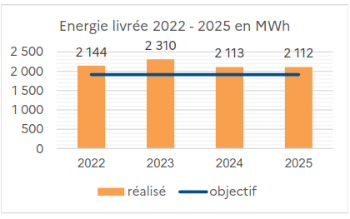
Four years after it went online, in November 2021, the Narbonne solar thermal power plant had delivered more than 8,500 MWh to the network as a substitute for gas, thereby preventing the emission of nearly 1,700 metric tons of CO2—the equivalent of driving around the Earth 195 times. The observed coverage rate was approximately 89% in July, compared to 8% in February.
Focus
The large solar thermal power plant in Narbonne is unique in that it is located in a decentralized manner (at the end of a branch of the district heating network) and at a higher elevation relative to existing heat producers (gas and biomass).
This constraint, resulting from the limited availability of land in a highly urbanized area, necessitated specific studies to validate the successful integration of solar power into the network, regardless of the season: in winter, when demand is primarily met by biomass, and in summer, when demand is primarily met by solar power.
| “This plant is a concrete example of the competitiveness of solar thermal energy, and it directly reduces our dependence on fossil fuels and, above all, preserves the purchasing power of end consumers. We invite all local governments and stakeholders in the district heating sector to follow the example of the City of Narbonne: large-scale solar thermal installations are technically and economically efficient, particularly for municipalities with more than 10,000 residents!” Mr. Ignace de Prest, President of Newheat |
Factors for Reproducibility
To help heat consumers replace their fossil-fuel-based heat production systems or build new, more environmentally friendly facilities, ADEME supports exemplary projects led by public authorities or private companies.
Through the Heat Fund, which it manages on behalf of the government, the Agency finances renewable heat generation facilities (solar thermal, geothermal, biomass, etc.) and district heating networks.
See also the ADEME video
Sources
ADEME document: Grande centrale solaire thermique de la ville de Narbonne (11) (Large solar thermal power plant in the city of Narbonne (11))
To go further
-
On the ADEME website : www.ademe.fr/les-defis-de-la-transition/energies/
-
Newheat : www.newheat.com ; contact[@]newheat.fr