Minimize the impacts of air pollution on areas with limited development potential
The Plaine Commune initiative, which led to the development of the MODELAIRURBA method
January 2025
Agence pour l’Environnement et la Maîtrise de l’Energie (ADEME)
With its numerous major road infrastructure projects, the territory of the Plaine Commune Public Territorial Authority (EPT) (Seine-Saint-Denis) is affected by high levels of air pollution and faces the challenge of developing sites in environmentally constrained areas.
Born out of a political commitment to protect residents, the MODELAIRURBA experimental study aimed to incorporate air pollution as an input factor in the design of urban projects and to initiate a discussion on how to better address this public health issue in policy documents.
This report on lessons learned from the Plaine Commune Territorial Public Institution (EPT) (Seine-Saint-Denis Department) presents the MODELAIRURBA experimental study—a winner of the AACT-AIR Call for Projects—which was conducted on two urban development projects in the region (the Six-Routes sector in La Courneuve and the Porte-de-la-Chapelle sector in Saint-Denis) and aimed at refining development scenarios to minimize residents’ exposure to air pollution.
This proven method allows air quality to be integrated as an essential component of design decisions in urban development projects and is the subject of an ADEME guide.
To download : fiche-minimiser-les-impacts-de-la-pollution-de-l-air-sur_des-secteurs_d-urbanisation-contraints_fr.pdf (1.7 MiB)
Plaine Commune : Air Quality as an Input for Territorial Development
“ Continue to build to address the region’s challenges, but not at the expense of public health ” F. DEQUIEDT - General Delegate for Ecological Transformation and Resilience.
With its numerous major road infrastructure projects, the territory of the Plaine Commune Public Territorial Authority (EPT) 1 is affected by high levels of air pollution. Like many local authorities, Plaine Commune faces the challenge of developing increasingly constrained sites to meet population growth and land-use densification targets, while ensuring a healthy and pleasant living environment for residents and users.
In pursuit of the goals set forth in its first Integrated Local Urban Planning Program (PLUi), which aims to reconcile urban development with environmental health, the EPT Plaine Commune launched the experimental “ MODELAIRURBA ” study in 2020, focusing on air quality issues. Born out of a political commitment to protect residents, the study aimed to incorporate air pollution as an input factor in the design of urban projects and to initiate a discussion on how to better address this health issue in policy documents.
What are we talking about ?
-
An experimental study conducted on two urban development projects in the region (the Six-Routes sector in La Courneuve and the Porte-de-la-Chapelle sector in Saint-Denis) aimed at
refining development scenarios.
-
A commitment to updating the local government’s framework documents to better address air pollution issues and minimize public exposure.
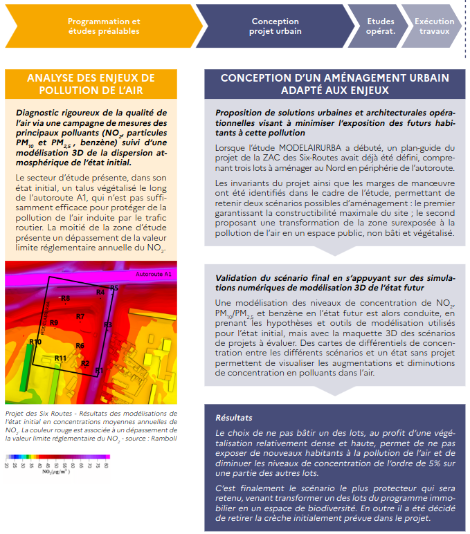
The MODELAIRURBA Method in the Six-Routes Project
Located in the municipality of La Courneuve, the Six-Routes neighborhood is characterized by a heterogeneous urban fabric organized around the very large intersection known as “ Six-Routes .” The study area is located to the north of this neighborhood, along the A1 highway. At the start of the MODELAIRURBA study, a multi-thematic analysis of the key issues was conducted, allowing the following major issues to be prioritized :
-
exposure to road traffic - territorial integration - urban planning - perceptions and ambiance.
The main steps of the MODELAIRURBA method and its application to the Six-Routes project are illustrated below.
The Porte de la Chapelle Project
A Development Through Negotiated Urban Planning
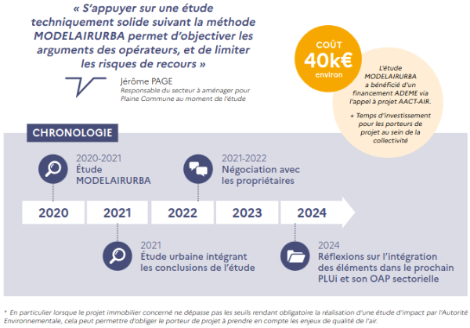
“ Relying on a technically sound study based on the MODELAIRURBA method allows us to objectively evaluate developers’ arguments and limit the risk of legal challenges .” For the Porte de la Chapelle sector project, the planning primarily concerns economic activities. Nestled between the Paris ring road, the A1 highway, and a major rail corridor, this area is also highly exposed to air pollution.
Negotiated Urban Planning Project
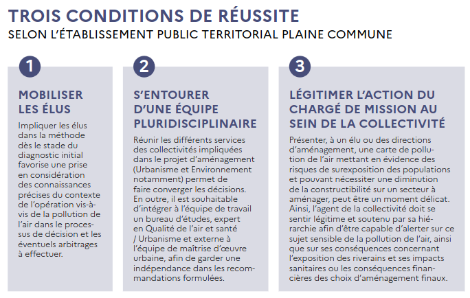
In such a project, the PLUi (Local Urban Planning Initiative) is the local government’s primary tool for action. One of the local authority’s challenges was therefore to secure the real estate developer’s acceptance of the conclusions of the MODELAIRURBA study, as air quality requirements had not yet been incorporated into the PLUi’s sector-specific Development and Planning Guidelines (OAP).
Results of the MODELAIRURBA Study
The study led to adjustments being made to a real estate development to comply with a setback requirement relative to the road axis. For the real estate developer, this adjustment resulted in a reduction in buildable area (13,000 m² out of the 18,000 m² initially planned for one of the lots), which in turn led to a reduction in the project’s financial scope and, consequently, its profit margin.
The Plaine Commune’s Objectives as Outlined in the PLUI
The Plaine Commune region aims to include very specific provisions regarding air pollution in its Environmental Health Land Use Plan (OAP). This plan would propose an approach based on two areas:
-
An area where regulatory air quality thresholds are exceeded, within which the construction of multi-unit housing and facilities serving populations sensitive to air quality is prohibited (e.g., schools, daycare centers);
-
A monitoring zone along major roadways (200 meters on either side of highways and the ring road, 35 meters on either side of roads with traffic volumes exceeding 10,000 vehicles per day), within which project developers must demonstrate that air quality has been taken into account in the development of site plans.
This involves, in particular, an initial study of air quality at the project site and 3D modeling tailored to the characteristics and scale of the site and the project, which will result in guidelines for spatial organization, land-use decisions, and building design aimed at protecting residents and users. For large-scale developments, this modeling may be repeated several times as the project progresses to ensure regular adjustments that further reduce risks to the population.
1 Plaine Commune is a regional public authority located in Seine-Saint-Denis that comprises eight cities on the northern border of Paris: Aubervilliers, Épinay-sur-Seine, L’Ile-Saint-Denis, La Courneuve, Saint-Denis–Pierrefitte, Saint-Ouen-sur-Seine, Stains, and Villetaneuse.
Sources
ADEME document: Minimizing the Impacts of Air Pollution on Areas with Limited Development Potential (in French)