Cities100: Medellín’s interconnected green corridors
C40 Cities Climate Leadership Group, Nordic Sustainability, October 2019
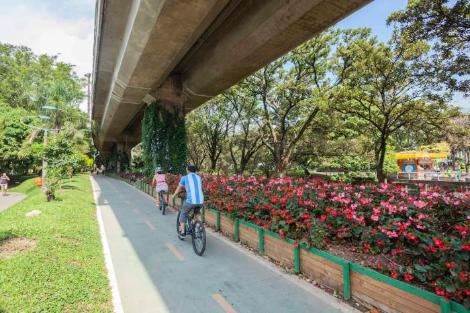
Between 2016 and 2019, Medellín created over 30 ‘Corredores Verdes’ to form an interconnected network of greenery across the city. This ambitious initiative added to and further connected existing green spaces. Today, it reduces the city’s urban heat island effect, soaks up air pollutants, supports urban biodiversity and captures carbon dioxide.
The Green Corridors project demonstrates how integrated, nature-based policies like widespread urban tree planting and the equitable expansion of green space can have a far-reaching impact, improving residents’ day-to-day quality of life and well-being.
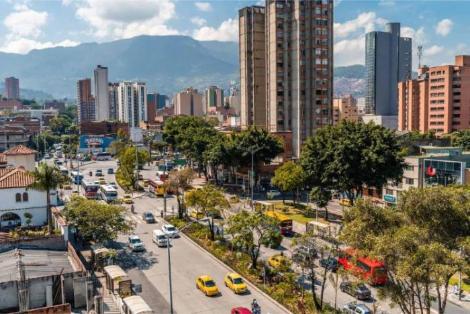
By 2015, as a result of 50 years of rapid urban development, polices that led to huge growth in trips by private car and the removal of trees for traffic projects, Medellín was experiencing a severe urban heat island effect. Air pollution also reached historical highs and public pressure to address the problem was mounting.1
The city implemented a three-year ‘greener Medellín for you’ programme, significantly shifting its urban design paradigm. As part of the $16.3 million initiative, over 100 residents hailing from disadvantaged backgrounds were trained by Medellín’s Joaquin Antonio Uribe Botanical Garden to become city gardeners and planting technicians, and 2,600 workers were employed through the project. They initially planted 12,500 trees and palms in the 30+ corridors that cover 65 hectares. In one of the city’s busier thoroughfares, around 600 palms and trees were planted, as well as more than 90,000 smaller plants. The Green Corridors project also integrated 80km of new bike paths and considered desirable walking and cycling routes, helping to deliver a 34% rise in cycling and a smaller increase in walking.2
This was among the 100 solutions highlighted in the 2019 edition of Cities100, which recognised 100 of the boldest city-led projects working to address climate change and build a better, greener future. The publication highlights solutions that are replicable and scalable, and which reduce emissions and address the issues that cities face as a result of climate change.
Medellín’s Green Corridors have achieved international recognition for its success, and inspired and informed projects in other cities in Colombia, Latin America and beyond. We update this page periodically due to ongoing interest.
These Green Corridors provide Medellín with a host of benefits: they help to reduce average city temperatures by 2°C and achieve a 10°C drop in some places; they capture particulate matter (PM2.5) to improve air quality, delivering a drop in associated premature deaths and reducing rates of acute respiratory infections from 160 per thousand inhabitants to 95; and they increase urban biodiversity thanks to creation of more wildlife-friendly habitats, with birds, butterflies and other species returning to the city.3 The project included trees that are known to be especially effective at absorbing air pollution, such as the mango tree (Mangifera indica).
Building on the success of the Green Corridors, Medellín is now implementing a 2024-2027 Urban Plan which emphasises the expansion of green space and restoration of the city’s streams and rivers to further improve people’s quality of life. Among other things, it will see the creation of more green corridors, parks and greenery.4
| Testimonial: “Residents of Medellín feel that greenery is an important part of our landscape. There’s a sense of ownership. People take better care of the spaces where there’s greenery”. Marcela Noreña Restrepo, Medellín’s Secretary of Environment5 |
The Green Corridors project won the 2019 Ashden Award for Cooling by Nature – watch the video below to hear more about the project from the city’s mayor.
Medellín’s advice for other cities
Target busiest areas for greatest impact
Oriental Avenue, one of the city’s most polluted streets with more than a million people passing through daily, was targeted as one of the key Green Corridors. The more polluted the area, the greater the potential environmental returns, meaning that including these avenues in the green, interconnected, biodiverse network will reap great rewards for general city life.
Make the most of national and local legislation opportunities
Colombian legislation stipulates that a part of cities’ budgets – Participatory Budget – is invested in projects which residents help to select through a democratic vote. The Green Corridors received a popular mandate though this vote, enabling them to be implemented across the city.
IMAGE : Gardener smiling and holding a plant next to a planted area for the Green Corridor, Oriental Avenue in 2019 2019 in Medellin, Colombia © Ivan Valencia - AFP Images
Wider benefits
-
Social: As part of the ‘A greener Medellín for you’ programme, over 100 locals from more disadvantaged backgrounds were trained to be city gardeners and planting technicians to plant and maintain the 30 Green Corridors as part of their full-time work.
-
Health: Three years after the programme’s beginning, Medellín’s urban heat island effect has been reduced by 2°C. In spite of climate change, city officials expect a further decrease of 4-5°C in 28 years’ time when trees have matured. This reverses the previous trend that saw the city’s average temperatures in 2010 a whole 6°C above what should have been Medellín’s average temperature.
-
Economic: The initial investment to deliver the project cost a total of US $16.3 million. Annual maintenance costs are around US $625,000.6
-
Environmental: A bioclimatic study estimated that in just one corridor, the new vegetation growth would absorb 160,787 kg of CO2 per year for the initial phase of the plants’ lives. The study’s 100-year projection is that around 2,308,505 kg of CO2 would be taken up in the plants’ biomass. Green corridor, Corredor verde Estadio - quebrada Green corridors
Note bas de page :
1 BBC (2023) How Medellin is beating the heat with green corridors.
2 UCL Bartlett Faculty of the Built Environment (2022) Medellín: A new chapter of resilience.
3 UCL Bartlett Faculty of the Built Environment (2022) Medellín: A new chapter of resilience; Sustainable Energy for All (2021) Creating a greener, cooler and healthier Medellín.
4 Arch Daily (2024) Environmental Urbanism and Urban Geographies: Medellín 2024-2027 Urban Plan.
5 Saldarriaga J. and Faratin P. (2025) Medellín’s sublime return to nature – in pictures.
6 BBC (2023) How Medellin is beating the heat with green corridors.
Sources
Online Document: Cities100: Medellín’s interconnected green corridors
To go further
Website :www.c40.org/