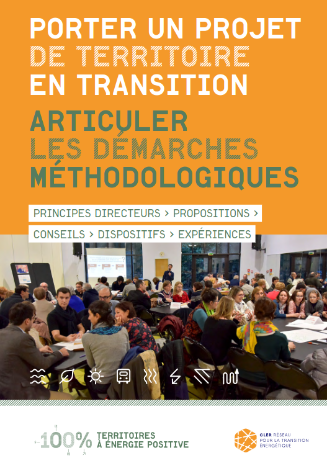
Leading a regional transition project
Coordinate methodological approaches
May 2021
Territoires à Energie Positive (TEPOS)
At a time when the ecological and energy transitions are becoming imperatives for local communities, CLER—Network for Energy Transition—offers, through this guide, an inspiring and practical framework for carrying out ambitious projects. Drawing on ten years of experience working with pioneering local governments (TEPOS, PCAET, CRTE, etc.), it invites us to rethink public action not as a series of separate procedures, but as a systemic, cooperative approach grounded in the long term. Through concrete case studies, guiding principles, and a call for strengthened regional planning, this document demonstrates how to transform constraints into drivers of development, while empowering local stakeholders to take action. Essential reading for those who believe that the transition is built with local communities, not for them.
This summary covers the key points from pages 18 to 30.
To download : porter-un-projet-de-territoire-en-transition-2021_fr.pdf (4.3 MiB)
Leading a Regional Transition Project : An Ambition That Empowers
(Pages 14–17)
A Region, a History, a Soul. The guide opens with a profound reflection : a regional development plan is not merely a technical document, but a collective endeavor, a shared vision that gives meaning to public action. Over the past twenty years, the concept of a regional development plan has evolved, shifting from a technocratic approach (where responsibilities were exercised opportunistically) to a comprehensive strategy, in which local stakeholders become the architects of their own development.
Energy autonomy as a lever for freedom. The example of Le Mené, a pioneering region, illustrates this philosophy : “Energy is beneath our feet and above our heads. It’s up to us to harness it. ” Autonomy is not about turning inward, but about opening up: it enables regions to jointly build on local resources (expertise, coordination, collective intelligence) and position them in external markets. It is a liberation—an ability to envision shifts in values and practices by drawing on what defines the region’s identity.
Toward a Regional Energy Operator. To make this autonomy a reality, the guide highlights the importance of regional energy operators : locally rooted actors capable of coordinating energy production, distribution, and supply, while capitalizing on knowledge and creating regional value. These operators do more than just produce energy: they also foster autonomy by bringing together citizens, local governments, and businesses in a shared governance model.
Setting Regions in Motion; Four Principles for Action
(Pages 18–23)
-
Create the conditions for engagement, here and now. “ Change does not happen on its own. It faces resistance. ” To overcome this resistance, we must spark a desire: highlight the region’s intangible cultural heritage (memories, stories, local events) to foster pride and a sense of belonging. Commitment is built through quick wins (small, concrete actions) that create a snowball effect : trust, learning, and collective risk-taking.
-
Act cooperatively, stay the course, and sustain the effort. Cooperation is not just a nice-to-have, but a necessity for navigating change in all its complexity. It requires :
- A shift in mindset : power with others, not over others.
- Spaces for interaction to break down mistrust and learn together.
- An ability to put conflicts to work : differences become resources to enrich the action. “ Cooperating also means managing conflict. ” Economies of scale, resource pooling, and synergies naturally follow.
-
Act in an integrated and systemic manner. This means putting on a pair of glasses that broaden one’s perspective :
- Involve all stakeholders (citizens, elected officials, technical staff, businesses) to expand the scope of action.
- Drive the project forward with pairs of elected officials and technical staff, moving beyond hierarchical structures.
- Pay attention to externalities (unanticipated effects) to identify new stakeholders
- Think on multiple scales (municipal, intermunicipal, catchment area) to mobilize all useful resources.
-
Assess the value created; focus on beneficial effects. Evaluation should not be limited to quantitative indicators. Intangible value must also be measured :
- Level of stakeholder engagement.
- Quality of cooperation.
- Resilience capacity. “ Capitalizing means taking the time to pause in order to gain greater relevance. ” Unanticipated outcomes (such as collective dynamics) are just as strategic as planned results.
Coordinating regional transition initiatives : building coherence
(Pages 24–30)
A proliferation of programs… and a “French malady.” Over the past ten years, the government has introduced a growing number of tools to support local communities: PCAET (Territorial Climate-Air-Energy Plan), TEPCV (Positive Energy Territories for Green Growth), CTE (Ecological Transition Contracts), Cit’ergie, the Circular Economy, CRTE (Recovery and Ecological Transition Contracts)… Each initiative has its own specific features, but their juxtaposition has created a jungle for local governments, which struggle to make sense of it all. “ Each has its own law, its own call for projects, its own budget… ”: such is the recurring criticism, revealing a lack of continuity in public policies and clarity for those on the ground.
Restoring Coherence : The CRTE as an Opportunity ? The CRTE marks a positive development :
-
It places the regional development plan at the heart of the contractual relationship between the State and local governments.
-
It encourages a systemic approach and territorial dialogue (with citizens, businesses, and organizations).
-
It aims to unify contracts (rural development, CTE, city contracts, etc.) and move beyond project-based planning to support a comprehensive strategy.
But limitations remain :
-
No dedicated funding for human resources planning, despite its crucial importance.
-
No strong incentives for environmental ambition. “ Without territorial intelligence and human resources, there can be no transition. ”
A Call for Sustainable Territorial Planning. To enable regions with a structural shortage of planning resources (especially rural areas) to get involved, we must :
-
Streamline access to existing programs (ADEME Objectives Contract, FNADT) through an open-door approach.
-
Increase allocated budgets (several tens of millions of euros per year).
-
Make project manager positions permanent to prevent turnover and allow for skill development.
The document emphasizes the importance of territorial intelligence and deliberative democracy to ensure the transition’s long-term sustainability. Pioneering regions (such as those cited as examples) demonstrate that the key lies in:
-
Local coordination (project managers, spaces for dialogue).
-
Pooling of resources (resources, skills, funding).
-
Experimentation (room for error, collective learning).
| See concrete examples (Le Mené, Thouarsais, Parc des Grands Causses…), summary tables, and metaphors (“pulling the string without breaking it”) that highlight testimonials (from elected officials, technical staff, and citizens) and concrete challenges (resistance, cooperation, funding). |
Sources
TEPOS Document: Leading a Regional Transition Project (French version)
To go further
TEPOS : Led by the Cler network, the TEPOS network brings together more than 150 stakeholders committed to energy transition in their regions : local governments, project leaders, and local stakeholders.