Cities and the challenge of water
Selecting, designing and implementing Natural Water Retention Measures in Europe (NWRM) : urban areas
European Commission, February 2023
Urban areas, where concrete and tarmac predominate, are particularly vulnerable to flash floods and heat islands. However, solutions do exist to transform cities into ‘urban sponges’: green roofs, retention basins and trees in urban areas. These Natural Water Retention Measures (NWRMs) can reduce runoff by 15 to 30 per cent, recharge groundwater, and improve the quality of life.
By incorporating these practices into development projects, cities can reconcile urban development with sustainable water management, whilst strengthening their resilience to climate change. These measures are in line with the objectives of the Water Framework Directive, the Floods Directive and local adaptation strategies.
What if the city of tomorrow were one that, rather than fighting against water, learnt to embrace it ?
This factsheet summarises the ‘urban’ theme from the document ‘Selecting, Designing and Implementing Natural Water Retention Measures in Europe (MNRE)’. See the three other factsheets on: Agriculture, Forestry, Hydromorphology, Urban
To download : mesures-naturelles-de-retention-deau-en-europe_fr.pdf (8.4 MiB)

The challenges : Why take action on water in urban areas ?
Sealed surfaces (roads, car parks, buildings) prevent water from infiltrating the ground and accelerate surface runoff, increasing the risk of flooding. In Europe, 75 per cent of urban land is impervious, posing a major challenge for stormwater management.
Furthermore, urban heat islands (up to 10 °C warmer than rural areas) and air pollution (fine particulate matter, NOx) reduce the quality of life for city dwellers. Finally, urban biodiversity is often reduced to a bare minimum due to a lack of suitable habitats.
NWRM solutions for more resilient cities
Restoring soil permeability
Green roofs (U1)1 transform rooftops into water reservoirs and green spaces. They reduce runoff by 50 to 80 per cent and improve the thermal insulation of buildings, thereby reducing the need for air conditioning. Their cost ranges from €100 to €200 per square metre, but the energy savings and the extended lifespan of the roofs (up to 50 years) more than offset the investment.
Permeable surfaces (U3), such as porous surfacing or honeycomb paving slabs, allow water to infiltrate directly into the ground, thereby reducing runoff. They are particularly suitable for car parks, pavements and school playgrounds.
Managing rainwater at source
Rainwater harvesting (U2) enables water to be stored and reused for watering, flushing toilets or cleaning. This measure reduces the strain on sewerage systems and limits the discharge of pollutants into the natural environment.
Rain gardens (U9) are vegetated depressions that temporarily store rainwater before allowing it to infiltrate the ground. In Copenhagen, these gardens have reduced the volume of water sent to treatment works by 30 per cent, whilst creating green spaces that are popular with residents.
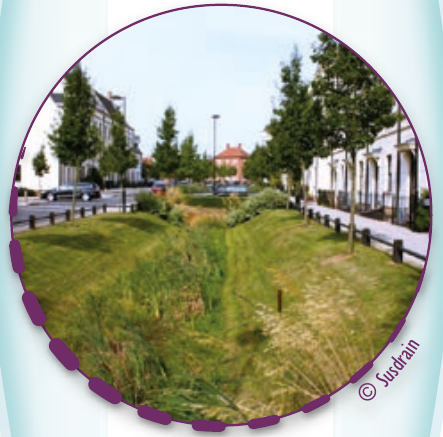
Retention basins (U4), canals and channels (U5), and filter strips (U6) guide rainwater towards infiltration areas, such as infiltration wells (U7) or infiltration trenches (U8). These measures, often used in combination, help to recreate a natural water cycle in urban environments.
Integrating nature into the city
Urban woodland parks (F11) and trees in urban areas (U12) play a key role in stormwater management. Their soils, which are more permeable than hardened surfaces, promote infiltration and groundwater recharge. They also reduce the heat island effect and improve air quality by trapping pollutant particles. The wooded wetland at Kylmaojankorpi (Finland) demonstrates how urban forests can store large quantities of water whilst providing recreational spaces and enhancing biodiversity.
Retention basins (U10) and retention ponds (U11) temporarily store rainwater during heavy rainfall events, thereby reducing the risk of flooding and allowing for gradual infiltration. In Belford (United Kingdom), these measures have contributed to a reduction in peak flows of 15–30 per cent.
Implementation : Challenges and opportunities
NWRM measures in urban areas apply at several scales :
-
Building : Green roofs (U1), rainwater harvesting (U2).
-
Neighbourhood : Permeable surfaces (U3), rain gardens (U9).
-
City : Urban woodland parks (F11), retention basins (U10).
Costs and funding :
-
Green roofs (U1) have a high initial cost (€100 to €200 per m²), but energy savings and grants (e.g. local funding) make these investments cost-effective in the long term.
-
Rain gardens (U9) and permeable surfaces (U3) involve lower costs (€20 to €50 per m²), with immediate benefits in terms of stormwater management.
Barriers and drivers :
-
Barriers : Regulatory complexity, lack of space, resistance from property developers.
-
Drivers : Grants (ADEME, local authorities), awareness-raising (practical examples), integration into urban planning documents (PLU, SCOT).
Multiple benefits : Beyond water management
NWRM measures in urban areas generate a cascade of positive effects :
-
Climate : Urban trees (U12) and green roofs (U1) reduce the heat island effect and sequester CO₂.
-
Biodiversity : Urban woodland parks (F11) and rain gardens (U9) provide habitats for numerous species (birds, pollinating insects).
-
Economy : Reducing flood risks and enhancing green spaces generate savings for local authorities.
-
Social : Urban green spaces improve quality of life and provide places for relaxation and socialising.
Conclusion : Towards ‘sponge cities’
Natural Water Retention Measures in urban areas demonstrate that urban planning and water management can go hand in hand. By reducing soil sealing and integrating nature into the city, these practices offer sustainable and multifunctional solutions to :
-
Reduce the risk of flooding by storing and infiltrating water.
-
Improve air quality and combat heat islands.
-
Restore urban biodiversity.
-
Strengthen cities’ climate resilience.
To ensure their widespread adoption, it is essential to :
-
Raise awareness amongst elected representatives, urban planners and citizens.
-
Simplify access to funding (grants, public-private partnerships).
-
Incorporate these measures into urban planning documents (PLU, SCOT, ZFE).
What if the city of tomorrow were one that, rather than fearing water, embraced it as a resource ?
1 : see the summary on the topic of Urban Planning (in French) : U1 – Green roofs – U2 – Rainwater harvesting – U3 – Permeable surfaces – U4 – Sump pits – U5 – Canals and channels – U6 – Filter strips – U7 - Infiltration wells - U8 - Infiltration trenches - U9 - Rain gardens - U10 - Retention basins - U11 - Retention ponds - U12 - Infiltration basins
Sources
-
European Commission document : Selecting, designing and implementing Natural Water Retention Measures in Europe (MNRE),
available on the website : www.sgle.fr/wp-content/uploads/2024/02/Mesures-naturelles-de-retention-deau-en-Europe_compressed.pdf - Mesures-naturelles-de-retention-deau-en-Europe_compressed.pdf
-
Website : Syndicat Grand Lieu Estuaire
To go further
-
NWRM Project: nwrm.eu/measures-catalogue
-
ADEME (France): www.ademe.fr/
-
Sustainable Cities Network: www.citiescanb.org/