Agriculture: an unexpected ally in water management
Selecting, designing and implementing Natural Water Retention Measures in Europe (MNRE)
European Commission, February 2023
In Europe, where agricultural land covers nearly 40 per cent of the territory, the intensification of farming practices has often gone hand in hand with soil degradation, diffuse pollution and an increased risk of flooding. Yet another way forward exists: Natural Water Retention Measures (NWRMs), which propose rethinking agriculture as a means of regulating water.
Permanent grassland, buffer strips, crop rotation and traditional terraces… These practices, tested and documented by the European Commission, demonstrate how to reduce runoff by 50 to 100 per cent, promote infiltration and preserve soil quality, whilst maintaining agricultural productivity. They form part of an ambitious regulatory framework: the Water Framework Directive (WFD), the Floods Directive, and the European Biodiversity Strategy.
These measures illustrate a gentle revolution: what if, rather than fighting against water, agriculture learnt to live with it? By restoring the natural functions of soils and landscapes, they offer concrete solutions to mitigate flood peaks, recharge groundwater, and limit erosion – whilst strengthening farms’ resilience to climate change.
This factsheet summarises the first theme, ‘Agriculture’, from the document ‘Selecting, Designing and Implementing Natural Water Retention Measures in Europe (MNRE)’. See the three other factsheets on: Forestry, Hydromorphology, Urban
To download : mesures-naturelles-de-retention-deau-en-europe_fr.pdf (8.4 MiB)

The issues : Why take action on water in agriculture ?
Intensive farming has profoundly altered the water cycle, with direct consequences for ecosystems and societies. Soil compacted by machinery, monocultures and the lack of permanent vegetation cover reduce infiltration capacity, leading to increased run-off which exacerbates the risk of flooding downstream. Furthermore, nitrates, phosphates and pesticides, washed away by rain, contaminate surface and groundwater: in Europe, 40 per cent of water bodies are not in good chemical status.
Without vegetation cover, soil is also washed away by rain. Studies from the NWRM project show losses of up to 61 tonnes per hectare per year on unmanaged slopes. Finally, the simplification of agricultural landscapes depletes habitats for pollinators, birds and soil micro-organisms, which are essential for soil fertility.
To address this, the European Union has put in place a range of legal and financial measures: the Water Framework Directive (WFD, 2000), which aims to achieve good ecological status for all bodies of water by 2027, the Floods Directive (2007), which promotes integrated catchment management, and the Common Agricultural Policy (CAP), which funds agri-environmental practices.
NWRM solutions for resilient agriculture
Reducing runoff and promoting infiltration
Among the most effective measures for reducing runoff, hay meadows and pastures (A1)1 stand out for their simplicity and impact. These permanent grasslands, whether mown or grazed, act like sponges: their deep soil and dense vegetation cover promote optimal infiltration, reducing runoff by 50 to 66 per cent compared with arable land. This is a major asset for flood-prone regions, such as the Marais Poitevin in France, where these practices have enabled the storage of up to 1.5 million m³ of water during periods of heavy rainfall.
Another complementary solution: buffer strips and hedgerows (A2), which are strips of vegetation strategically placed along the edges of fields or watercourses. Their role? To slow down water flow, filter out pollutants (reducing phosphates by up to 96 per cent and nitrates by 81 per cent), and limit erosion.
A moderate investment (€400 to €800 per hectare for planting, €75 to €100 per hectare per year for maintenance) yields long-term benefits, as demonstrated by the flood-protection hedgerows in the south of France.
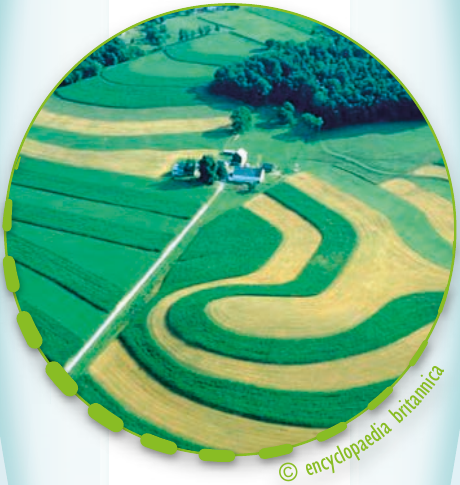
Strip cropping with contour planting (A4), which alternates strips of dense crops (hay, cereals) with row crops (maize, soya), can reduce run-off and erosion by up to 50 per cent on sloping land. Finally, early sowing (A9), carried out up to 6 weeks before the usual time, provides rapid winter cover that protects the soil and improves water retention, with a reduction in runoff and erosion of up to 50 per cent.
Improving soil structure and combating erosion
Crop rotation (A3), which involves alternating different crops on the same plot, improves soil structure by increasing organic matter. The result: better water infiltration and reduced erosion, at a moderate cost (€32/ha to change crop rotations, with subsidies of €128/ha/year).
No-till farming (A6), or direct drilling, avoids turning the soil and preserves its structure. This practice reduces erosion by 89 per cent and increases water retention by 6 to 12 per cent, whilst saving fuel (€30 to €67 per hectare). An initial investment of €10,000 in equipment pays for itself quickly.
Minimal tillage (A7), which leaves at least 30 per cent of crop residues on the surface, also reduces erosion (by 12 to 84 per cent when combined with a catch crop) at a cost of €32 to €67 per hectare.
Traditional terraced farming (A10), a legacy of centuries of farming on sloping land, enables an additional 50 per cent of runoff water to be stored and reduces soil loss by 95 per cent (i.e. 19 to 61 tonnes per hectare per year). Maintaining them costs around €200 per hectare per year, a reasonable price for long-term benefits, as seen in Veneto (Italy).
Finally, mulching (A13), which involves applying a layer of organic material (straw, bark) to the soil surface, reduces runoff and erosion, resulting in 15 times less sediment in the water. Its cost ranges from €0.05 to €0.15 per m² depending on the type and thickness.
Preserving water quality and biodiversity
Intercropping (A5), which combines two or more crops on the same plot, reduces runoff by 20–55 per cent and improves the use of resources (water, nutrients). It is eligible for grants of €110 per hectare per year.
Plant cover (A8), such as green manure sown in winter, protects the soil and reduces runoff by up to 80 per cent or 50 mm, whilst limiting erosion by 50 per cent. Its cost (€40 to €140 per hectare for seeds and planting, €52 to €63 per hectare per year for maintenance) is largely offset by water savings (12–46 per cent) and reduced nitrogen losses (10–46 kg per hectare), as observed in Andalusia (Spain).
Controlled-traffic farming (A11), which restricts machinery movements to permanent tracks (15 per cent of the area), reduces soil compaction and improves infiltration by 84 to 400 per cent, at a cost of €22.8 per hectare (installation) and yielding savings of €213.6 per hectare (mechanisation).
Finally, reducing stocking density in livestock farming (A12) limits soil compaction caused by livestock, thereby improving soil structure and reducing runoff by 50 per cent. This measure involves no direct cost, but may require modifications to livestock buildings (€860 to €2,500 per head).
Implementation : Challenges and opportunities
NWRM measures in agriculture apply at several scales : at plot level (buffer strips, mulching, early sowing), at farm level (crop rotation, no-till farming, controlled traffic), or at catchment level (coordination between farmers). Their effectiveness is greatly enhanced when combined: combining buffer strips (A2), no-till farming (A6) and plant cover (A8) multiplies the positive impacts on water retention and soil quality.
In terms of costs and funding, NWRM measures involve initial investment but generate long-term savings. For example, no-till farming (A6) requires a direct-drill seed drill (€10,000), but leads to savings on fuel (€30 to €67 per hectare) and labour. Converting arable land to grassland (A1) may result in a loss of income (up to €140/ha/year), but this is often offset by CAP subsidies. NWRM grants (up to €128/ha/year for crop rotation) and Rural Development Programmes (RDPs) provide additional funding.
However, barriers remain: resistance to change, high initial costs, a lack of training, and administrative complexity. To overcome these, it is essential to raise awareness amongst farmers through demonstrations (pilot farms), to simplify access to funding, and to provide technical support (chambers of agriculture, cooperatives).
Multiple benefits: Beyond water management
NWRM measures in agriculture generate a cascade of positive effects.
In terms of climate, no-till farming (A6) sequesters between 20 and 1,300 kg of carbon per hectare per year, whilst permanent grassland (A1) and buffer strips (A2) increase earthworm biomass by 300 per cent, thereby enhancing soil biodiversity.
Economically, these practices reduce costs (inputs, energy) and improve yields. For example, controlled-traffic farming (A11) increases yields by 4 per cent, and intercropping (A5) enables better use of resources, with productivity gains compared to monocultures.
Finally, from a social and landscape perspective, traditional terraces (A10) preserve cultural heritage, as in Veneto, whilst the reduction in water pollution (nitrates, pesticides) improves public health.
Conclusion : Towards agriculture that is in harmony with water
Natural Water Retention Measures in agriculture demonstrate that water management and productivity are not mutually exclusive. Drawing inspiration from natural ecosystems, these practices offer concrete, cost-effective and sustainable solutions to mitigate flood risks, preserve water quality and strengthen farms’ climate resilience.
To ensure their widespread adoption, it is essential to :
-
Continue awareness-raising efforts amongst farmers.
-
Simplify access to funding (grants, payments for ecosystem services).
-
Integrate these measures into local policies (SAGE, SDAGE, PLU).
-
Develop monitoring tools (runoff sensors, biodiversity indicators).
What if the agriculture of tomorrow were one that, rather than dominating nature, drew inspiration from it to live more harmoniously with water ?
1 : see the document’s table of contents (in French), topic: Agriculture : A1 – Hay meadows and pastures – A2 – Buffer strips and hedgerows – A3 – Crop rotation – A4 – Contour strip cropping – A5 – Intercropping – A6 – No-till farming – A7 - Low-till farming - A8 - Plant cover - A9 - Early sowing - A10 - Traditional terraced farming - A11 - Controlled-traffic farming - A12 - Reducing livestock stocking rates - A13 - Mulching
Sources
-
European Commission document : Selecting, designing and implementing Natural Water Retention Measures in Europe (MNRE),
available on the website : www.sgle.fr/wp-content/uploads/2024/02/Mesures-naturelles-de-retention-deau-en-Europe_compressed.pdf - Mesures-naturelles-de-retention-deau-en-Europe_compressed.pdf
-
Website : Syndicat Grand Lieu Estuaire
To go further
-
NWRM Project : nwrm.eu/measures-catalogue
-
Water Framework Directive (WFD) : European Commission website
-
Agroecology Network (France) : agroecologie.fr/