Ibn Tofail University Living Lab Wastewater Treatment Plant (Morocco)
Circular and resilient water management in urban areas
August 2025
ICLEI-Local Governments for Sustainability
In Kenitra, Ibn Tofail University (UIT) has transformed its campus into a living laboratory for circular water management, combining wastewater treatment, reuse for irrigation and environmental education.
Launched in 2019, this pioneering project demonstrates how an academic institution can become a key player in local water resilience, whilst training the next generation of experts in sustainable water management.
Driven by collaboration between researchers, students and professionals, this project illustrates the importance of innovation and awareness-raising in addressing water-related challenges.
This factsheet summarises one of the 12 case studies in the document: Circular and Resilient Water Management in Urban Areas
Kenitra, the capital of the province of the same name, is a port city situated at the mouth of the River Sebou, near the Marjat Al Fouwarate wetland (listed as a RAMSAR site). With a population of 507,736 (2024) and more than 50,000 water users on the campus of Ibn Tofail University (UIT), the city faces growing demand for water, pollution of surface and groundwater, and pressure on local resources. Its mixed economy, combining intensive agriculture, an expanding industrial sector and a rapidly growing university campus, places significant pressure on water resources. The city’s geographical location, in a historically marshy area, makes it particularly vulnerable to seasonal flooding, a problem exacerbated by urban expansion and inadequate stormwater management infrastructure.
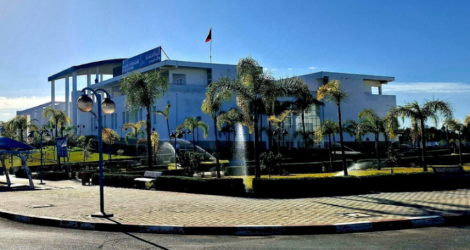
The UIT Living Lab Wastewater Treatment Plant, launched in 2019, is a pilot project aimed at enhancing the campus’s water resilience whilst serving as an educational and research platform. Developed by Ibn Tofail University and its Separation Processes Laboratory, this initiative combines wastewater treatment, reuse for irrigation, pollution reduction and raising awareness of sustainable water management. The aim is to create a self-sufficient system where wastewater is treated and reused on site, thereby reducing dependence on freshwater resources and contributing to the campus’s environmental sustainability.
Solutions implemented
-
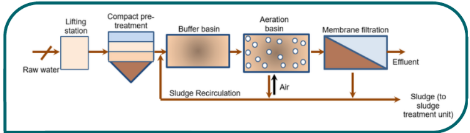
Membrane bioreactor (MBR) treatment plant : This compact, decentralised system combines biological treatment and membrane filtration to effectively treat wastewater from the campus’s laboratories and buildings. The ultrafiltration membrane comprises two types of membrane : a hollow-fibre membrane and a flat-sheet membrane.
-
Reuse of treated water : Around 500 m³ of wastewater is treated each day, amounting to a total of approximately 170,000 m³ in 2024. The treated water is used to irrigate 25 per cent of the campus’s green spaces (approximately 5 ha), thereby reducing drinking water consumption by 70 per cent.
-
Living laboratory : The site serves as a demonstration and training centre for students and professionals. It promotes hands-on learning, capacity building and knowledge transfer in the field of sustainable water treatment technologies.
-
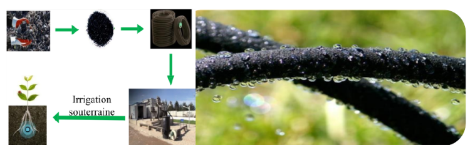
Underground irrigation network and 40 m³ storage tank : These enable the efficient distribution of treated water for irrigation.
-
Chlorine disinfection unit : Treats the stored water before it is redistributed to ensure it meets quality standards.
Key results
-
Improved wastewater treatment capacity : The BAM treatment unit treats approximately 500 m³ of wastewater per day, amounting to a total of around 170,000 m³ of treated water in 2024.
-
Reduction in drinking water demand : The 170,000 m³ of treated water produced by the BAM unit is used to irrigate 25 per cent of the university’s total green space, thereby reducing drinking water consumption by 70 per cent.
-
Improved water quality : The treatment and reuse of wastewater, in accordance with water quality standards, have significantly reduced pollution of surface and groundwater.
-
Education and capacity building : The site hosts more than 10 technical workshops and tours each year, attended by over 90 people, including engineering and environmental science students.
-
Sustainability and self-sufficiency : The university has achieved self-sufficiency in the local treatment of its wastewater, thereby improving operational sustainability and reducing its dependence on municipal services.
-
Energy efficiency : The BAM system operates with an energy consumption of approximately 0.2 kWh per cubic metre of treated water, equating to an annual consumption of 33,230.87 kWh in 2024, which is considerably more efficient than conventional systems (0.3–0.5 kWh per cubic metre).
Climate and environmental impacts
-
Climate change mitigation : By reducing energy consumption compared to conventional systems, the BAM system helps to lower the university’s carbon footprint. By treating wastewater locally, the project also avoids the need to transport water over long distances, an energy-intensive operation.
-
Climate adaptation and resilience : The reuse of treated wastewater for irrigation reduces pressure on freshwater resources, which is essential in a context of increasing water stress. Furthermore, self-sufficiency in wastewater treatment strengthens the campus’s resilience in the face of water shortages or disruptions to municipal services.
-
Ecosystem protection : By reducing the discharge of untreated wastewater into the River Sebou and groundwater aquifers, the project helps to preserve the quality of surface and groundwater, thereby protecting local ecosystems and biodiversity.
Success Factors
-
Values :
₋ An integrated approach combining wastewater treatment, reuse, education and applied research.
₋ Recognition of the importance of sustainable water management for local resilience and environmental protection.
-
Connections :
₋ Physical connections : The BAM system and associated infrastructure (reservoir, irrigation network) create an integrated system where water is treated, stored and reused on-site.
₋ Social connections : Collaboration between the university, researchers, students and professionals in the water sector. The site serves as a platform for exchange and learning, strengthening the links between theory and practice.
-
Investments :
₋ Total project cost : 8 million dirhams (approximately 760,000 euros).
₋ Return on investment : The savings made on drinking water consumption and treatment costs enable the project to pay for itself quickly.
Scalability for Morocco
This model could be replicated in other Moroccan universities or industrial areas, such as Casablanca, Marrakesh or Fez, where pressure on water resources is high and where wastewater treatment infrastructure is often inadequate. By combining decentralised treatment, reuse and training, this project demonstrates how institutions can become drivers of the transition towards a circular water economy.
For example, in Marrakesh, where hotels and tourist resorts consume large quantities of water, adopting similar systems would help reduce demand for drinking water whilst raising awareness among industry professionals about more sustainable management practices. Similarly, in industrial areas, such as Casablanca, this model could help treat and reuse wastewater for non-potable processes, thereby reducing pressure on natural resources and operational costs.
Sources
Online document, see pages 54 to 66 : Gestion circulaire et résiliente de l’eau en milieu urbain - Circular and resilient water management in urban areas
To go further
Websites : iclei.org/ & iclei-europe.org/
Bibliography :
1. Fanack Water. (n.d.). Water management in Morocco [La gestion de l’eau au Maroc]. water.fanack.com/morocco/water-management-in-morocco/
2. Université Ibn Tofail. (22 mars 2024). Ibn Tofail University’s commitment to water stress challenges: Pioneering solutions for sustainable water management [L’engagement de l’université Ibn Tofail face aux défis liés au stress hydrique : des solutions pionnières pour une gestion durable de l’eau]. sd.uit.ac.ma/ibn-tofail-universitys-commitment-to-water-stress-challengespioneering-solutions-for-sustainable-water-management/
3. Université Ibn Tofail. (n.d.). Économie circulaire de l’eau : Made in Morocco. sd.uit.ac.ma/economie-circulaire-de-leau-made-in-morocco/
4. Université Ibn Tofail. (n.d.). Station de dépuration et de recyclage des eaux usées de l’Université Ibn Tofail. sd.uit.ac.ma/station-depuration-et-de-recyclage-des-eaux-usees-de-luniversite-ibn-tofail/
5. Université Ibn Tofail. (s.d.). Water Technology Platform [Plateforme technologique de l’eau]. sd.uit.ac.ma/watertechnologyplatform/
6. Pays membres de l’OMM. (2023). WMO Climatological Standard Normals for 1991–2020: Kenitra station (CSV) (NCEI Accession 0253808) [Dataset]. National Centers for Environmental Information [Normales climatologiques de l’OMM pour 1991-2020 : station de Kénitra (CSV) (NCEI Accession 0253808) [Ensemble de données]. Centres nationaux d’information environnementale.] water.nature.org/waterblueprint/city/casablanca/
7. Banque mondiale. (2017). Managing Urban Water Scarcity in Morocco. Annexes to sections 2–4 [Gérer la pénurie d’eau en milieu urbain au Maroc. Annexes aux sections 2-4]. documents1.worldbank.org/curated/en/820871516882762722/pdf/122698-WP-v2-PUBLIC-anneces-to-sections-2-to-4.pdf