Fighting against marine pollution with local fishermen
The BlueFishers Project
Laura Lo Presti, July 2025
BlueFishers: how Viareggio’s fishermen are tackling marine pollution. In Tuscany, along the coast of Viareggio, 50 million polystyrene crates are used every year to transport and store fish. This packaging, which is lightweight and fragile, often ends up in the sea or on beaches, where it breaks down into microplastics and enters the food chain.
In response to this scourge, the BlueFishers project, led by Marevivo and the Tuscan Environment Foundation, offers a practical solution: replacing these disposable crates with reusable and recyclable polypropylene boxes. This initiative combines environmental protection, the circular economy and local engagement, and has already helped to eliminate 35,000 polystyrene crates in just six months.
To download : factsheet_bluefishersproject_en.pdf (1.7 MiB)
The Problem: Polystyrene in the Sea
Expanded Polystyrene (EPS) is a lightweight, buoyant, water-resistant material commonly used in the seafood industry, particularly for fish crates. Its insulating properties help maintain low temperatures during transport, making it an attractive option for preserving freshness. However, the very qualities that make EPS effective in logistics—its light weight and cushioning properties—also make it a serious environmental liability, as it is not durable and tends to crumble easily into smaller, persistent pieces that persist for hundreds of years in the sea.
These particles are frequently mistaken for food by marine organisms, including fish, seabirds, and even filter feeders like mussels. Once ingested, microplastics can cause internal injuries, starvation, and exposure to toxic substances. These plastics, and the chemicals they carry, accumulate up the food chain, ultimately ending up in seafood consumed by humans.
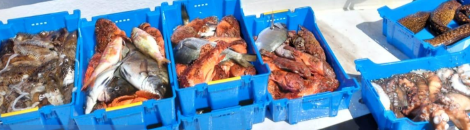
Beyond ingestion, EPS poses direct physical dangers to marine life. Larger chunks can entangle animals or obstruct their movement, while sharp fragments can damage tissues. Moreover, EPS is not chemically inert. It can leach hazardous substances such as styrene, a suspected carcinogen, and absorb other pollutants from the surrounding water, acting as a toxic delivery system within marine ecosystems.
Despite its benefits for short-term use, EPS represents a long-term threat to ocean health and food safety. Addressing its impacts means reevaluating the materials we allow into our supply chains and prioritizing safer, reusable, and non-toxic alternatives.
Moreover, these boxes are typically used once and then discarded, underscoring the urgency to shift toward reusable or recyclable alternatives that are not only more durable, but also promote a more conscious and efficient use of materials and resources.
The Response: The BlueFishers Project
To tackle marine pollution in the Versilia coastal region of Tuscany, the Tuscany Environment Foundation is funding Marevivo’s BlueFishers project. The initiative is carried out in collaboration with Marevivo’s Regional Delegation in Tuscany, local authorities including the City of Viareggio, the Coast Guard, the Port Authority, as well as the Cittadella della Pesca of Viareggio, a social cooperative representing nearly the entire local fishing sector.
Objectives
-
Pollution Reduction: Replace single-use expanded polystyrene (EPS) fish boxes with reusable and recyclable polypropylene alternatives.
-
Awareness BuildingAwareness Building}}: Raise awareness among local fishers about the environmental impact of EPS waste and promote sustainable alternatives, such as reuse, to encourage more responsible practices.
-
Circular Economy: Develop a strong business case for the adoption of reusable boxes in the fishing sector, highlighting their economic, environmental, and operational benefits.
-
Community Engagement: Support the ecological transition by engaging fishing communities in adopting best practices for waste prevention and marine protection.
The sustainable alternative being introduced consists of reusable and recyclable polyethylene boxes supplied by DuWo. These boxes, approved under the EU’s Restore Our Ocean and Waters mission, can be recycled at the end of their lifecycle either into new boxes or incorporated into road surface materials. The technology includes embedded microchips that enable tracking of both the catch and the boat. This system will also enable streamlined sanitation of the boxes once the Viareggio fish market is upgraded with integrated IT and washing infrastructure, expected by summer 2025. Currently, manual washing is performed in compliance with HACCP standards. The boxes are guaranteed for two years. If a replacement is needed due to wear, DUWO will handle the collection of the used box and ensure fishermen receive the best possible price for a new one.
Results
The BlueFishers project has so far engaged 58 artisanal fishing boats, each selling their catch directly at the pier. As part of the initiative, the Tuscany Environmental Foundation has donated a total of 2,320 reusable and recyclable polypropylene boxes, 40 boxes for each participating boat.
Over the first six months, the project has successfully eliminated 35,000 polystyrene boxes, marking a significant step toward reducing single-use plastic in the fishing sector.
Next Steps
The next phase of the project will focus on engaging trawling operations and large-scale distributors to support the establishment of a closed-loop system, where feasible. Particular emphasis will be placed on involving local supermarkets and restaurants, enabling efficient collection and return of reusable boxes.
In parallel, advocacy efforts with local and regional authorities will be intensified. All findings, including reports on benefits, long-term cost implications for fishers, and the overall feasibility of the system, will be compiled and submitted to the central government.
Sources
To go further
-
Marevivo is a Environmental Foundation that protects the sea and its resources from over 35 years, focusing on biodiversity conservation, sustainable development, enhancement and promotion of marine protected areas, pollution and illegal fishing.
-
The Tuscany Environment Foundation (TEF) works to protect and restore the natural beauty, biodiversity, and ecosystems of Tuscany (Italy). It raises funds from individuals and businesses connected to the region to support leading local environmental organisations. TEF backs scalable projects that bring economic and social renewal to communities and fosters a strong network of people committed to supporting environmental champions across Tuscany.
-
Founded in May 2009, Zero Waste Italy (ZWI) connects Italian Zero Waste efforts with broader European and global networks. ZWI collaborates with local groups and organisations, especially Ambiente e Futuro and the Capannori Zero Waste Research Centre.
-
Zero Waste Europe is the European network of communities, local leaders, experts, and change agents working towards the prevention and elimination of waste in our society. We advocate for sustainable systems; for the redesign of our relationship with resources; and for a global shift towards environmental justice, accelerating a just transition towards zero waste for the benefit of people and the planet.