ADméd: Sustainable Agriculture in the Mediterranean (France)
août 2021
Agence pour l’Environnement et la Maîtrise de l’Energie (ADEME)
In the sun-scorched landscapes of Provence and Occitania, where the earth cracks under the weight of drought and the winds carry the scent of lavender and despair, agriculture is at a crossroads. Yields stagnate, soils degrade, and farmers—guardians of ancient knowledge—watch their livelihoods wither under the relentless Mediterranean sun. Amid this crisis, the ADméd network (Sustainable Agriculture in the Mediterranean), led by the CIVAMs (Centers for Initiatives to Valorize Agriculture and Rural Areas), emerged as a beacon of hope. Since 2010, this farmer-driven initiative has woven a tapestry of resilience, where agroforestry, knowledge-sharing, and collective innovation transform vulnerability into strength. Here, trees are not just crops—they are allies against erosion, drought, and climate despair.
À télécharger : capitalisation-cc-adaptation-practices-mediterranean-011449b-projectfolio-en.pdf (3,2 Mio)
How does this initiative contribute to the territory’s adaptation to climate change?
Agricultural systems are growing weaker
In the South and Occitania regions, agricultural systems have shown increasing fragility due to climate change in recent years. Crop yields on certain farms are stagnating or declining, resulting in zero or negative profitability, especially during periods of drought, which are affecting the region more and more frequently. Climate change, which is likely to cause changing rainfall patterns, higher temperatures, and more frequent, longer droughts, therefore seems set to exacerbate the socio-economic vulnerability of the agricultural sector. Today, certain rural stakeholders are questioning the sustainability of agricultural systems and practices.
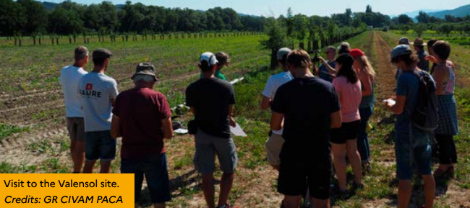
Support from CIVAMs to develop and adapt agricultural practices, through ADméd
CIVAMs bring together farmers and rural stakeholders to achieve territorial innovation through information-sharing, discussions, and group momentum. They work to develop and promote cost-effective, autonomous agricultural systems that fit into their territory and form the core of local food systems.
Since 2010, the South and Occitania regional CIVAMs have joined forces within the ADméd hub to support farms in improving their practices. This includes making them more resistant to climate change impacts and ensuring their sustainability.
Agroforestry: a driver for economic, social and environmental resilience
Many initiatives supported by the CIVAMs within the ADméd network are especially aimed at developing farming and agroforestry groups. One of the members of the ADméd network, Mr. Rastello, a farmer from the Plan d’Aups (Sainte Baume) municipality, took up agroforestry in 2016. He is interested in this activity for several reasons. First of all, agroforestry offers a wide range of technical options and enables economic diversification. It has many advantages from an environmental point of view, and helps to mitigate and adapt to climate change.
Project spotlight
Goal
To promote resilient agriculture by means of a farmers’ exchange network to share innovative practices.
Background
The ADméd project was created in 2010 by the Occitania and South region CIVAMs as a structure for joint actions on agricultural sustainability. The goal was to identify the main difficulties in the Mediterranean area with the region’s farmers, to provide support for groups, and to work with them on practical tools for action.
Through training, experience-sharing, and visits, farmers develop initiatives and try out new practices ('living countryside' initiative, cost-effective and autonomous production systems, creating and maintaining farming and rural activities, etc.) while benefiting from the assistance, support, and constructive criticism of their other colleagues within the group. Several discussion topics have emerged: reusing green waste, managing organic matter, managing water quantities, sustainability of market gardening and wine-growing systems, etc.
How the CIVAMs take action through ADméd
The ADméd project, like all other CIVAM actions, aims to promote experience-sharing between farmers and the joint development of practical initiatives to improve the resilience of agricultural systems within a territory.
ADméd implements three tools for action:
-
Creating networks on agricultural practices, and providing support for farmers.
-
Structuring and supporting groups.
-
Advocacy on public policies and territorial development to raise the awareness of funding bodies and politicians about agricultural issues.
Focus on an agroforestry initiative
Mr. Rastello, a farmer located in Plan d’Aups (83), noticed that meadow and cereal yields had been steadily falling for several years. Productivity losses, which are partly due to soil degradation and aridity in the area, are likely to get worse as the physical impacts of climate change take hold. To ensure the future viability of his farm, Mr. Rastello modified his production system using soil restoration principles: reducing tillage (direct sowing) and reintroducing trees on his farm. The farmer revisited the ecosystem of his agricultural land using a two-stage plan:
-
In the short term: implementing direct sowing under plant cover for annual crops. This technique dispenses with tillage and integrates plant cover into crop rotations, which will help to naturally loosen the soil and increase living organisms within it.
-
In the long term: implementing agroforestry. This practice consists in combining woody plants and annual crops and/or livestock-rearing on the same plot of land.
In 2017, after having participated in a course organized by GR CIVAM PACA, he received support from a design consultant and several local institutional partners (municipalities, Regional National Park, etc.), and created his first 1.5 hectare agroforestry plot.
Territory concerned:
South and Occitania regions Initiative holders: CIVAM PACA Regional Group, CIVAM Occitania Regional Federation, CIVAM Network (national federation) Partners: Multiple sources of funding: Ministry of Agriculture (DRAAF), ADEME, Europe, Foundations, etc. Funded as a project.
Calendar:
-
Start date: 2010
-
Network start date: 2011
-
The network will be maintained provided that funding remains available
Human resources:
-
2 full-time facilitators from CIVAM PACA
-
1.5 full-time facilitator from CIVAM OCCITANIA
Financial resources:
Variable according to each initiative, the technical skills involved, and the agreed funding arrangements.
What are the tangible results?
Gradual adaptation of the agricultural sector to ensure long-term resilience
The promotion of sustainable agriculture in the Mediterranean region by the CIVAMs, especially by creating networks between farming stakeholders, aims to gradually build the long-term resilience of production systems to growing pressure from socio-economic, environmental, and climate factors.
More specifically, by implementing agroforestry practices, Mr. Rastello is seeking to achieve the following results: minimize the erosion of fragile soil exposed to potentially severe weather events (droughts and floods), improve grass and cereal production by boosting shade from trees acting as « climate shelters », reduce water losses and sustainably store carbon in the soil, protect and maintain biodiversity, increase nectar and pollen production (by mainly choosing melliferous species) to sustain the village’s beekeeping activities, develop beneficial organisms for crops and reduce the use of plant protection products. In this case, the use and maintenance of ecosystem services are considered as vectors to improve the resilience of agricultural systems, especially to climate change.
Sharing best practices by creating farmers’ networks
Since 2010, experience-sharing days, training courses, visits, and workshops at farms on topics of interest (including agroforestry) have built a large, tight-knit network of farmers and project initiators. These themed workshops bring together various entities involved in agricultural development, experimentation, and research, and a large number of participating farms. Sustainability assessments are also carried out and presented during group sessions. These discussion sessions provide a favorable environment to form new partnerships and launch new projects.
CIVAMs highlight valuable initiatives and promote outstanding practices
A website has been created to shine a spotlight on valuable initiatives in the Mediterranean area. This includes a series of experience factsheets that highlight outstanding practices. There are currently 33 factsheets, promoting various innovative activities. Videos and brochures are also produced and distributed, for example: « Why and how to reuse green waste on a farm. » Many other events (seminars, training sessions, etc.) and documents (study reports, assessments, etc.) also help to improve agricultural practices by promoting valuable initiatives.
Increasing cooperation with the research community
Experimentation is another important issue for farmers investing in alternative agricultural practices or new operational methods. It is often difficult for farmers to shoulder the financial burden of « live » experimentation on their own, and even more difficult to share its results. For example, when setting up an agroforestry plot, many options are available to select tree species (trees for timber or wood-energy, fruit trees, melliferous trees, etc.). These choices depend on technical and economic factors, and reference documents do not always exist on such topics. For this reason, farmers are asking for greater cooperation with the research community. The South region CIVAM is therefore currently taking steps to increase cooperation with INRAE in Avignon to design decision-making tools that will be tested with groups of farmers. Other joint projects could also be envisaged, by taking inspiration from the wide range of research topics in this field: interactions between trees and crops with regard to light, water, or nutrients; the impact of trees on useful biodiversity and carbon storage under temperate conditions; the sociological obstacles to the development of agroforestry, etc.
What are the conditions for success?
Engage in public-private co-funding
Certain agroforestry practices are too costly for farmers to self-finance without additional external funding (particularly when a farmer wishes to extend agroforestry over a large portion of the farm’s useful land). In this case, investments must cover project planning (feasibility study, scaling, etc.), purchasing trees and equipment, as well as monitoring and managing trees (especially for timber) and skills acquisition. The latter involves either paying for technical consultancy, or employing specialist staff. In the South region, there is limited public funding for agroforestry. The key to compensate for the lack of public funding is to engage in co-funding opportunities combining public-private funds, or to approach foundations. Dependence on public funding (mainly regional, departmental, Ministry of Agriculture or European funds) is currently a major constraint for farmers.
Improve technical support, in agroforestry and other areas
Reintroducing traditional agricultural systems—which have now been updated with modern farming equipment—must not be limited to alternative networks; farmers must also receive widespread support from mainstream technical networks (chambers of agriculture, technical institutes, etc.).
Support for experimentation through cooperation with research institutes
Ideally, solid expertise and an experimental period are required before investing in a new farming practice, due to the specific agricultural, climate, and soil conditions of each plot of land. Creating networks with farmers that have already tried out new practices, who have a clear view of their agronomic and economic performance and whose farming land has similar characteristics, can help other farmers adopt new practices.
Combine practical initiatives with advocacy campaigns targeting various political authorities
Although there is a growing interest among elected representatives and other public decision-makers (at the departmental, regional, and national level) in innovation and evolving agricultural practices—especially due to their direct link with climate change mitigation and adaptation—organizations working in this sector believe that there is still a « gap » in awareness, which must be bridged through advocacy. Regional CIVAM representatives are therefore responsible for maintaining connections with public authorities that play a role in defining agricultural policy (DRAAF, DDTM, DREAL, etc.). They also ensure that changes in public policy, especially those relating to sustainable practices, are communicated to members of the network. Practical issues encountered in the field are seen as effective tools to influence deliberations and budgetary decisions at the departmental or even Ministerial level, based on a bottom-up approach.
Maintain a dynamic perspective on adaptation
One of the lessons learned from the farmers’ network is that adapting agricultural practices is a dynamic process. This is especially the case for agroforestry projects, which cannot be designed in a standardized manner. Time must be assigned for experimentation and experience capitalization, using flexible approaches. The development of agricultural practices must therefore be based on a long-term vision and approach that aims to achieve a gradual return to ecosystem services.
| Words of a participant « We must allow ourselves to continually update and develop our projects, and gradually implement resilient systems. There is plenty of space for experimentation. » — Christian Rastello, farmer |
Références
Study carried out by Lucie Royer, Ramboll
ADEME Document : Capitalisation on climate change adaptation practices in the mediterranean area. Project portfolio
En savoir plus
Advocacy to develop agroforestry:
-
L’agriculture à l’abri des arbres en Région SUD - Trees provide shelter for farming in the South region
Contacts
-
Maylis Carré - ADméd Coordinator for the CIVAM network: maylis.carre[@]civam.org
-
Florian Carlet - Facilitator, GR CIVAM PACA: florian.carlet[@]civampaca.org
-
Christian Rastello - Agroforestry farmer, Plan d’Aups Sainte Baume