An inclusive, participatory process to plan territorial development that is resilient to climate change in the Douimis river basin
août 2021
Agence pour l’Environnement et la Maîtrise de l’Energie (ADEME)
The Douimis river basin, a 9,000-hectare rural area in northern Tunisia, faces severe climate pressures, including water stress, flooding, drought, and soil erosion. Agriculture, the region’s economic backbone, is increasingly vulnerable to declining rainfall, rising temperatures, and emerging fungal diseases.
To address these challenges, a participatory territorial planning process was launched under the Water, Climate and Development Programme (WACDEP). This initiative brought together national ministries, local authorities, and communities to co-design a Climate Change-Resilient Development Plan for Douimis.
By integrating climate risks into local policies, the project demonstrates how bottom-up collaboration can build adaptive capacity in vulnerable rural areas.
À télécharger : capitalisation-cc-adaptation-practices-mediterranean-011449b-projectfolio-en.pdf (3,2 Mio)
How does this initiative contribute to the territory’s adaptation to climate change?
The impact of climate change on natural resources and habitats
The Douimis basin has a mainly semi-arid climate, with large seasonal fluctuations in rainfall that also vary from year to year. In addition, water resources are currently under pressure both in terms of quantity (increasing demand, limited possibilities for additional surface water resources, overexploitation of groundwater, etc.) and in terms of quality (pollution, saltwater intrusion, etc.). Rising temperatures are also fuelling evapotranspiration and drying out soil and vegetation. Climate change is thus causing increasing weather-related risks of forest fires. Numerous forest fires have been registered in the Douimis area. Climate change is therefore likely to exacerbate current climate variations and their effects on socio-economic systems and ecosystems.
The impact of climate change on the region’s economic activities
Douimis is not the worst affected region in Tunisia in terms of water shortages; however agriculture is an important activity in the region, together with natural areas that require protection. Rising temperatures, decreasing rainfall, increasing evapotranspiration and declining water resources: these factors are all likely to jeopardise yields from irrigated crops (annual crops and orchards) and rain-fed crops in Douimis by the end of the century, threatening the economic sustainability of the agricultural sector.
Over the last few years, harvests have tended to be poorer, while new fungal diseases have emerged, affecting all cultivated land. In parallel to these changes, farmers have observed losses in land productivity, which increases the economic vulnerability of the agricultural sector.
A participatory approach to integrate climate change into territorial planning
The third strategy to develop and conserve agricultural land in Tunisia entails a territorial approach that focuses on socio-economic development and inclusion. This approach targets the most vulnerable populations, takes into account gender issues and incorporates additional pressures from climate change. As a practical application of this strategy, a pilot study based on a participatory approach was carried out in the Douimis river basin, in the Bizerte governorate. This project plays a pioneering role, not only by preparing a planning document, but also by developing methodology to guide the integration of climate change adaptation into territorial planning for a whole river basin.
Project spotlight
Goal
The programme aims to include safeguards for water resources and climate resilience in the development process. It also aims to promote investment strategies and increase the funding allocated to the water sector and climate change adaptation.
Background
The Douimis river basin covers 9000 hectares, and hosts a rural population of around 2000 people. The basin has been selected as a pilot site due to its economic assets and potential, as well as its environmental vulnerability. The area is characterised by severe erosion and retreating forest cover, which has led to its classification by the Bizerte Commission for Agricultural Development (CRDA) as a priority intervention zone for soil and water conservation work. This situation is compounded by the region’s precarious socio-economic conditions and its fragile ecological equilibrium.
Within the territory, the Douimis dam is currently under construction; it will represent a capacity of 45 million m3 and serve as a buffer reservoir for the water transfer system between the North, Centre and South of Tunisia.
From a national perspective, the ongoing decentralisation of Tunisian institutions in 2014 caused specific issues for interactions between stakeholders, including between the Ministries and local authorities.
Technical description
In order to promote economically resilient and socially sustainable development, the Water, Climate and Development Programme (WACDEP) launched a multi-sector (Ministry of Agriculture, Water Resources and Fisheries, Ministry of Equipment, Ministry of Local Affairs and the Environment, Ministry of Culture, etc.) and multi-level (central, regional, and local levels) process to draw up a territorial development plan for the Douimis river basin. This process was based on a participatory approach to ensure that all stakeholders within the territory could take ownership of the adaptation issues and solutions.
The process used to design the Douimis basin development plan followed the four phases of the African Ministers’ Council on Water (AMCOW) strategic framework for water security and climate change-resilient development.
Territory concerned: Douimis river basin
Initiative holders: Global Water Partnership Mediterranean (GWP-Med)
Partners:
-
Tunisian Ministry of Agriculture,
-
Water Resources and Fisheries,
-
Bizerte local authorities.
Calendar: 2014-2017
Human resources: Public and private actors, associations, citizens.
Financial resources: Unconsolidated funding from multiple sources. Estimated budget: €300,000 – €350,000
What are the tangible results?
Creation of a Climate Change-Resilient Development Plan for Douimis
This project enabled the creation of a Climate Change-Resilient Development Plan for Douimis. This long-term plan also includes short-term adaptation activities, and represents a budget of around €7 million.
The plan comprises three lines of action:
1. Reducing the vulnerability of natural resources to climate change and conserving ecosystem services
2. Adapting infrastructure and living conditions to climate change
3. Integrating climate change adaptation into development activities
Inclusion in the 2016-2020 Five-Year National Development Plan
One of the programme’s achievements is that the plan has been endorsed in high-level planning documents. The plan was approved by the Bizerte CRDA in 2016, and was also included in the 2016-2020 Five-Year National Development Plan, which was adopted by the Assembly of the Representatives of the People (ARP) in 2017.
Applying the knowledge and lessons learnt from the Douimis climate change integration model
The knowledge and lessons learnt from the Douimis river basin climate change integration model have been put to work in decentralised planning policies for sustainable, resilient development. This knowledge has already started to be reused. To this end, the Bizerte Conference was organised in March 2017, under the aegis of the Bizerte Governorate, the Ministry of Agriculture, Water Resources and Fisheries and the Ministry of Local Affairs and the Environment, in partnership with GWP-Med. Over 120 people participated in this conference, representing regional and national ministerial departments, local and regional authorities, profession and civil society organisations, the population of Douimis, technical and financial partners, academics, independent experts and the media.
Building participatory methodology that can be reused across the country
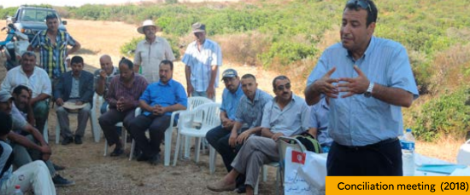
The programme was based on a participatory approach: throughout the planning process, local representatives were involved in working groups that were designed to facilitate dialogue. In addition to fostering increased involvement and ownership of the plans, this method also raised the awareness of residents and economic actors on local and regional climate change issues. The method effectively demonstrates the benefits of using a participatory approach, and the resulting methodology (types of stakeholders involved, hosting meetings) can be used for other territories.
Increased recognition of regional and local cooperation
This programme highlights the importance and the effectiveness of a multi-level approach. In fact, governments are increasingly recognising the advantages of regional cooperation to fight climate change, and this point was emphasized at the end of the programme.
| Words of a participant: “Preparing an integrated development plan, with local participation, that takes into account climate change adaptation, is a relevant, useful and essential initiative. The lessons learnt from this experience should be examined so that they may be reused in other locations and territories throughout the country”. Sarra Touzi, Senior Programme Manager, GWP-Med |
What are the conditions for success?
A social approach is a key factor
This programme voluntarily adopted a social approach, by involving a sociologist to form working groups and facilitate dialogue during meetings. Social acceptance and increased awareness have played a key role in the project’s success.
During the initial assessment phase, residents expressed certain reservations: weather-related hazards have existed for a long time and the population did not necessarily understand the need for climate change adaptation. This raised the issue of local stakeholders’ understanding and ownership of the programme.
The involvement and continued interest of various local and national actors during the participatory workshops demonstrated an increasing awareness among the various stakeholders in the Douimis river basin. Once this awareness-raising process was complete, the stakeholders’ attachment to their territory became one of the project’s strengths. In addition, the fact that the project is managed by people who are closely linked with the territory and the approach, rather than by international development agencies, is also a success factor.
Critical areas: a significant need to build institutional capacities
Climate change adaptation planning in Tunisia generally comes under the national government’s mandate, so it is centralised. This unusual approach therefore requires a lot of interactions between local partners and the national administration.
This unusual approach therefore requires a lot of interactions between local partners and the national administration. Since local actors are not familiar with national policies, this may result in an incomplete framework on which to build local policies.
This observation highlights the need to develop the underlying capacities required for this type of programme, even though this capacity-building does not fall within the bounds of this programme, nor within its financial resources. At the local and regional level, this planning process requires institutional and technical knowledge, as well as the ability to host meetings and facilitate concertation and dialogue. Overall, it is quite a cumbersome undertaking, which requires facilitators, moderators, trained coordinators and educators. This long, meticulous process does however pay off, as has been shown by the development of new territorial planning methodology that takes into account climate change.
Financial obstacles were overcome but forethought is required
Since the programme is a joint undertaking between GWP-Med, national Ministries and local authorities, it did not receive funding from one single source, but instead benefited from support in the form of mandays from various entities. The coordinators estimate that a total budget of about €300,000 - €350,000 would be necessary to replicate this programme.
One of the lessons learnt is the importance of identifying – as soon as the project commences – sources of funds that can finance subsequent phases of the project’s implementation; this was the reason for registering it in the five-year plan. If it had not been officially registered in this way, this could have jeopardised the implementation of activities, in the Tunisian context.
One of the hopes for this programme was to mobilise the Green Climate Fund (GCF). However, actions are prioritised nationally, and preparation seemed to be lacking in this regard. The fund was therefore difficult to access for this local project, due to complicated application procedures and the specific knowledge required.
Secondary topics to be included in future projects
As this project was the first of its kind and due to budgetary constraints, the plan does not specifically address gender issues and jobs for young people, which are however prominent concerns in this area.
One of the ways to improve future projects would be to take these topics into account during the participatory process.
Références
Study carried out by Blandine Arvis,Ramboll
ADEME Document : Capitalisation on climate change adaptation practices in the mediterranean area. Project portfolio
En savoir plus
-
Watch the video presentation on this approach
Contacts
-
Sarra Touzi, Senior Programme Manager, Global Water Partnership - Mediterranean (GWP-Med) Coordinator of the territorial planning approach
-
Bizerte Regional Commission for Agricultural Development (CRDA) - CRDA focal point for the development of territorial plans