LIFE AgroClimaWater (Greece and Italy)
août 2021
Agence pour l’Environnement et la Maîtrise de l’Energie (ADEME)
In the ancient lands of Crete, where olive trees have withstood millennia of drought and the sea breeze carries the scent of thyme, a new enemy looms: climate chaos. Prolonged heatwaves scorch the earth, while sudden downpours erode the soil, threatening the livelihoods of farmers who have tilled these lands for generations. Amid this turmoil, the LIFE AgroClimaWater project, led by HYETOS S.A. and a consortium of local partners, emerged as a lifeline. Its mission? To slash water use by 30% while boosting production through sustainable, low-cost practices: mulching, drip irrigation, pruning, and fertigation. Here, innovation is not born in labs but in the fields, where farmers like George Motakis relearn how to cultivate in harmony with an increasingly unpredictable climate.
À télécharger : capitalisation-cc-adaptation-practices-mediterranean-011449b-projectfolio-en.pdf (3,2 Mio)
How does this action contribute to the territory’s adaptation to climate change?
A territory affected by extreme events and desertification
Main impacts observed on natural environments in this kind of territory are extreme events like heat waves and floods but at the same time desertification due to low annual rainfalls, that lead to ecosystem degradation (i.e. soil erosion).
Agricultural productions under pressure
These impacts affect the economic activities by reducing and sometimes destroying all the agricultural production. Ecosystem degradation may result into problems like plant diseases that directly affect the production.
How to increase production and quality at a reduced cost?
This project is a natural resource management initiative for the well-being and increase of the local production, considering local climate change effects. Climate change impacts on production were the main reason to launch the project but also the local needs in order to identify the best ways to adapt to climate change and at the same time increase the production by reducing production costs. Therefore, the adaptation of tree plantations to the upcoming climate change effects (water scarcity, floods) and the adaptation of the agricultural practices (low-cost techniques) were the main goal of the initiative.
The added-value of adapting orchards in Crete
The project has contributed to the implementation of agricultural practices improving the state of natural resources, to socio-economic development incentivizing farmers to stay and continue to produce locally. Water governance actions were also explored. The Adaptive Capacity of the agricultural sector was also developed through public consultation and training of the involved parties on the requirements of the Agricultural Water Management System and the proposed water management adaptation (to climate change) strategy.
Project spotlight
Goal
The LIFE AgroClimaWater project’s main objective is to promote water efficiency and support the shift towards climate resilient agriculture in Mediterranean countries through the development of water management adaptation strategies in three Farmers’ Organizations (FORs) in two areas in Crete, Greece (Platanias and Mirabello) and one in Basilicata, Italy (Metapontino).
Background
Like large areas of southern Europe characterized by low annual rainfall, Platanias in Crete (Greece) is particularly affected by climate change. In addition, these areas (e.g. Crete region) are also characterized by conflicts of use around water, notably between agriculture and tourism. Maintaining a high level of production in orchards, while significantly reducing water use, would free up enough water for climate-resilient agriculture. On the other hand, a lack of adaptation of orchards would reinforce the trend of abandonment with negative consequences for local communities and ecosystems.
The project was mainly focused on the application of good agricultural practices to adapt to climate change, enhance water efficiency, and rationalize agrochemicals utilization in 10 pilot farms per project area (8 olive farms and 2 citrus farms in the Platanias area) for 3 cultivation periods (years) under the supervision of the Farmers’ Organizations’ agronomists.
Technical description
The project identified good agricultural practices that were applied into the demonstration plots of each pilot site and monitored. The groups of interventions include:
-
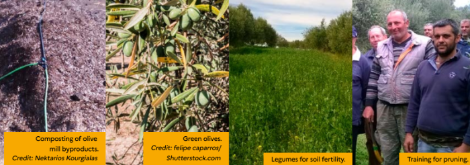
Reduction of water evaporation losses from soil surface: Soil mulching, No weed control, Weed mowing
-
Reduction of transpiration water losses through winter pruning and summer pruning
-
Reduction deep percolation water and nutrient losses: Increasing organic matter, Fertigation
-
Reduction of surface runoff (especially in sloppy areas): introducing traps and bio-rolls from pruning residues
-
Measures in order to maximize the efficiency of irrigation, based on the calculation of evapotranspiration losses in each farm
-
Rationalization of fertilizers and agrochemicals utilized, according to a fertilizing schedule (based on soil and leaf nutrients analysis on each farm)
Territory concerned:
Two areas in Crete, Greece (Platanias and Mirabello) and one in Basilicata, Italy (Metapontino) – Arid and Semiarid environments Initiative holders: HYETOS S.A. STUDIES, RESEARCH & CONSULTING SERVICES (Coordinator) - www.yetos.gr
Partners:
-
University of Basilicata
-
Hellenic Agricultural Organization «DEMETER»
-
RodaxAgro Ltd
-
Agricultural Cooperative Partnership Mirabello Union S.A
-
Assofruit Italia
-
Platanias Municipality Development Enterprise
Calendar:
Project duration: 60 months (1 September 2015 – 31 August 2020)
Financial resources:
-
Total budget of the LIFE AgroClimaWater project: €2,423,223
-
Co-financed by the European program: €1,395,749 (57.8%), and the project partnership: €1,027,474 (42.2%)
What are the tangible results?
Natural resource management for the resilience of local farms in Crete
The initial objective of the project, to reduce by 30% the water usage and at the same time to increase the production, was reached with different means. More than 20 farmers were identified as active on the field, while hundreds participated in the trainings and workshops provided by the project.
All the actions were relevant to the expectations of the beneficiaries and the needs of the territory, especially on how to improve the quality of life of the locals by increasing the production but at the same time reducing the costs of the production, considering climate change impacts (water scarcity, floods, heat waves) and indirect climate change effects like plant diseases.
Social, economic, and environmental co-benefits
The project has contributed to avoid further soil erosion at pilot actions’ scale, by testing and applying relevant low-cost techniques (e.g. soil mulching, cover crops, winter and summer pruning, application of organic matter, application of irrigation according to the crop water needs, fertigation, etc.).
Using less pesticides also resulted in a positive contribution to environmental and health issues.
Better conditions were created for local farmers to continue producing locally and avoid abandoning their fields. Indeed, due to the financial crisis in Greece and the low price of the olive oil and citrus crops, many farmers tend to abandon their fields.
Further implications
There was room for adaptation as some activities were slightly changed based on the local needs and reality (for example, application of fertigation and no-tillage practices were already adopted by some farmers; summer pruning and application of kaolin in olive farms were not applied due to an unusually rainy summer, therefore the benefits under these circumstances would have been insufficient to justify the cost of application).
Also, 3 pilot farms had to be replaced – one was bought by an owner who did not intend to continue the farming activity, the two others were owned by a non-cooperative farmer, who never accepted the new irrigation system and the monitoring equipment in the demonstration part of his field.
Only in one farm, a significant yield reduction occurred due to olive fruit fly infestation, before harvesting as there was a misunderstanding between the farmer and the contractor as to the responsibility to apply plant protection sprays in the demonstration part of the field.
A major aspect that is still under discussion among the project partners and local stakeholders, concerns plant protection activities (against insect and fungal infestations), that were not included in the project but would be necessary.
What are the conditions for success?
Key success factors
The project’s activities were positively perceived by the relevant stakeholders of the region.
Another success factor is to benefit from both local practices and knowledge and bilateral support from the political and technical actors of the region.
Communication and awareness-raising are significant in order to further engage local stakeholders and decision-makers.
The project partner was constantly working on including more and more stakeholders (farmers) actively on the field activities, especially this year as there were issues with the amounts of production.
There is strong added value arising from knowledge transfer and training of local farmers to alternative techniques and practices. Practical exchanges (through field visits) help participants to get familiar with low-cost techniques that could be used to increase their production and the quality of their products.
Visible results also confer legitimacy to proposed solutions, related to the management of natural resources and more specifically of water and water run-off. Significant differences have been observed between the fields with applied low-cost techniques, compared to the ones without.
However, there are still some difficulties to overcome, especially on subjects related to stakeholder engagement and the communication with the farmers.
Arguments to mobilize on adaptation
Climate change increases existing conflicts (namely, conflicts of use around water, notably between agriculture and tourism) and calls for solutions. It has been proven that low-cost solutions exist to increase production and quality of products in arid and semi-arid areas.
Maintaining a high level of production in orchards, while significantly reducing water use, would free up enough water for climate-resilient agriculture. Moreover, a lack of adaptation of orchards would reinforce the trend of abandonment with negative consequences for local communities and ecosystems.
Useful lessons for similar initiatives
Activities were well planned from the beginning and local producers involved from the design phase of the project. The inclusion of plant protection could be an extra activity to be provided.
Main advice given to an organization that wants to carry out a similar initiative could be:
-
Seek maximum local engagement
-
Select appropriate sites for the field activities (and be ready to adapt them in case of unforeseen situations)
-
Set up continued monitoring of activities and results, have a transparent and constant communication with farmers who are part of the experimentation concerning what is expected from them, and how the project team will intervene during the project’s calendar (to avoid any misunderstandings as it has been the case, affecting project results)
-
Enough time to evaluate results and capture natural conditions, to better reflect « climate change conditions »
-
Include as many different variables as possible, like different cultivations, to provide wider feedback of climate change results on different aspects.
| Words of a participant « Natural Resource Management is essential for the well-being and the fight against climate change. » — George Motakis, local farmer, agronomist of the agriculture cooperative |
Références
Investigation by Thanos Smanis, independent consultant
ADEME Document : Capitalisation on climate change adaptation practices in the mediterranean area. Project portfolio
En savoir plus
Contacts
From the Institute of Olive, Subtropical Plants and Vine of Chania, Hellenic Agricultural Organization « Dimitra »: Dr. N. Kourgialas, Dr. G. Psarras, Dr. G. Koumbouris Reference point: kourgialas[@]nagref-cha.gr