Information systems to support water planning in Morocco (Sebou river basin)
août 2021
Agence pour l’Environnement et la Maîtrise de l’Energie (ADEME)
Morocco’s Sebou river basin—home to 6.2 million people and a key agricultural hub—faces severe climate pressures: droughts, aridification, desertification, and diminishing water resources. The National Water Information System (NWIS) initiative, launched in 2013, aims to standardize and share water data across institutions to support Integrated Water Resources Management (IWRM) and climate adaptation.
By embedding climate scenarios into the Sebou Basin Master Plan (PDAIRE), the project enables evidence-based decision-making for water allocation, flood defense, and aquifer protection. Its multi-stakeholder governance—involving river basin authorities, ministries, and civil society—demonstrates how data-driven planning can bridge gaps between policy and local action, despite challenges like funding constraints and institutional fragmentation.
À télécharger : capitalisation-cc-adaptation-practices-mediterranean-011449b-projectfolio-en.pdf (3,2 Mio)
How does this initiative contribute to the territory’s adaptation to climate change?
The visible effects of climate change in Morocco and the Sebou river basin
Morocco is faced with negative impacts of climate change, including:
-
drought,
-
land aridification,
-
the advancing desert,
-
diminishing water resources. In the Sebou river basin, the Gharb plains are regularly affected by flooding. In addition, periods of drought are also causing water stress.
The need for data to plan water management for each river basin
Scenarios that project future water supply and demand, and take into account climate change-related parameters (rainfall, temperatures), are necessary to define how to manage and adapt water quantities to multiple constraints. Based on these scenarios, adaptation measures can then be defined.
The Mediterranean Water Knowledge Platform project aimed to contribute to the development of sustainable policies for Integrated Water Resources Management (IWRM) and climate change adaptation by producing a Mediterranean White Paper on water in addition to National Water Information Systems (NWIS). Although water databases do exist, they are very disparate and are scattered throughout various institutions. The NWIS should enable all this information to be standardised and shared by various institutions in participating Mediterranean countries. Today, the White Paper and the platform are not yet available.
National ambitions still need to be implemented locally
Morocco’s National Water Plan (PNE) comprises regulatory and institutional measures to combat vulnerability to natural hazards caused by climate change (flood protection, drought prevention), as well as water-saving and conservation measures for agriculture (monitoring the use of resources, targeted irrigation, a tariff system to encourage the rational use of water, generalising aquifer contracts for groundwater reserves that are showing stress or are overexploited, etc.). These objectives now need to be implemented in each territory.
Water planning under review for the Sebou basin
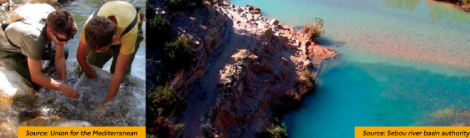
Although certain components of the Water Information System (WIS) to evaluate and monitor water resources are already available for the Sebou basin (e.g. water availability, pollution), other information on usage and pressure on water resources (including climate change impacts) is still to be included. The Integrated Water Resource Basin Master Plan (PDAIRE) for the Sebou basin, which is currently being revised, is however intended to include the impacts of climate change on water resources and usage.
Project spotlight
Goal:
To set up an operational Water Information System (WIS) to support water management planning in the Sebou river basin, which takes into account the impact of climate change on water resources and defines appropriate climate change adaptation measures.
Background
Covering around 40,000 km2, the Sebou basin is one of the largest river basins in Morocco. It currently has a total population of around 6.2 million people (2004 census), which represents about 20% of the country’s overall population. 49% of these residents live in urban areas and 51% in rural areas. Its agricultural and industrial economy makes a substantial contribution to the nation’s economy.
This basin is facing major water quality issues. Groundwater quality is considered alarming in intensively farmed regions (Gharb, Sais, Maamora) due to increasing concentrations of nitrates, and surface water quality has deteriorated, especially downstream from major urban areas. In terms of quantity, the basin’s water inflows are unevenly spread over the length of the river, and occur at irregular intervals. The upper Sebou above the Allal El Fassi dam is the exception, with a continuous flow due to intakes from water sources. The other tributaries of the Sebou river, especially the Ouergha and the Inaouène, vary according to rainfall, with very high water levels during the rainy season. The basin’s groundwater resources supply drinking water and serve industrial water needs for the majority of urban and rural areas.
They also provide water for irrigated areas (small and medium hydraulics systems). These productive aquifers are vulnerable to drought, overuse and pollution.
Technical description
Morocco is one of the four pilot countries for the Mediterranean Water Knowledge Platform. The Moroccan water department has made a commitment to this Mediterranean experience-sharing approach in order to develop its own system. This long-term project was launched in 2014 (by comparison, the French WIS required 15 years to complete and is still being modified today). 2016 is an important milestone: the WIS was recognised in the Water Law and a decentralised approach to water management was adopted (by river basin), based on basin information systems, and in close contact with local stakeholders and resources.
The European institutional twinning between Morocco, France and Spain (2015-2017) on Integrated Water Resources Management and Governance in Morocco enabled progress to be made regarding the use of data to manage water resources and the definition of the future basin WIS.
Territory concerned: 4 pilot countries (Morocco, Tunisia,Lebanon, Jordan)
Initiative holders: International Office for Water, Mediterranean Water Institute
Partners:
-
Moroccan Ministry of Energy, Mines, Water and Environment, Euro-Mediterranean Information System on know-how in the water sector (EMWIS),
-
League of Arab States - Centre of Water Studies and Arab Water Security (COFWS), Plan Bleu - Mediterranean
-
Network of Basin Organisations (MENBO),
-
the Euro-Mediterranean Water Institute (IEA), AGBAR Foundation.
Calendar: 2013 - 2017
Financial resources: Total Budget: €9.525 million
What are the tangible results?
Recognition of the need for transparent information
Several milestones have been passed, including:
-
The inclusion of the central, structural role played by effective, coordinated management of water information in Water Law 36/15, which was adopted in 2016
-
The gradual development of water information systems within River Basin Authorities (RBA), in coordination with basin stakeholders (public and private actors, elected representatives and civil society organisations working on water issues)
-
A national thinktank has been created to support the development of the Water Information System
Climate change adaptation using PDAIREs
In the Sebou basin, the 2015 PDAIRE is currently being updated, especially the section on the impact of climate change on water resources and the demand for water. This has enabled climate change adaptation actions to be defined, for example: saving and reusing water, using reforestation to counter plans for dams, water infrastructure, flood defences, aquifer contracts, etc. These measures, as well as their quantifiable targets, will soon be approved with stakeholders.
The implementation of aquifer contracts has already commenced, for example in the Saiss region, to reduce pressure on the aquifer. « Participatory aquifer management contracts », in keeping with Water Law 36/15, are being implemented for aquifers that are running low and/or where groundwater resources are being overexploited. This new groundwater governance method relies on the participation and commitment of local and regional partners to manage these resources using a concerted, participatory approach. This type of contract regulates the extraction of groundwater and restricts the drilling of new boreholes.
In addition, the natural environment’s water requirements are taken into account in the PDAIRE update (this specific need is accounted for below every dam), since aquatic ecosystems are particularly vulnerable to climate change. To meet these needs, a minimum water flow is provided. A statutory text relating to ecological flow (the « minimum flow for aquatic life » decree) is currently being drawn up.
Information channels need to be improved
Data exchange needs to be automated between various national institutions on the one hand (RBA, Ministries – including Industry, Tourism, Agriculture, Interior, National Office for Electricity and Drinking Water, etc.) and EMWIS on the other hand, to streamline information-sharing and improve reporting processes.
However, the fact that the PDAIRE is currently being revised, which entails concertation with the Basin Committee (comprising one-third State representatives and two-thirds local authority and user representatives), has limited access to information on the document’s quantifiable targets, proposed measures and the scale of its actions.
Sustainability of the initiative
The fact that a less-endowed ministry (the Ministry of Energy, Mines, Water and Environment), with less political weight than other ministries, is supporting the implementation of Water Information Systems, could affect their sustainability, even though water is a cross-cutting issue. In addition, if the RBAs do not base their PDAIREs on these systems, this could reduce their long-term use within each basin.
Finally, the long-term sustainability of such systems depends on funding for their implementation, operation and future evolution, to enable them to provide the information required and to develop over time.
What are the conditions for success?
Key success factors
The following factors facilitated the implementation of information systems, both nationally and by river basin:
-
An appropriate legal environment (WIS are recognised in national water legislation)
-
The legitimacy of RBAs to consult with users and State institutions
-
The establishment of Basin Committees, which enable the coordinated development of a PDAIRE
-
The acknowledged importance of integrating adaptation measures into the planning process (PDAIRE and PNE)
Critical areas
However, the following limiting factors were encountered:
-
Government restructuring, which slowed down the implementation of national WIS governance
-
Lack of funding to implement and operate basin WIS
-
Water stress, exacerbated by periods of drought, which made it difficult to maintain a minimum flow. Water availability conditions could be stipulated to cover this situation.
In particular, the central issue is how these information systems will be funded (including their operation) in countries where the ‘polluter pays’ and ‘user pays’ principles are not yet in force. The challenge will therefore be to invent a mechanism to fund them (for example based on taxing water usage and/or pollution emissions). The arguments to mobilise funding for information systems could be their low cost and their generally very positive return on investment.
In fact, in comparison with other investments in the water sector (infrastructure, sewage treatment plants, distribution networks, etc.), investments in data production and information management are much lower and can have a very positive impact on decision-making and the allocation of investments.
Useful lessons for similar initiatives
Identifying issues precisely, based on reliable, confirmed information (using robust methodology), is an essential first step to defining operational measures and allocating funds to them.
It is particularly vital to take into account the current and future effects of climate change on water resources, so as to prevent the deterioration of water resources and aquatic environments, as well as potential conflicts over water usage.
Over the long term, effective information systems can also enable the introduction of charges and taxes on water usage and pollution emissions, like those recommended in the IWRM implementation principles.
Références
Study carried out by Zhor Lebbar, AGROCONCEPT
ADEME Document : Capitalisation on climate change adaptation practices in the mediterranean area. Project portfolio
En savoir plus
-
Mediterranean Water Knowledge Platform website: mwkp.semide.net/index.php/fr/
Contact
-
Eric Mino, Manager and coordinator of EMWIS (Euro-Mediterranean Information System on know-how in the water sector)