Adapting the City of Ramallah to Climate Change
août 2021
Agence pour l’Environnement et la Maîtrise de l’Energie (ADEME)
Ramallah, the de facto political and economic capital of Palestine, faces intensifying climate threats, including extreme heatwaves, violent storms, flash floods, and prolonged droughts. These risks exacerbate urban vulnerabilities, straining water resources, critical infrastructure, and public health.
In response, the municipality launched the Resilient Ramallah 2050 Strategy, integrating climate adaptation into urban planning. This initiative prioritizes renewable energy, wastewater management, solid waste recycling, and the expansion of green spaces to enhance resilience. By engaging a wide range of stakeholders—from schoolchildren to local authorities—it fosters inclusive, community-driven solutions.
The project demonstrates how adaptive urban planning can align socio-economic development with climate action in a conflict-affected context.
À télécharger : capitalisation-cc-adaptation-practices-mediterranean-011449b-projectfolio-en.pdf (3,2 Mio)
How does this action contribute to the territory’s adaptation to climate change?
Ramallah city prone to diverse risks due to climate change
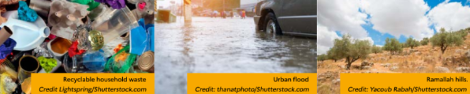
Ramallah city is increasingly hit by extreme weather conditions that include violent winds, torrential rain, heat waves, floods and droughts. Slow onset events, like changed precipitation patterns and temperature increase, are also expected to affect the city. Overall, the risks induced by climate change on Ramallah city are the following:
-
Increased urban heat. Higher number of yearly days of high temperature (daily maximum temperatures above 30°C), acute heat waves, major sand storms, high evaporation rates;
-
Desertification;
-
Decrease in the annual precipitation (10% by 2020) and change in precipitation patterns;
-
heavy snow and rain storms.
-
Flash floods;
-
Decrease in water availability due to lesser runoff and higher demands;
-
Aggravation of runoff flood risk.
Expected impacts of climate change on socio-economic activities of Ramallah
Extreme weather conditions impact human health and productivity by adversely affecting economy-dependent sectors including agriculture, tourism, and transportation. This is especially true in Ramallah, the central and economic capital of the West Bank. Extreme conditions may also damage property and critical infrastructure, reduce accountable labour hours and alter supply chain operations. Moreover, the energy demand will also increase as power generation becomes less reliable and clean water less available. The scarcity of water resources in addition to the growing food insecurity will result in a noticeable uptick in food prices.
Moreover, irregular precipitation will add to the risk of waterborne and foodborne diseases and allergies and will facilitate propagation of disease vectors affecting vulnerable population (the elderly, children and low-income communities). Not to mention that extreme weather and climate-related natural disasters can also exacerbate mental health issues.
Planning climate change adaptation to strengthen socio-economic resilience
The resilient Ramallah 2050 strategy represents an ambitious but practical program. It includes actions in which the municipality and other partners can achieve immediate benefits, as well as other longer-term actions that have the potential to be truly transformative.
The City’s Strategic Resiliency Plan, of which climate change adaptation is an essential component underlines the interdependency between climate resilience and socio-economic resilience and the importance of co-benefits of adaptation and mitigation measures undertaken.
The implementation of this program started in 2012. Its contribution to the socio-economic resilience of the city is considered clear and significant, especially through the last five years where most of the project components (energy, wastewater, widening of green areas…) showed concrete results on the ground that improved the quality of life through direct and indirect employment opportunities.
Project spotlight
Goal
Implementing the City’s Strategic Resiliency Plan, of which climate change adaptation is an essential component. The implementation of this plan aims to:
-
Protect the environment of Ramallah city through the reduction of the carbon dioxide emissions by enlarging the green areas, encouraging clean production and starting the transition to renewable energy, and invest in sustainable development.
-
Reduce the risk of groundwater pollution by wastewater effluent by connecting the entire city to the sewer network. Also reduce the risk of wastewater flooding by replacing all asbestos pipes and treating and reusing wastewater.
-
Focus and invest in solid waste recycling projects.
-
Enhance community engagement for shared responsibility in climate change adaptation and establish an emergency network with relevant stakeholders to address hazards resulting from extreme weather conditions.
Background
Ramallah is a hilly city that spreads over an area of 19 km². It functions as the main political, economic, and cultural capital of Palestine. Its population doubles daily as people flock to it to shop and work. The city’s main environmental problems can be summarized as follows:
-
Increased urban heat and decreased precipitation which results in higher temperatures and lower availability of water resources.
-
Change in precipitation patterns resulting in flash floods and desertification.
-
Growing issues related to food availability, accessibility, utilization and security. These can be traced to problems in food production, distribution channels and changes in the purchasing power and market flows.
-
Finally there are problems linked to human health, in particular via nutrition.
In 2008, the city celebrated its centennial by launching a series of festivities and projects that were a result of a strategic plan, where enhancing the city’s environmental status was among its top priorities. This particular project counts among them.
Description
The project targeted the energy, wastewater and solid waste sectors in addition to the widening of green areas.
The funding of this initiative took the form of external funding of which each component was funded by a different source/s. An empowerment of each sector has been at the basis of the plan implementation: each sector possessed its own funding source, was in charge of the project team management and of the delivery of project products, notably through a monitoring and control system; which mainly depends on the sector at hand. The progression and completion of the work was directly assessed by the municipality itself or by the beneficiary of the project.
One of the weaknesses of the initiative is that no numbers are available in a centralized way, to give a clear overview of the outcomes. This is notably due the fact that the strategy implementation is made out of many small projects based on different sources of funding and different criteria in the reporting systems.
Territory concerned: Ramallah City (Urban area)
Initiative holders: Ramallah Municipality
Partners:
-
Rockefeller Foundation,
-
Anera (American Near East Refugee Aid),
-
Palestine Investment Fund,
-
Bank of Palestine,
-
Taawon organization
Calendar:
-
Start year: 2012
-
Duration: 7 years
Human resources: The total number of beneficiaries is around 24,600 (population count of the city)
Financial resources: The total estimated budget is around EUR 1 million
What are the tangible results?
Key results arising directly and indirectly from the implementation of the City’s Strategic Resiliency Plan
Renewable Energy:
-
Started the switch to renewable energy through piloting with solar energy on the roof tops of municipal infrastructure. (Electricity outcome: 70 MW and CO2 emissions cut: 150 tons)
-
Invested in power generation from renewable energy to cover the needs of the municipality.
-
Replaced conventional streets lighting with low energy-consumption LED lights
-
Promoted the continued use of solar water heaters in households, by updating licensing procedures and through environmental awareness initiatives
-
Facilitated the installation of electric car charging stations in the city
Sewage Water Network:
-
Connected 83% of the city with sewage water network
-
Installed an advanced WWTP by MBR technology producing 300-500 M3 of reclaimed water per day with an Effluent BOD: 10mg/L, COD:26 mg/L, TSS: <2mg/L and re-using the reclaimed water.
-
Expanded storm water network by 30 km
Promoting pilot system for recycling of solid waste:
-
Replaced open community waste collection containers with curbside collection system resulting in 45% waste reduction and increase in solid waste fleet management efficiency by 65%
-
Supported the operations of a composting plant in neighboring rural community
-
Supported the establishment of small enterprise for plastic recycling.
-
Collected paper and cardboard separately in commercial establishments.
-
CO2 emissions reduction – not measured
Green areas
-
Conducted tree planting campaigns that included planting 15 thousand trees, where the city council endorsed new regulations to ensure completion.
-
Included rain harvesting systems in new buildings.
-
Increased the number of public parks, with an annual rate of 2 parks per year.
-
Operated a nursery that produces fifty thousand plants/year, and replanting all uprooted olive trees in designated locations in the city.
The strategy will allow the local community to deal more effectively with a wide range of challenges associated with rapidly growing cities, as well as building resilience to external pressures (notably climate change) that undermine Palestine’s stability and can drive internal migration, increasing overcrowding and socioeconomic inequality.
An inclusive and participative approach
Ramallah city was the first Palestinian city in 2014 to join an international Network called « 100 Resilient Cities » pioneered by The Rockefeller Foundation.
Throughout the development process of Ramallah Resilience strategy 2050, a wide range of stakeholders had participated in shaping Ramallah 2050 vision, which is considered as an institutional commitment from the public authorities. Notably, kids were consulted and included in the selection of environmental actions, through brainstorming workshops conducted in some schools.
This strategy reflects the municipality’s success in planning and developing a new nontraditional environmentally-friendly approach.
Obstacles encountered and levers mobilized
During the operational implementation of climate change adaptation, many factors were found to make it harder to plan or adapt to climate change issues. These commonly include lack of resources (like funding, technology, or knowledge), faulty institutional characteristics, or lack of connectivity and environmental quality for ecosystems.
A more detailed appraisal follows
-
Knowledge deficit: Imprecise knowledge mainly affects perceptions of risks, leading to overconfidence in the ability of actors to manage climate risks or their evolution, in turn constraining adaptation.
-
Technical constraints: dearth of up-to-date technologies, poor capacity to finance technical adaptation projects, limited skills to operate and maintain funded projects, lack of acceptability from users and affected stakeholders; and effectiveness in managing climate risks. The West Bank in general does not possess even the simplest levels of technology in many environmental and climate issues (solid waste is a major example in this area where there is no solid waste landfill in the city of Ramallah and there is no recycling industry in the city).
-
Financial constraints: Financial capital can manifest in a variety of forms including credit, insurance, and tax revenues, as well as earnings of individual households or private entities. The private sector does not always prioritize environmental funding.
-
Human Resources Constraints: Human resources provide the foundation for intelligence gathering, the uptake and use of technology, as well as leadership regarding the prioritization and measures of adaptation policies and their implementation. This area is very weak and requires extensive capacity building and enhancement both at the stakeholder level and the decision making level.
-
Social acceptance and constraints: many issues are still related to public rejection. Changing community behaviour and raising awareness of stakeholders is still a priority (e.g. reuse of the treated wastewater effluent and the separation of the solid waste at household level are two examples on this area).
-
Political constraints: the Israeli authorities set a major constraint in obtaining a permit for any adaptation option selected by the project.
| Words of a participant: « The powerful part of communicating with the school kids is that they think outside of the box. They come up with original ideas that the adults usually miss. The involvement of school kids started from the beginning of planning, through brainstorming workshops. Those kids shared ideas and contributed to the selection of themes and subjects for the environmental protection programs conducted in their schools. The project was successful in involving the young generation on vital and critical issues like climate change and on the importance of finding the most suitable adaptive solutions for a better future. Especially the social media explosion helped in increasing awareness to these issues amongst the new generation. » Rula Hayek-PYP teacher |
What conditions for success?
Key success factors
-
Design the project’s various tasks and components based on the identified needs of the city. This has been a result of prior projects’ recommendations (implemented by the municipality and other active organizations), and the expertise gained from the expressed needs of the inhabitants.
-
Engage and actively communicate with all stakeholders, local authorities, funding agencies, and NGOs throughout the project lifetime, starting from the planning and ending with sustainability measures. Engaging the beneficiaries from the beginning was very useful especially in selecting the most convenient and practical solutions.
-
Securing financial resources is a major factor for success. The size of the activity is generally dependent on the available funds.
-
Legal cooperation. This was evidenced by the environmental penalty draft authorized by the ministry of local governance.
Critical Areas
With experience gained over time in implementing projects related to environmental issues and to climate change, the following points are found critical and attention-worthy at the local level:
-
The decreasing precipitation and increasing demands on water is leading to significant water scarcity and pressure on this resource. In addition, the fact that conflicting entities govern the area’s resources (Palestine and Israel) significantly increase the issue of water resources sustainable management and the sustainability of the ongoing initiatives.
-
Local expertise and technical skills in the environmental field are desperately needed. For example, there is no expertise in the field of energy recovery from waste. The composting unit in the village of Betello is a living example of this: the project was abandoned due to a lack of qualified maintenance capacity, which wasted the money and time spent on its design.
-
Private sector interest in the environmental sector must be bolstered.
-
The community is the main driver of any project on the field. Therefore, social acceptability is one of the main pillars of success. A lot of work remains to be done to raise public awareness - for example, the public still refuses to treat treated wastewater effluents.
-
Although much effort has gone into organizing and allocating funds in the area of climate change or the environment, prioritization and targeting of funds remains chaotic between donors and local authorities.
Useful lessons for similar initiatives
Raising awareness among community, employees and decision makers is a key step towards the success and sustainability of any climate change adaptation or mitigation project. To this end, the municipality has created dedicated positions and hired permanent employees in its awareness department.
With hindsight, cheaper adaptation actions could be carried out. This includes the transfer of solid waste from Ramallah governorate to Jenin governorate, which started seven years ago. For instance, the operation costs one million dollars per year, which represents up to seven million dollars in total expenditure for the transfer of solid waste to a landfill in another governorate. This money could for example cover the cost of a solid waste disposal project which could cover waste management in the target area over the same period.
Arguments for adaptation
Local climate change effects are accelerating and seemingly becoming more dangerous. If neglected, the situation will worsen severely and the impacts will soon become unmanageable. Adaptive solutions provide opportunities to mitigate the inevitable. Ramallah city is already suffering from failed monsoons with unsteady, fluctuating rainy seasons in winter, and longer, warmer temperatures in summer. If adaptive solutions are neglected, the first and worst to suffer will be the vulnerable, the poor, and the marginalized. The scarce fresh water resources will keep dwindling while needs rise. And energy and food prices will become unaffordable when compared to the low income rates per capita.
Finding additional sources of water (reclaimed wastewater), fighting pollution of the existing sources (polluting the groundwater aquifers), creating feasible and manageable sources of renewable energy, and raising awareness amongst the community is the main objective of this initiative.
Sustainability of the initiative
By offering an exchange platform and by building on available financial resources, the idea is that the government, the private sector and the active national and international agencies now work hand in hand with the community members to achieve the current and future planned adaptive solutions in the city.
The implementation of this strategy will help open a new phase of greater investments to deal with natural, climate or human-made shocks and stresses, and to secure wellbeing and safety of the people in all circumstances regarding to climate change adaptation.
Références
ADEME Document : Capitalisation on climate change adaptation practices in the mediterranean area. Project portfolio
En savoir plus
Contacts
-
Malveena Al Jamal, Director of Health and Environment Department, The project manager.
-
Ramallah Municipality Email: m.aljamal[@]ramallah.ps - Tel: 00970 2 294 5555 - Fax: 00970 2 296 3214 - Website: www.ramallah.ps Email: info@ramallah.ps - Social Media: www.facebook.com/R.Municipality