Agroecology to build agricultural resilience (Morocco)
août 2021
Agence pour l’Environnement et la Maîtrise de l’Energie (ADEME)
In Morocco’s Pre-Rif region, extreme weather events—droughts, heatwaves, and torrential rains—threaten food sovereignty and biodiversity, while rural exodus drains local communities of their youth.
The Kissane educational farm and Ariaf Kissane cooperative have pioneered agroecology as a holistic solution, combining traditional knowledge with modern techniques to restore soil fertility, preserve native seeds (like small spelt and Origanum compactum), and create economic alternatives (beekeeping, agro-tourism).
Since 2002, this bottom-up initiative has not only boosted resilience against climate shocks but also reversed migration trends by offering viable livelihoods in agriculture. Its success demonstrates how sustainable farming can revitalize rural economies while protecting ecosystems.
À télécharger : capitalisation-cc-adaptation-practices-mediterranean-011449b-projectfolio-en.pdf (3,2 Mio)
How does this initiative contribute to the territory’s adaptation to climate change?
Extreme weather events are threatening food sovereignty and food security
The Pre-Rif is a very fragile mountainous area, which is suffering from the increasingly marked effects of climate change. Heavy, short-lived downpours are more and more frequent, interspersed with long periods of excessive heat and severe drought.
Plant life cycles are disrupted by delays in seed planting, and plantations are suffering from water stress, which threatens food security and food sovereignty. It is also important to highlight the deterioration in local biodiversity, as well as high soil erosion, both of which are caused by human and climate-related factors.
Economic, social and environmental factors are also taking their toll on the territory
Many young people are leaving rural areas: they are turning away from local agriculture and settling in neighbouring cities (Meknès, etc.) or using their agricultural skills on farms elsewhere, since this gives them the opportunity to find paid work. Others are leaving the agriculture sector to work in caftan-tailoring (men and women).
Moreover, agricultural, culinary and craft skills are gradually being lost, while traditional seeds are being replaced by hybrid seeds, which are less resistant to local climate conditions. In addition, the use of chemical fertilisers has greatly increased. These factors, combined with the consequences of climate change, are taking their toll on this territory.
Agroecology, a form of local resilience
The project focused on sustainable agriculture, without using any chemical products, as the key to resilience in this region, from an ecological (enriching soil, resistance to climate change), social and economic (necessary workforce) point of view. The project also aimed to implement a strategy to involve the region’s young people, by capturing their interest and reinstating farmers and agricultural workers in their legitimate roles. In this region where agriculture has been predominant for generations, the farmer’s role and knowledge are essential pillars in the local system, although the use of chemical products has cast doubt on these skills. A return to traditional agricultural techniques is therefore necessary, using improved agroecology techniques.
Project spotlight
Goal
To develop the territory using sustainable, resilient agriculture.
Background
The rural municipality of Kissane is situated in the Moroccan Pre-Rif region. It forms part of the Rhafsai circle in Taounate province.
The region is mostly devoted to farming and olive growing. The municipality is isolated in the mountains, and its local economy is suffering from the increasingly marked effects of climate change. In addition, the region has been affected by severe environmental degradation and many young people have deserted the area in search of opportunities.
This project has several ambitions, including: preserving land, highlighting the value of agricultural products that are disappearing, and encouraging the development of income generating activities for farmers in the Pre-Rif region. The priority was to train farmers in agroecology, in order to enable them to use these alternative techniques rather than current cultivation methods.
Technical description
This initiative is an integrated development project, comprising three complementary sub-projects:
-
An individual beekeeping project;
-
A family project for an agroecology educational farm that aims to achieve food and energy self-sufficiency;
-
A community project for an agricultural cooperative focusing on the production of premium quality olive oil, equipped with a two-phase olive-pressing machine, which enables olive oil to be extracted using an environment-friendly process. At the same time, the project is implementing strategies to:
-
Build up the population’s capacities (raising awareness, training);
-
Promote agro-tourism to develop the territory and make it more attractive;
-
Retain young people;
-
Create cooperatives;
-
Safeguard traditional crops (small spelt and Origanum compactum).
Territory concerned : Kissane rural municipality, Taounate province, Moroccan Pre-Rif
Initiative holders :
-
Kissane educational farmAriaf Kissane
-
Agricultural Cooperative
Partners :
-
North Morocco Development Agency
-
National Human Development
-
Initiative (INDH)
-
Local farmers
-
Slow Food
Calendar :
-
2002: launch of beekeeping project
-
2006: agroecology education farm - creation of the cooperative
-
2013: FAO authorisation for organic certification
-
2017: acquisition of a small spelt dehusking machine
Human resources:
-
22 cooperative members
-
8 permanent employees at the farm, as well as seasonal staff
Financial resources : 920,000 Dirhams (INDH, Ministry of Agriculture, North Morocco Development Agency, private loans) and own funds
What are the tangible results?
Measures to foster local biodiversity
The agroecology training provided to women’s groups, farmers, beekeepers and plant breeders, both at the farm and at the cooperative, has enabled several types of projects to be implemented, including:
-
Planting a wide variety of trees (15 different varieties of fig trees, citrus fruit orchards, carob trees), herbs and medicinal plants at the farm, which are well-adapted to climate change. Seed swapping has enabled varieties from all over the world to be cultivated;
-
Propagating Origanum compactum, an endemic wild plant that was disappearing from the region, at the farm.
-
Planting hedgerows for bees and small animals in the vegetable patches;
-
Preserving and highlighting the value of local agricultural seeds, especially small spelt, which is now cultivated by several female seed sowers. This cereal variety is cultivated at the farm, and marketed at the cooperative.
Promoting a sector that contributes to local vitality
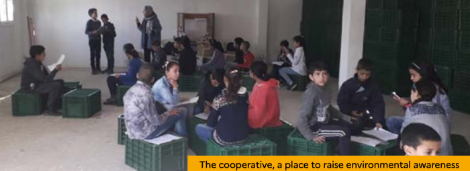
Building the capacity of the local population has reduced the rural exodus and encouraged young people to work locally and innovate in environment-friendly activities. 4 men and 4 women are employed full time at the educational farm, together with seasonal staff.
The Ariaf Kissane cooperative, which brings together 22 people, has helped to increase the employability of young people, since the cooperative’s office is managed by young people who have received accounting training, to ensure the organisation’s financial sustainability.
The cooperative also enables products to be marketed, and has improved their quality. Cooperative members are proud to be part of the cooperative, and their income has increased by 30-40% on average since they joined. Olive pressing now requires less water. In addition, the resulting vegetable water is not toxic and is used on the farm as bio-fertiliser (following a controlled dilution process). The olive pulp is used for heating or resold if there is a surplus. This method thereby enhances crop fertilisation and reduces waste.
Prospects: tourism as an asset for agriculture
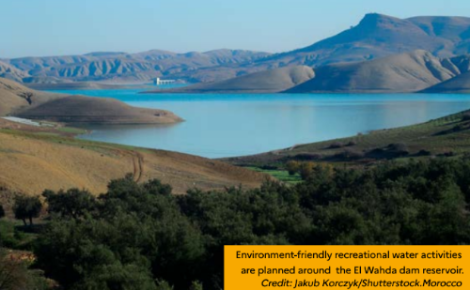
Local stakeholders agree with the development of agro-tourism in the region, to foster rural development, but for the moment they are facing constraints on accommodation capacity and bathrooms. Tourism could provide additional income for young people and encourage them to settle in the region.
The need to set objectives for results
Scientific expertise would have been beneficial to support the initiatives carried out, to prove that agroecology is useful and has a positive effect on crop yields, and to democratise these practices.
| Words of a participant : « I am 34 years old, I come from a family of farmers, and I have been working on the farm for two years as a ‘compost master. I have learned several agroecology techniques, which I pass on to others, including my father. » Driss, a full-time employee at the educational farm |
Sustainability of the initiative
Agroecology, and the interest expressed by the local population in this type of agriculture, has prompted the Ministry of Agriculture to stop offering training on chemicals (pesticides) for farmers in the Khartali area. Plans to develop agro-tourism in the region (mountain lodges) and recreational water activities on the banks of the Al-Wabda dam reservoir, now this farm, are currently under discussion.
What are the conditions for success?
Key success factors
For this type of project to be successful, the following conditions should be met:
-
Know the territory well,
-
Do not be afraid of failure, carry out experiments, be dynamic,
-
Always seek information on environmentally friendly techniques,
-
Build up capacity and pass on knowledge,
-
Work as part of a network,
-
Be meticulous, keep up to date with accounting and manage the cooperative effectively.
One of the project’s strengths is that the initiative holder comes from the region, has higher-education qualifications and has previous experience working in the agro-food industry. She therefore has better knowledge of the territory and its increasing difficulties, and a more precise vision of the region’s potential and which projects could achieve local development.
In addition, she also holds a legitimate role among members of the local community, who call upon her for advice. Finally, her experience has provided her with the right arguments for certain fund-raising initiatives, or to complete applications for authorisations.
Moreover, her involvement and work within a network of people who share the same vision and values (Terre et Humanisme, Slow Food) has enabled the following:
-
Exchange of expertise, knowledge and skills,
-
Communication about the project,
-
National and international outreach.
The territory’s isolated location is at once a strength and a weakness: although this enables several local crops to be preserved through agroecology, access to education, healthcare and opportunities to sell products are limited. Finally, there is very little support for « organic » farming from the Ministry of Agriculture. For example, there are no subsidies for this sector, as opposed to conventional agriculture.
Arguments for adaptation
Agroecology is an effective technique against soil erosion and to improve adaptation to climate hazards. As an integral part of a rural development project, it builds up the local population’s adaptation capacities, through sustainable, environmentally friendly activities.
Useful lessons for similar initiatives
The project is based on personal initiatives, as well a lot of voluntary work.
The local population has managed to create momentum in the region and is developing action plans to promote their territory both nationally and internationally.
Références
ADEME Document : Capitalisation on climate change adaptation practices in the mediterranean area. Project portfolio
En savoir plus
Contact
Souhad Azennoud, Agroecology facilitator and beekeeper Study carried out by Zhor Lebbar, AGROCONCEPT