Adaptive Management of the Lagoons and Marshes on the Camargue Saltworks Site (France)
août 2021
Agence pour l’Environnement et la Maîtrise de l’Energie (ADEME)
In the wild heart of Camargue, where the Rhône River dissolves into the Mediterranean and flamingos paint the marshes pink, a silent battle rages between land and sea. With 70% of its surface less than a meter above sea level, this delta is on the frontline of climate change, its fragile ecosystems and saltworks threatened by rising waters and storms. Since 2011, an adaptive management approach has transformed the abandoned saltworks into a natural buffer zone, letting nature reclaim its rights while fostering new human uses: ecotourism, fishing, and grazing. Here, adaptation is not built against nature—it is built with it, proving that sometimes, the best solution is to let go and let the land heal itself.
À télécharger : capitalisation-cc-adaptation-practices-mediterranean-011449b-projectfolio-en.pdf (3,2 Mio)
How does this initiative contribute to the territory’s adaptation to climate change?
The Camargue is threatened by rising water levels
Rising sea levels (estimated at +16 cm between 1902 and 2010) and coastal erosion (exacerbated by increasingly frequent storms) are already having a severe impact on the shoreline and biodiversity of lagoon ecosystems, as well as the way they function. In the medium to long term, climate change will seriously affect the biodiversity of isolated wetlands, especially less-mobile species (plants, molluscs, etc.) and endemic species, which cannot migrate to adapt to disruptions in their ecosystem.
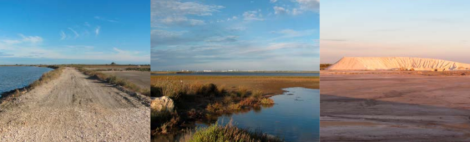
The Camargue is particularly exposed to flooding by the sea, since 70% of its surface area is less than 1 m above sea level, and the delta is sinking (subsiding) by about 2 mm every year. This situation is compounded by a projected rise in sea levels of between +10 and +25 cm by 2050.
Pressure on natural environments and activities
Rising sea levels and coastal erosion are impacting certain economic activities (the saltworks for example), with significant effects on biodiversity and major financial consequences (costly maintenance of « artificial » conditions, both specifically for salt production and more generally sea defenses to protect the area). As a result of rising sea levels in the Camargue, it has become increasingly difficult to drain the Vaccarès lagoon. In addition, the whole area’s population, infrastructure, and activities – including tourism – are threatened by natural or climate-related disasters.
Adaptive management as a nature-based solution
The restoration of Camargue wetlands on the site of the former saltworks is a strategy to slow and reduce rising sea levels and risks of flooding, and thereby increase resilience to the impacts of climate change. The challenge is to use the wetlands’ capacity to temporarily store sea water during flood events. In addition, Salicornia and other marsh ecosystems can also trap sediment.
Rediscovering the delta’s natural, gravity-based mechanism, and creating new uses on the site
In addition to the natural formation of a shifting coastal sandbar, which helps to reduce erosion and submersion risks at zero cost, the management approach has also helped to improve the overall ecological status of the lagoon habitats. This has revived fish stocks at sea and in the lagoons, increased the populations of nesting colonies of gulls, terns, and waders, while bare ground has been recolonised by Salicornia salt meadows. In addition, the approach has also encouraged the diversification of the site’s uses, including ecotourism, beach tourism, fishing, hunting, and grazing.
Project spotlight
Goal
To achieve a controlled, gradually retreating shoreline in sectors affected by erosion and to recreate a natural, gravity-based water mechanism by reconnecting the lagoons with one another, with the sea and with neighbouring sub-water catchments.
Background
The Rhone delta, also known as the Camargue delta, is located to the west of Marseille and covers 140,000 hectares. In particular, it contains rice cultivation and salt production areas. The Salin-de-Giraud saltworks (Bouches-du-Rhone) were created in 1855 and gradually increased in size in the 19th and 20th centuries. Between 1950 and 1970, the Compagnie des Salins du Midi installed major infrastructure to transform the Camargue marshes into an industrial salt production area. These installations maintained artificially high water levels in the summer, so that sea water could be pumped into evaporation ponds in spring and summer, and low levels in winter. At the same time, larger numbers of people visited the area, since the site was much more accessible.
Between 1990 and 2007, the site fell on hard times, which led to the sale of part of the saltworks. Since the Coastal Conservation Authority purchased the 6,527-hectare site between 2008 and 2012, this salt-producing area has now been transformed into a wetlands conservation zone.
Technical description
The co-management convention between the Coastal Conservation Authority, the Camargue Regional National Park (PNR), the French Nature Protection Society (SNPN), and Tour du Valat set the following management objectives, based upon which several operations were defined:
-
Re-establish a more natural hydrology mechanism
-
Replenish coastal ecosystems
-
Maintain or increase habitat for colonies of water birds
-
Implement an adaptive management approach in response to rising sea levels
-
Take into account local economic issues
Abandon coastal embankments and consolidate internal dikes. Concerning the existing water infrastructure for salt production, several steps were taken to reconnect the various water bodies during two phases of work in 2015 and 2019: canals were dredged, sluices were built or renovated, and dikes were levelled.
From a socio-economic perspective, the North and South entrances to the site were enhanced (signposts, restoration of historical buildings), conventions were signed for agro-pastoral and hunting activities, and beach management plans are defined every year (Beauduc area).
Water quality is regularly monitored, as are the area’s plants and wildlife, to evaluate the impact of the modified water mechanisms on the landscape and biodiversity.
Territory concerned:
Lagoons and marshes on the Camargue saltworks site Initiative holders: Coastal Conservation Authority (owner), co-managers: Camargue PNR (coordinator), SNPN, Tour du Valat Partners: WWF, European Union, Rhône-Méditerranée-Corse Water Authority, French Ministry of Ecology, Total Foundation, South Region, MAVA, Fondation de France
Calendar: 2011-2019
Human resources:
-
Around 4 full-time staff per year
-
Hydro-morphological, hydro-biological, and ecological monitoring
-
Project management (water infrastructure works, renovation of cultural heritage, etc.)
Financial resources:
-
Total budget for the 2013-2016 management period: €1,814,770, subsidized by the partners and the Coastal Conservation Authority
-
Water infrastructure work carried out in 2019: €600,000
What are the tangible results?
A natural water mechanism and recolonisation by wildlife
A « natural » water mechanism has been re-established: the area’s morphology has changed (overwash and reformation of a coastal sandbar), water movements are gravity-induced and variations in water levels are less controlled and more natural. The gradual disintegration of coastal embankments has resulted in sand being redeposited along the shoreline, modifying the topography of beaches. The de-compartmentalisation of lagoons enables water to flow more freely, lower salinity has helped fish reproduction sites to recover, the return to a natural water cycle (floods in winter, drought in summer) has left space for Salicornia, marsh plants and aquatic vegetation to recolonise the area, and the endangered European eel has reappeared. Many species of birds have also returned to the site, also due to lower salinity levels.
A less costly strategy than building dikes
Abandoning nine kilometres of coastal embankments has resulted in savings of 13-17 million euros in reconstruction investments, 7-24 million euros in dike construction costs, and at least 800,000 euros per year in maintenance.
Investments are being focused on maintaining the inland embankment, which is 16 km long. The total estimated value of coastal wetlands can be as high as 160,000 euros per hectare per year, taking into account carbon storage, coastal protection, healthy fish stocks and improved water quality. Moreover, the economic advantages of ecological restoration also include the many ecosystem services that restored wetlands can provide, including possibilities for tourism and leisure activities.
Efforts must continue
A number of future actions are planned or being considered, based on the results of 10 years of adaptive management, including:
-
Creating cycle paths (in conjunction with local authorities) and testing a shuttle service to improve access to the site.
-
Continuing water system restoration works, including upstream.
-
Defining forward-looking models/scenarios on the effects of rising sea levels.
-
Maintaining dialogue with local actors and residents of the neighbouring village, Salin-de-Giraud.
-
Evaluating the hydrological functions of restored ecosystems and their ability to act as a climate buffer zone.
Difficulties to be overcome
Following the removal of polder enclosures, low quality fresh water has entered the site due to upstream agricultural activities, and solutions must be found to improve water quality. New, unintended species of wildlife have colonised the former saltworks, including large birds of prey such as the European eagle-owl (Bubo Bubo), which is threatening the reproduction of the Flamingo colony. When a site is renatured, it is not possible to control everything, and sometimes there must be compromises on biodiversity.
Finally, it was not easy for site users to accept the abandonment of the coastal embankment. Communication and cooperation with Camargue residents must be improved to help them accept the long-term changes on the site.
Encouraging alternative approaches to risk management in coastal areas
Adaptive management, as presented here, only applies to the former saltworks, which is owned by the Coastal Conservation Authority. It should however enable the following questions to be asked: under which conditions is this type of management a good idea, or even necessary? Which compromises are required to implement it? The objective being to promote a more coherent, systematic shoreline management approach throughout the country or even internationally. The LIFE adapto project, which commenced in 2017 for a period of 4 years on 10 experimental sites throughout France and its Overseas Territories, will contribute to this reflection process. This project aims to demonstrate that integrating ecosystems and natural habitats into flexible shoreline management can provide a climate change adaptation solution in coastal areas.
What are the conditions for success?
Key success factors
One important factor for success was the unprecedented partnership between the three co-managers (PNR, SNPN, Tour de Valat), each of which provided skills and a distinct vision of the issues affecting the Camargue coastline.
Another key factor was the social acceptance of this approach for which very little experience exists (worldwide), and which requires the local population and tourists to accept uncontrolled natural development. Although the conflicts and feelings generated by the approach may be difficult to manage, it is essential to take them into account. This may be achieved, for example, through usage agreements, the involvement of stakeholders in defining measures (concertation), regular communication on the approach and its results, etc.
Finally, financial support from private sponsors helped accomplish certain activities within the approach.
Critical areas
There are several critical areas for future phases of the project. These include increasing the capacity of co-managers to monitor, quantify and plan future scenarios for a rapidly-evolving site. In addition, a better understanding of (complex) shoreline and sediment mechanisms, and their effects on the site’s plants and wildlife, must be gained.
Special attention must be paid to the social acceptability of these transformations and to changing perceptions: this involves explaining to the local population and users that the current changes are not catastrophic and that although natural processes may be unpredictable or disturbing, they make the site rich and original.
Final tasks include evaluating the ability of restored ecosystems to function as a hydrological and climate buffer and retrospectively demonstrating the value of this management experience.
Arguments for adaptation
In view of rising sea levels and coastal mechanisms (especially where there is erosion), many coastal areas will be exposed to higher risks of saltwater intrusion. Coastline maintenance strategies are costly, and may not be effective against extreme weather events.
The idea is to think about what is workable locally, and here nature-based solutions can provide an interesting alternative to « inflexible » management - in the end it is better for coastal areas to anticipate a retreating shoreline rather than it being forced upon them.
Références
Study carried out by Lucie Royer, Ramboll
ADEME Document : Capitalisation on climate change adaptation practices in the mediterranean area. Project portfolio
En savoir plus
Contacts :
-
Marion Péguin, Coastal Conservation Authority
-
Gaël Hemery, Camargue Regional National Park
-
Marc Thibault, Tour du Valat Anaïs Cheiron, French Nature Protection Society