Water management in Menjez municipality (Lebanon)
August 2021
Agence pour l’Environnement et la Maîtrise de l’Energie (ADEME)
In Menjez, a rural village in northern Lebanon, climate change exacerbates water scarcity, with projections of 4–11% rainfall decline by 2100 and rising temperatures threatening agriculture and drinking water supplies. Since 2012, the municipality has pioneered an incremental, community-driven approach to shift from groundwater dependence to surface water use, addressing both water access and energy efficiency.
Through six interconnected projects—including a 60,000 m³ rainwater collection lake, irrigation networks, and reverse osmosis systems—Menjez has diversified its water resources, reduced groundwater exploitation, and created new economic opportunities (avocado farming, ecotourism). This bottom-up model highlights how local ingenuity and international funding can transform water management into a catalyst for circular development.
To download : capitalisation-cc-adaptation-practices-mediterranean-011449b-projectfolio-en.pdf (3.2 MiB)
How does this initiative contribute to the territory’s adaptation to climate change?
In Lebanon, a massive drop in water levels is on the horizon
With a 1.5°C temperature increase projected in 2050, and +3.2°C by the end of the century, rainfall in Lebanon is expected to decline by -4% and -11% respectively. It should be noted that, even today, Lebanon’s per capita water resources place it just above the water stress marker. Lower rainfall will have a serious impact both on the replenishment of groundwater and on the flow of springs, rivers and streams. This will be compounded by longer periods of drought (+9 days in 2050, +18 days in 2100).
A challenge for agriculture
These changes in climate will have an impact on water: they will not only take their toll on the population’s drinking water supplies, but will also very severely affect farming activities. Agriculture will already be feeling the impact of rising temperatures, which will bring new diseases, fungi and insects, as well as declining crop yields. However, a drop in rainfall will also have other consequences: the moisture content of soil will drop, making it less fertile, and there will be less water available for irrigation. As it stands, irrigation is the main water consumer in Lebanon (61%). In addition, 70% of irrigation channels are open to the air, making them inefficient.
Significant institutional and operational challenges
In rural areas, where agricultural activities are still the main source of income for the population, making farming operations more sustainable in terms of water and better adapted to climate change is an essential issue. However, this means addressing a significant number of challenges:
-
Transforming existing infrastructure
-
Transforming water usage practices as well as agricultural practices
-
Ensuring sufficient institutional and financial means to carry out the necessary projects
This is not an easy prospect in Lebanon, which has an outdated infrastructure and where the priority is water supply networks for large towns and cities. In addition, the public institutions responsible for drinking water and irrigation – the Regional Water Authorities – are too weak, both institutionally and financially, to tackle irrigation issues in peripheral rural areas like Menjez. The definition of institutional prerogatives, between water authorities and local authorities, also hinders municipal action on water issues in Lebanon.
Behind water and irrigation lies an energy challenge
In addition to the availability of water, irrigation based on tapping into groundwater using boreholes also faces energy issues. As the level of the water table falls, pumps need more electricity to extract water, resulting in financial costs and pollution. For this reason, it is necessary to develop a sustainable water-usage system based on surface water.
Project spotlight
Goal
To use surface water instead of groundwater to meet the village’s drinking water and irrigation needs
Background
Menjez is a rural village covering 6 km², with a population of 800 people. It is situated in the Akkar governorate in northern Lebanon, on the Syrian border. Olive groves are the main agricultural activity in the area, and more recently avocados, carob, etc.
Menjez has a wealth of natural resources including woodlands, as well as a rich archaeological heritage: 80 bronze-age megalithic burial monuments, a Roman temple and a crusaders’ fort. Menjez has two main water courses. On one side, the Nahr AlKabir river marks the border with Syria, and on the other, the Menjez river crosses the village. The source of this river has always provided water for the village and to irrigate agricultural areas. However, the river and its source have been polluted for years by the formation of a muddy pond of unhealthy water above the source. This affected both the population’s access to water and the village’s agricultural activities. Many households and farmers therefore used illegal, unofficial boreholes to pump water directly from groundwater reserves to meet their needs.
Menjez municipality was created in 2012. In a short period of time, the municipality has managed to develop an impressive number of projects covering energy, forestry, tourism, fire protection and agricultural issues. It has however paid particular attention to water issues, with the development of six projects in 8 years.
Technical description
Although they were not initially designed as one global project, these six, incremental projects now resemble a structured whole that the municipality calls its Action Plan:
-
In 2013, the first project aimed to remove the muddy pond, install decantation tanks and a water purification system, and provide drinking water for the whole village with a new 20 km water network.
-
Later, due to problems with the purification system, the municipality decided to supply households with non-drinkable water, but only for domestic use. As for drinking water, a reverse osmosis treatment system was installed to supply a water fountain in the centre of the village, near the town hall and school, where residents can come to collect drinking water.
-
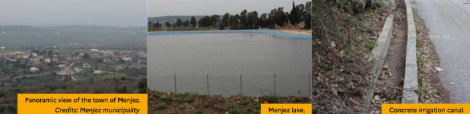
Three projects focused specifically on irrigation. The first project created a 500 m concrete conduit. The second project installed 3 km of plastic irrigation pipes to serve two previously irrigated areas of the village. This project also included drip irrigation systems for around twenty farmers. Unfortunately, the main over-ground conduit was damaged and vandalised. This led to a third project, to install a 2 km underground plastic pipeline, which was regularly monitored to manage and maintain it.
-
The most ambitious project was the creation of a 60,000 m³ hillside lake to collect rainwater from three road side drainage pipes. The lake then feeds into a 5 km irrigation pipe, enabling water to be distributed to two areas where there was previously no irrigation.
-
Currently, the municipality is in the process of preparing a project that will enable the surplus electricity produced by its field of solar panels to be used to pump water from the river to the lake. This will provide water reserves during the dry season. Then, the flow of water can be used to produce electricity.
-
In addition to these projects, the municipality has implemented other initiatives including the creation of a water tank for the fire brigade, the distribution of 4 aerators to each household and the installation of a rainwater collection system on the school roof.
Territory concerned : Menjez village (rural border area in north Lebanon)
Initiative holders : Menjez municipality
Calendar : Six projects since 2012
Partners : International funding partners (EU,USAid, IFAD, GIZ, JICA, Coca-ColaFoundation, etc.), international organisations (UNDP, UNICEF, etc.), universities and local NGOs
Human resources : The municipality has 7 employees, including one full-time employee for water-related issues. Technical experts are called upon during projects. In addition, the Mayor plays a very active role.
Financial resources
-
Total cost: nearly $800,000, mainly financed with international development funding, with some support from the
-
State and the municipality itself
What are the tangible results?
Diversification of water resources
The results of the municipality’s actions on water issues are clearly visible. For the first time in decades, the village can count on a reliable network that supplies water to their homes 24 hours a day, as well as an irrigation system that satisfies farmers who hold rights to the Menjez source, and extends to new areas that were not previously irrigated. This has all been achieved in parallel to reducing dependence on groundwater.
Aiming for more complementarity and circular development
The water projects in Menjez, as well as the interactions between the water management system and other sectors (energy, fire protection, tourism, agriculture, forestry, etc.), are contributing to a cross-cutting, circular approach to development.
New economic opportunities
These projects have made a significant impact on the local economy. Following the development of these water projects, in particular for irrigation, new types of irrigated crops can now be seen in Menjez, especially avocados and carob. The irrigation of new land enables this land to be farmed more intensively. Furthermore, the rainwater collection lake is viewed as an opportunity since it has enabled the development of certain lakeside tourist activities - in fact, there is already a small museum on megalithic burial monuments.
Less pressure on groundwater reserves
The projects provide the population with an alternative to using groundwater, which means that these reserves can be preserved in anticipation of periods when water shortages may be more severe.
Strengthening local authorities
These projects have contributed to the successful « in house » management model used by the Menjez municipal authorities. Water management is no longer a problem, but instead provides financial resources that the municipality invests in the education, cultural and social sectors. There has also been a marked increase in local expertise on water-related issues and how to manage them.
Technical problems cause project delays
During the water projects, the municipality was faced with some bad technical planning, which led to delays and additional expenses. This was the case for the water purification plant in the first project, which did not function correctly, as well as for the overground irrigation conduit that was damaged and vandalised. As a result, this lack of initial planning led to fragmented funding and delays.
Risk of mal-adaptation due to water-intensive irrigation methods
Although the action taken by the municipality has enabled the protection of groundwater reserves, it has only had a limited effect on reducing water consumption (distribution of aerators, creation of a 60,000 m3 lake). In fact, irrigation is the most water-intensive activity in rural areas, and these projects have increased the area of irrigated land. The implemented projects only enable 20 farmers in Menjez to use drip irrigation techniques, out of a total of 200.
What sustainability?
The municipality has other ambitions for new projects in Menjez. These projects will focus on water that is present in the ground and in the air.
The Mayor admits that groundwater is the missing element in the municipality’s action for water in Menjez, despite its importance.
The municipality will not be able to envisage sustainable water management if it does not have a clear picture of underground resources and how they are replenished. The municipality is therefore interested in acquiring greater knowledge about groundwater, as well as in projects to send surface water underground to recharge the water table. Regarding water in the air, the Mayor is soon planning to develop a water recovery project using water condensation in the air.
What conditions for success?
Key success factors
-
Strong backing by the municipality
-
An incremental, project-by-project approach, but with an overall vision
-
Knowledge on project development and on responding to calls for projects from international funding bodies
-
The central role played by the Mayor
Critical areas
Two aspects will determine whether the municipality’s approach will be successful over the long term:
-
The municipality’s ability to transform current irrigation methods that consume very large quantities of water
-
The municipality’s ability to independently maintain its momentum, aside from the central role that the Mayor is currently playing, and to build a stronger institutional base.
Arguments for adaptation
The main connection between the Menjez municipality’s water projects and climate change adaptation is the idea that using surface water can reduce groundwater exploitation. However, the key argument used with local actors is financial (cheaper, reliable, more plentiful water), to convince them to stop using unofficial boreholes.
Useful lessons for similar initiatives
It is important not to consider water management as a problem (demand, pollution, etc.) but instead as an opportunity for the municipal management entity. Water management not only contributes to economic development and living standards, but can also provide financial resources for the municipality.
The Mayor insists that this service must not be free. It must be reasonably priced and proportionate to water consumption, but not free. This is important, both symbolically and financially. To make the service sustainable, the municipality must design a business model that is also sustainable over time.
Alongside the strategy underpinning access to water resources, there must also be an approach to reduce/limit water needs, so as to avoid a future deadlock or tensions between demand for surface and groundwater, and the effects of climate change.
Sources
Study carried out by Jihad Farah, UPLoAD
ADEME Document : Capitalisation on climate change adaptation practices in the mediterranean area. Project portfolio
To go further
Contact
Mr. George Youssef, Mayor of Menjez Municipality: +961 03706221 - menjezmunicipality[@]gmail.com