Improving the resilience of the Mesguina argan forest by promoting green jobs and empowering women (Morocco)
August 2021
Agence pour l’Environnement et la Maîtrise de l’Energie (ADEME)
In Morocco’s Souss-Massa region, the Mesguina argan forest—a UNESCO Biosphere Reserve—faces climate-induced degradation from droughts, floods, and heatwaves, alongside social pressures like gender inequality and poverty. Since 1996, the Ibn Al Baytar Association has championed a participatory model to restore the forest and empower women through cooperatives producing high-value argan oil (now IGP-certified).
By linking ecological conservation with economic opportunities, the project has replanted 25 hectares of argan trees, launched an ecotourism route, and improved incomes for rural women. This gender-inclusive approach proves that adaptation must address both environmental and social vulnerabilities to build long-term resilience.
To download : capitalisation-cc-adaptation-practices-mediterranean-011449b-projectfolio-en.pdf (3.2 MiB)
How does this initiative contribute to the territory’s adaptation to climate change?
Extreme weather events are reducing forest cover and putting populations at risk
The following signs show that various parts of the Mesguina territory are under threat from climate change:
-
Increasingly violent and frequent floods;
-
Lower rainfall and more frequent periods of drought;
-
Increasing air temperature and longer, more frequent heatwaves. These changes are causing forest cover to retreat, and placing greater pressure on natural resources (in particular, the reduction of water resources available for various uses).
Growing social and gender inequality
Water resources are unevenly distributed throughout the territory, both in terms of timing and location. At the same time, drinking water supplies and water available for irrigation are declining. Moreover, extreme weather events such as droughts and floods have differing effects on each category of the population. Women are thus more exposed to these risks than men, who leave the area to work in Greater Agadir.
The argan forest as a solution to adapt to climate change
Adaptation to climate change hinges on reforestation. The argan tree, which is endemic to Morocco, plays a very important socioeconomic and environmental role. The argan forest ecosystem can not only be used as an instrument to fight desertification and climate change, because it forms a natural barrier against the desert and can store carbon, but it is also of high value in terms of biodiversity.
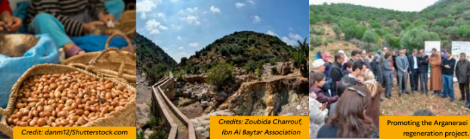
The argan forest as a solution for local development
The economic value of argan trees has raised the local population’s awareness of the need to protect them. High-value, argan-based products can indeed be used in cosmetics or pharmaceuticals. However, to develop the argan forest and implement adaptation measures successfully, it is essential to take into account gender issues, especially in local communities. The project has provided the following benefits for the local population:
-
Promotion and development of the territory
-
Restoration of the landscape as well as the local, architectural, historical and natural heritage
-
Promotion of social economy systems
-
Marketing the cooperatives’ products locally
-
Development of income generating activities for women
-
Training and education for women and girls
Project spotlight
Goal
To preserve the Mesguina argan forest by involving local populations and empowering women.
Background
The Mesguina territory is located in the Souss-Massa region, about 5 km from Agadir, in the foothills of the Western High Atlas, in the Taghzout valley. Mesguina is part of the Arganeraie Biosphere Reserve.
This mountainous site, with its varying landscapes and ecosystems, is valuable. Its natural, cultural and architectural heritage are also valuable.
The overarching problems in this territory are the advancing desert and the effects of climate change. There are also social problems, mainly due to gender inequality, especially regarding access to education and property.
The Mesguina argan forest covers 30,000 hectares of the area surrounding Agadir. This ecosystem is currently under high anthropogenic pressure and faces some important challenges to achieve sustainable development:
-
A relatively high level of poverty,
-
Retreating forest cover (due to urbanisation, erosion, desertification, overexploitation, agriculture and land clearing), which is exacerbating pressure on natural resources,
-
The prevailing socio-cultural customs, which are hindering the emancipation of women and the organisation of argan production. These local issues are compounded by the more widespread problems facing the Souss-Massa region, such as desertification and water scarcity.
Technical description
The project consisted in supporting the creation of women’s cooperatives to promote argan products, then grouping these cooperatives together into Economic Interest Groups (EIG). The association ensures that the cooperatives receive the tools they need (tracking system, training, monitoring activities, intermediation) to improve their turnover and make their activity sustainable.
In addition, the association is working on initiatives to promote local territorial development and protect the environment, for example:
-
Initiating the Mesguina ecotourism route project
-
Campaign to vaccinate dogs against leishmaniasis
-
Responding to ad hoc requests from the population
-
Mobilising the initiators of innovative environmental protection projects, so that they can be tested on site
Territory concerned : Mesguina, comprising 13 douars and the argan forest
Initiative holders: Ibn Al Baytar Association
Partners:
-
Moroccan High Commissioner for Water and Forests
-
German development agency (GIZ)
-
Etc. (see next page)
Calendar:
-
1996: Creation of the Ibn Al Baytar Association
-
2003: First EIG
-
2011: Obtainment of the “IGP Argane” label
-
2014: Launch of the Mesguina ecotourism route project
Human resources: Between 5 and 25 members of staff depending on the project, as well as the association’s volunteers, trainees and participating PhD students
Financial resources : Several international development agencies funded various components of this project
What are the tangible results?
Organising the territory around resilient development projects and the reforestation of the argan forest
A few results are highlighted here, in chronological order:
-
2004: - literacy caravan benefiting 2000 women, which led to the development of income generating activities through the creation of around ten cooperatives. These cooperatives were then federated into a union to develop the production and sale of argan oil
-
2006: creation of a production centre meeting HACCP standards (funding from INDH and the Monegasque Cooperation)
-
2011: creation of the Mesguina Association for Argan Tree Rights Holders, to organise the argan production sector in the Mesguina forest. This association brings together local development associations working within the territory. Obtainment of the « IGP Argane » label, which led to an increase in the price of argan oil. It now sells for 250 Dirhams, rather than 40 Dirhams.
-
2011: the Tighanimine cooperative obtained the FairTrade certification
-
2013: A participatory assessment was carried out (funded by the Good Planet Foundation), involving the populations of 13 douars within the project’s territory, to identify the environment-related constraints that were limiting development in the area. This assessment provided a clear picture of Mesguina’s potential
-
In 2014, the Ibn Al Baytar Association suggested some ideas to develop ecotourism, encompassing the promotion of local products and handcrafted products, as well as local, architectural, historical and natural heritage. The Association then organised a participatory workshop (funded by GIZ-ACCN) to develop the concept of the Mesquina ecotourism route
-
Between 2015 and 2018, 25 hectares of argan forest have been replanted (funded by the Japanese and Norwegian development agencies, and by the High Commissioner for Water and Forests and to Fight Desertification)
-
The Association carries out regular training sessions on the regeneration of argan trees and the conversion of waste from the crushing process (charcoal or sale of excess production).
Continuing to develop tourism
The Association is continuing to work locally, especially on the planned tasks for the ecotourism route around the argan forest and the territory’s heritage sites:
-
Installation of information panels and signposts for the tourist circuit
-
Mobilising travel agencies
-
Integrating women’s cooperatives along the route
Risks or difficulties to be addressed
Despite the project’s mainly positive results, certain issues still prevail, such as the well-established patriarchy, illiteracy among the local population, waste management and waste water treatment. These issues place limitations on certain development prospects.
Moreover, throughout the country, the argan sector is still opaque and not well organised. This means that, although the commercial success of argan oil has had a positive effect, higher argan oil prices do not seem to have benefited the local population and producers (mainly due to multiple intermediaries and purchasing argan seeds - amandons - at local markets).
Furthermore, there is no information on the success rate of reforestation campaigns (some newly planted trees die because of drought).
Finally, pasture management is also a problem, since the area suffers from overgrazing, which disrupts the natural environment. It is therefore preferable to keep goats away from recently reforested areas, to protect young plants.
| Words of a participant : »We are members of one of the most recent EIGs. Thanks to the involvement of the Ibn Al Baytar Association and GIZ, we have managed to form a partnership with the High Commissioner for Water and Forests to regenerate the forest. The argan tree is our heritage, we must protect it. When you join a cooperative that is part of our EIG, there is one unequivocal condition: you must make a commitment to replant the argan forest.« Khadija, a member of the « Ethical Women » EIG |
Sustainability of the initiative
By safeguarding local skills, organising the argan sector, carrying out reforestation, providing a decent income and empowering women, these initiatives guarantee the sustainability of argan-related activities, which help to increase the capacity of local communities to adapt to climate change.
What are the conditions for success?
Key success factors
Scientific research on the argan tree and its ecosystem is a crucial component in this development process. By studying and shedding light on undiscovered aspects of the tree, this enables the development of technical, institutional, political and organisational solutions to manage the ecosystem sustainably.
The key to the project’s success is then the involvement of its beneficiaries. Since the headquarters of the Ibn Al Baytar Association is in Rabat, it therefore relies on their involvement to accomplish projects. In general, local communities have very quickly taken ownership of these initiatives.
Another vital component is the ability to raise funds, in order to enable projects to move forward.
Critical areas
Lack of structure in the argan sector is leading to increased inequality. A monopoly on these products is currently being organised.
To develop tourism in this area, it is necessary to provide visitors with sanitation facilities and to manage waste. Currently, the beautiful landscape is marred by waste. Regarding sanitation, an ecological liquid sanitation project using argan charcoal will soon be tested, which should eliminate odours and water coloration. This water can then be used for irrigation.
Arguments for adaptation
Climate change will exacerbate the negative mechanisms that are gradually weakening the territory: desertification, access to water, social and gender inequality.
It is important to anticipate these issues right away, in order to consolidate the resilience of the territory and its communities, while preserving their natural wealth and resources.
Useful lessons for similar initiatives
The cooperatives must be rigorously monitored (e.g. by requesting regular reports to facilitate remote follow-up).
It is important to make sure that people from all categories of the population participate in these projects, in order to embed traditional skills within society. This is particularly true for women, who rarely participate in community activities without encouragement.
The mobilisation of a large team of experts helps projects to progress and lends legitimacy to their results (and also encourages feedback on field experience).
Sources
Study carried out by Zhor Lebbar, AGROCONCEPT
ADEME Document : Capitalisation on climate change adaptation practices in the mediterranean area. Project portfolio
To go further
Contacts
-
Zoubida Charrouf, president of the Ibn Al Baytar association
-
Hassan Aboutayeb, Atlas Kasbah Ecolodge
-
Khadija Saye, president of the Ethical Women EIG