Optimising the production of goods and services by Mediterranean forest ecosystems in a changing global context (Lebanon)
August 2021
Agence pour l’Environnement et la Maîtrise de l’Energie (ADEME)
Lebanon’s forest ecosystems, already vulnerable to rising temperatures (+3.2°C by 2100), reduced rainfall (-11%), and desertification, face increasing pressures from fires, pests, and unsustainable land use. The Jabal Moussa Biosphere Reserve (6,500 ha) became a pilot site for a FAO-Plan Bleu initiative (2012–2016) aiming to mainstream climate adaptation into forest management.
By developing decision-making tools, economic valuations of ecosystem services, and participatory governance, the project sought to enhance resilience while supporting local livelihoods (beekeeping, ecotourism, thyme cultivation). Though scientific gaps and institutional tensions persisted, the initiative laid groundwork for sustainable forestry policies and carbon funding mechanisms, proving that adaptation requires both ecological knowledge and socio-economic integration.
To download : capitalisation-cc-adaptation-practices-mediterranean-011449b-projectfolio-en.pdf (3.2 MiB)
How does this initiative contribute to the territory’s adaptation to climate change?
Lebanon is very vulnerable to climate change
Temperatures are projected to rise by 1.7°C by 2050 and 3.2°C by 2100, together with an 11% drop in rainfall, a 70% decrease in snow cover, a 30% increase in flooding, 18 additional days of drought and a 60 cm rise in sea level. This will take an enormous economic toll on the country over the medium and long term.
The forestry sector is particularly vulnerable
Although forest cover is currently expanding in Lebanon, and the country is still a carbon sink overall, climate change is having a negative impact on its forests: rising numbers of forest fires, greater vulnerability to diseases and infestation by insects, reduction in size and destruction of certain types of forests, erosion. The destruction of forests has an indirect impact on the numerous economic activities that they serve.
In response to these impacts, the project aims to develop new practices in Lebanon to better understand, use and manage forests
These practices focus on climate change issues and aim to develop and pass on methods: 1) to better understand forest vulnerability, 2) to identify value chains and opportunities to develop forest products, 3) to establish appropriate, participatory governance.
This initiative aims to make climate change adaptation a mainstream issue in forest management policies and practices, by intervening at various levels and by developing synergies with other ongoing projects on the same theme
In Lebanon, the project will provide working methods and management practices for the Association for the Protection of the Jabal Moussa Reserve (APJM). It will enable the Lebanese Ministry of Agriculture to consider the payoffs and obstacles to using carbon funding mechanisms, and to assimilate value chain calculation methods that include ecosystem services. For SILVA MEDETERRENEA and the FAO, it will provide an opportunity to revive the Collaborative Partnership on Mediterranean Forests (CPMF) exchange network, especially between southern and eastern Mediterranean countries.
The project was developed in synergy with, and as a complement to the Adaptation au changement climatique des conditions cadres de la politique forestière dans la région MENA (Adapting the conditions governing forestry policy to climate change in the MENA region) project, implemented by GIZ and the same partners from 2010 to 2015.
Project spotlight
Goal
To encourage stakeholders to manage and restore Mediterranean forests, so that they can sustainably supply environmental goods and services, in a fast-changing global context with very high anthropogenic pressure on ecosystems
Background
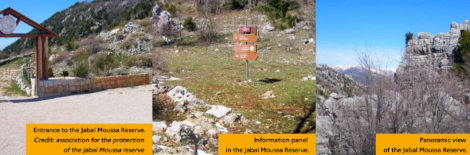
The Jabal Moussa Biosphere Reserve is the chosen pilot site in Lebanon for this initiative.
With its surface area of 6500 hectares, the reserve comprises a wide variety of habitats at altitudes ranging from 350 to 1600 m. It is a recognised Lebanese nature reserve, and includes three areas. The central area (1250 hectares) is totally protected to ensure conservation. The buffer zone, which extends to five villages, is for conservation with certain limited activities that are considered ecologically and socio-culturally sustainable. The so-called transition zone includes 24 villages, and this area allows socio-economic development activities with low environmental impact.
The reserve is managed by an NGO, the Association for the Protection of the Jabal Moussa Reserve (APJM). The following activities are carried out inside the reserve: ecotourism, artisan catering, beekeeping, as well as illegal coal mining and sheep and goat herding. The law imposes a moratorium on cutting down conifers.
Climate change is having a visible impact, causing the decline of several species of trees within the reserve. Illegal coal mining and herding is also contributing to the decline of other species. Soil erosion is exacerbating deforestation and the contamination of rivers and streams. Finally, there is a high risk of forest fires in certain areas.
Technical description
The project includes five components:
-
Component 1: Data production and development of decision-making and management tools on climate change vulnerability and adaptation capacities
-
Component 2: Estimation of the economic and social value of goods and services provided by forest ecosystems
-
Component 3: Development of participatory territorial governance methods
-
Component 4: Optimisation of environmental goods and services provided by Mediterranean forests, focusing on the opportunities offered by carbon funding mechanisms, especially REDD+
-
Component 5: Coordination and communication
Territory concerned :
-
For the whole project: 7 forests in Algeria, Lebanon, Morocco, Tunisia, and Turkey.
-
In Lebanon: the Jabal Moussa Biosphere Reserve and the Bentael Reserve (only for component 3).
Initiative holders : SILVA MEDITERRANEA (FAO) and Plan Bleu
Partners :
-
National Forestry Authorities in the five countries, GIZ, local forestry NGOs.
-
In Lebanon: Ministry of Agriculture (national), APJM (local)
Calendar :
-
Start date: July 2012
-
Finish date: December 2016
Human resources :
-
Two full-time staff working for the project initiators.
-
In Lebanon, two full-time staff at the Ministry and two at the AJPM, as well as specialist consultants for each component.
Financial resources :
-
For the whole project (all 5 countries): €8.5 million
-
Funding: €2.6M (FFEM), €4M (GIZ), €1.5M (EU), €0.35M (MAAF)
What are the tangible results?
A significant contribution to building and transferring knowledge, and to developing national forestry management capacities
-
Production and online publication of an extensive bibliography and methodology overviews
-
National capacity-building within the partner countries
-
Leading and facilitating a dynamic sharing process between Mediterranean countries, relaunching the CPMF platform
-
Assimilation of new forestry management methods by local partners
-
In Lebanon, the project created momentum to use carbon audit tools and thus support the National Reforestation Programme
-
The actions taken during this project indirectly contributed to the GIZ project. One particular example is the establishment of a 2015-2025 National Forestry Programme in Lebanon.
A limited response to local issues
-
For APJM, the databases and analyses produced during component 1 of the project have made a significant contribution to the reserve’s management. In fact, this data compensates for the lack of information that was constraining the reserve’s knowledge and ability to develop appropriate management tools.
-
Although the studies on goods and services have enabled the development of new methods at the Ministry level, they were not sufficiently appreciated locally. For APJM, although the analysis demonstrated the financial returns on developing beekeeping activities (as a priority), ecotourism and thyme cultivation, it did not provide enough practical recommendations for local populations to make better use of the forest’s goods and services.
An effective response to climate issues
-
The recommendations produced by component 1 have enabled APJM to rethink its forestry management practices, both to minimise fire risks and to allow endangered species to stabilise or even increase their populations.
Better environmental resilience and institutional sustainability
-
The new forestry management techniques used by the APJM are strengthening the reserve’s environmental resilience.
-
The Ministry of Agriculture has acquired significant knowledge on climate change issues and possible adaptation measures in terms of forestry management.
Tense relations between partners and consultants can be a substantial obstacle to the smooth running of the project
Regarding the actions taken during component 3 (participatory governance), interpersonal problems and diverging methodology between the consultant and APJM led to these actions being discontinued on the reserve. These actions had to be carried out on another site (the Bentael reserve), which resulted in delays and reduced the relevance of the Lebanese project’s interlinked components.
Structural mal-adaptation risks in Lebanon
-
The force of the law imposing a moratorium on cutting down conifers has a negative impact on some forests, especially in terms of fire risks.
-
The methods developed during this project seem to be particularly appropriate for forest areas where it is possible to develop economic activities and participatory governance. This excludes Lebanese reserves that are specifically classified as conservation areas, which are managed by specific, pre-established commissions/associations.
Words of a participant :
| «Before, we thought that climate change issues only covered forest fires and insect infestations. During this project, we have learned that climate change adaptation is a framework to seize opportunities for both ecological and socio-economic resilience arising from forestry management. » (Director of rural development and natural resources, Ministry of Agriculture) |
| «We had a severe lack of data on the forest. The project enabled us to create a remarkable database. In addition, the recommendations from component 1 provided us with a new method to manage the forest, which we have implemented. » (An APJM representative) |
Sustainability of the initiative
Two GEF and IRI projects were developed and launched following this project, with the same partners, to take further steps to protect Mediterranean forests from degradation.
What are the conditions for success?
Key success factors
-
Interest from the national governance institution and perception of the project as a learning opportunity on climate change topics
-
As well as enabling the compilation of databases, the project provided answers to local and national stakeholder’s questions, especially concerning the development of goods and services and their sustainability
-
A Mediterranean-wide perspective, which enables networking and experience-sharing
The project concluded that it was necessary to improve forestry governance, and in particular to review forestry policies on resource usage and improve regulatory and administrative procedures. The introduction of some form of compensation for ecosystem services would allow more sustainable management of natural resources.
Critical areas
-
The project mainly includes intangible products (studies) and lacks applied activities, which particularly frustrated local partners and raised doubts on whether recommendations are applicable
-
This project shows that a simultaneous drive to study the adaptation of forests to climate change at the local, regional and national level is a winning strategy. This does however require substantial efforts for the various partners to agree on expectations, timelines and actions to be taken.
Arguments for adaptation
In this project, there are two key arguments to mobilise partners:
-
Working on climate change adaptation for forests is a matrix to understand the local forest ecosystem and its vulnerabilities better, as well as to improve the management of its goods and services.
-
Taking an interest in adaptation issues can safeguard the sustainability of these goods and services, or even increase it.
Useful lessons for similar initiatives
-
Local partners must be involved earlier in the project, in other words right from the project definition phase. A local perspective is very important since this brings direct, day-to-day experience of the realities of forest management. Furthermore, developing the capacities of local stakeholders is just as important as those of national institutions, to ensure that the approaches implemented during the project will be sustainable over time.
-
Carbon funding mechanisms, in particular REDD+, are not necessarily of economic interest within the Mediterranean context. However, further thought on these mechanisms, in order to integrate them into the analysis and development of value-added forest goods and services, could be useful to plan sustainable management of Mediterranean forests over the long term.
Sources
Study carried out by Jihad Farah, UPLoAD
ADEME Document : Capitalisation on climate change adaptation practices in the mediterranean area. Project portfolio
To go further
For more information Websites:
-
planbleu.org/projets/optimiser-la-production-de-biens-et-services-par-les-ecosystemes-boises/
-
Technical report: planbleu.org/sites/default/files/publications/rapport_final_foret_libanc2.pdf
-
FAO study on sustainable forest management: www.fao.org/3/a-bb123f.pdf
Contacts
-
Nicolas Picard, Secretariat of SILVA MEDITERRANEA, FAO - Nicolas.Picard[@]fao.org
-
Chadi Mohanna, Director of Rural Development and Natural Resources, Ministry of Agriculture, CMohanna[@]agriculture.gov.lb