ADAPT: Assisting the Adaptation to Climate Change of Urban Systems in the Cross-Border Space (Italy and France)
August 2021
Agence pour l’Environnement et la Maîtrise de l’Energie (ADEME)
In the vibrant cross-border space of the Upper Tyrrhenian, where Italian and French cities stand as twin sentinels against the Mediterranean, flash floods have become the silent scourge of urban life. A single storm can submerge entire neighborhoods within hours, crippling roads, sewage systems, and human lives. In response, the ADAPT project, led by ANCI Toscana, chose a dual approach: technical and human. Between 2017 and 2020, 7 drainage infrastructures, 3 green infrastructure management models, and 2 monitoring systems were deployed across cities like Livorno, Ajaccio, and Sassari, turning them into open-air laboratories for climate resilience. Here, adaptation is not just about building higher walls—it’s about rethinking how cities breathe, absorb, and endure.
To download : capitalisation-cc-adaptation-practices-mediterranean-011449b-projectfolio-en.pdf (3.2 MiB)
How does this action contribute to the territory’s adaptation to climate change?
Flash floods threaten high density urban areas
The project was exclusively dedicated to the flash floods caused by extreme rainfall events in urban areas. Impacts have been analysed as a whole and on the general structure of the city.
Flash floods in high-density urban areas can cause damage to buildings and green areas, disruption to critical infrastructure, including roads, water distribution, and sewage systems, injury and illness, and in some cases loss of life. The impacts of flooding can be felt months and years after the event, in particular on health, well-being, livelihoods, and social cohesion.
Planning as an instrument for “climate-proofing” cities
The main issue of climate change events such as heavy and sudden rainfalls, that may cause flash floods, is their unpredictable nature. Consequently, it is challenging to develop an early-warning system, similar to the usual Civil Protection Plans. The most viable solution to address their impacts, reduce risks, and increase the resilience of urban areas, is the development of adaptation actions according to planning instruments that take into consideration climate change. The project aspired to contribute to the resilience of cities, and strengthen knowledge and skills of institutional actors and stakeholders.
The replicability of the project’s results in other urban areas and territories
The main activities developed by the project are replicable and scalable to other cities and territories. For example, the « Guidelines for the redaction of Adaptation Plans to flooding risk » are applicable to other municipalities that wish to develop Local Adaptation Plans. Furthermore, the cross-border Joint Adaptation Plan, that calls for homogeneous programming, contains replicable and transferable adaptation solutions to other cities that experience similar climate vulnerabilities.
Different tools allowed for building adaptive capacity in urban areas and promote knowledge transfer on climate adaptation: public consultation, workshops, open access webinar, and training to administrators and operators of the Municipalities and interested stakeholders (e.g. technicians, associations, and citizens).
Project spotlight
Goal
ADAPT project’s main goal is to make the Italian and French cities of the Upper Tyrrhenian area able to adapt to the consequences of climate change, in particular to floods caused by sudden and intense rainfalls, through capacity building, the strengthening of knowledge on climate adaptation, as well as the improvement of planning instruments.
Background
Flash floods are a major threat to settlements, with social, economic, and environmental consequences. Heavy rainfall can produce large volumes of surface water that can overwhelm drainage and sewer infrastructure. Moreover, the excessive waterproofing of cities exacerbate the negative impacts of heavy rainfall, contributing to catastrophic flooding events.
Over the past 5 years, floods due to sudden and intense rain events have caused more than €1 billion of damages in the cross-border area of the Upper Tyrrhenian, between Italy and France.
With the increase of average temperatures, drought periods, and frequency of extreme rain events, climate change already represents a common challenge that cities must face, not only fighting its causes but also adapting to its consequences, through their structure, organization, and enhancement of their resilience.
Technical description
In the context of the project and in line with the local adaptation plans and Cross-borders Joint Adaptation Plan, experimental activities were carried out in the project territories, including:
-
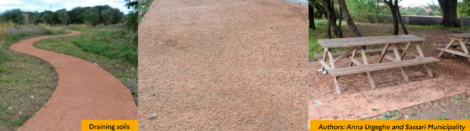
7 drainage infrastructures in portions of roads, green spaces, and public buildings to improve the drainage capacity of the urban areas (Livorno, Oristano, Alghero, Sassari, Vado Ligure, Savona, La Spezia)
-
3 models of green infrastructure management to improve their water retention capacity (Var Department, Anci Toscana, Bastia Agglomeration Community)
-
2 monitoring systems to control the water level in underground passages and sewers (Rosignano, CISPEL)
-
1 information system for road management in the event of urban flooding (Ajaccio)
-
1 geographic information system (La Spezia)
-
1 validation model for adaptation interventions, to assess their consistency with the cross-border adaptation plan (CIMA)
-
Greening (revegetation) action in schools (Ajaccio)
Territory concerned:
Upper Tyrrhenian areas: Cities in Italy (Tuscany, Liguria, Sardinia regions) and Cities in France (Corsica region, Var Department)
Initiative holders: ANCI Toscana (ancitoscana.it/)
Partners:
Comune di Livorno (IT) ; Communauté d’Agglomération de Bastia (FR) ; Mairie d’Ajaccio (FR); Département du Var (FR); Fondazione CIMA (IT); Comune di Rosignano Marittimo (IT); CISPEL (IT); Comune di Alghero (IT); Comune di Sassari (IT); Comune di Oristano (IT); Comune di La Spezia (IT); Comune di Savona (IT); Comune di Vado Ligure (IT)
Calendar:
-
Start date: 02/2017
-
Original End date: 02/2020
-
Extension: 06/2020
Human resources:
The INTERREG Maritime program allows for covering the 15% co-financing using internal human resources.
Financial resources:
-
Total project budget: €3,796,730.05
-
Co-financed by INTERREG Maritime: €3,227,220.55 (85%), using the European Regional Development Fund (ERDF), including €128,248.41 for the drainage infrastructures in Sassari (Italy)
What are the tangible results?
Raising awareness and supporting the development of Local Adaptation Plans
Different events took place during the project, ensuring the mobilization of relevant stakeholders, among which: 12 initial local workshops and 13 empowerment workshops made basically for the administrators and operators of the Municipalities and interested stakeholders (representatives of the economic-social system and citizens); over 20 events of knowledge transfer, capitalization, and networking; various Social ADAPT events (citizen awareness events) and Urban Partnerships for Adaptation (PUA) meetings; and training courses and webinars publicly available on the online platform.
Moreover, documents were produced to guide cities in their planning, including: guidelines for the redaction of Adaptation Plans to flooding risk; a cross-border Joint Adaptation Plan; and 11 Local Adaptation Plans drawn up by each urban system participating in the ADAPT project, based on Local Climate Profiles (they are not totally new plans but they are also based on a re-interpretation of current available plans). A total of 259 actions were planned in these local adaptation plans, classified between soft « non structural » actions (191 actions, e.g. studies; training, information and awareness; governance, planning, etc.), and structural actions (68 actions, including 23 green - e.g. green infrastructure to promote water drainage and mitigate other negative effects of climate change, and 45 grey actions - e.g. drainage infrastructure and measures promoting the collection and reuse of excess meteoric water).
Supporting the development of new infrastructures and improved infrastructure management
7 drainage infrastructures in urban roads, green spaces, and public buildings were built to improve the drainage capacity (Livorno, Oristano, Alghero, Sassari, Vado Ligure, Savona, La Spezia). Infrastructure management tools were also developed: 3 green infrastructure management models to improve rainwater management and infiltration; 2 monitoring systems to control the water level in the underpasses and the sewage system; 1 information system for traffic management in the event of urban floods (Ajaccio); 1 model of validation of adaptation interventions, to assess their consistency with the joint adaptation plan (CIMA).
Improved urban resilience to extreme events
Training, communication, planning, and implementation of green and grey adaptation interventions contributed to improve the resilience of cities of the Upper Tyrrhenian areas to extreme events.
Strengthened knowledge (e.g. quantity and quality of climate data on urban areas) and skills of institutional actors on climate change adaptation as well as improved management, governance, civil society participation in territorial planning that considers climate change are key elements in the cities’ resilience.
Limits and follow-up of the project
A more holistic approach is needed to elaborate an Adaptation Plan that could significantly improve the resilience of the urban systems to climate change. To maximize the positive effect of an Adaptation Plan, other important phenomena (other than heavy and sudden rain) that have negative impacts on urban areas should also be included in the assessment (e.g. extreme temperatures, drought, extreme wind, change in solar radiation, sea level rise). Adaptation actions could be then planned to address more impacts simultaneously.
Additionally and for future projects, an extra effort should be done to ensure the engagement of the policy makers, planning and applying ad-hoc methods to ensure political administrators’ involvement
along the entire project development. Their active participation would surely have had positive impacts on the project’s long-term sustainability.
For the success of the Local Adaptation Plans, the involvement of citizens is also essential and should be guaranteed at an early stage (e.g. in the design phase), facilitating discussion on priorities and exchange of knowledge. If engagement is well managed, it could give the opportunity to reach categories that are usually not included or initially not interested, as well as the ones particularly vulnerable to climate change.
| Words of a participant : “ADAPT has worked for the genetic mutation of cities, both in the physical structure and in the structure of services, so that they adapt to climate change”. Marinella Osilo, Environmental Sustainability Office Manager, Comune di Sassari |
What sustainability?
The project contributed to improve the resilience of urban areas to the risks related to flash flood; and disseminate information about climate adaptation, transferring knowledge also to other municipalities not directly involved.
For the sustainability of the initiative it is essential that Administrations keep up the commitment, ensuring that future political decisions support the adoption, improvement (considering other climate hazards, risk and further impacts) and implementation of the Adaptation Plans and Actions and their integration in existing planning instruments. Discussion with the Regional Institutions are already taking place to promote the allocation of funds, in the next regional funding programs, to the development of the actions foreseen in the Adaptation Plans.
What conditions for success?
Key success factors
One of the major factors of success was that the project’s partners were well selected, consequently the partnership was relevant and competent to implement the project.
The involvement of a pragmatic research centre (i.e. CIMA), that was already developing innovative research projects on climate adaptation under other programs, such as the Horizon 2020, was really beneficial.
The successful management of the internal communication was another important factor to avoid difficulties in the selection of project priorities and decisions, all established in agreement between partners.
All activities had the wider social acceptance and was positively perceived by the relevant stakeholders of the region.
The development of a Cross-borders Joint Adaptation Plan and approach that calls for homogeneous programming in order to maximize the positive results of the actions related to adaptation was also key.
Finally, the project has a wide potential as the number of beneficiaries that can access the Guidelines (replicable and scalable) as well as the online training courses is very high (millions of people, and thousands of Municipalities).
Critical areas
The main constraint was the low participation and involvement of some political administrators at municipality- level. This behavior could be perceived by citizens as a lack of interest, demonstrate that the activity is not a priority and impact negatively any further project results. On the opposite side, the activities had a wider social acceptance and were positively perceived by stakeholders, whose level of participation was high.
The main focus of the guidelines for the development the Local Adaptation Plans is on infrastructure (Grey and Green) development, therefore other soft actions were partly overlooked. The integration of a specific section on “Services” and other adaptation measures is also needed to ensure the resilience of urban areas (e.g. a quality manual and to establish procedures, with a check list). The monitoring of key climate variables and indicators related to the management and further development of adaptation actions should be ensured.
Arguments to mobilize on adaptation
The negative consequences of flash floods on densely populated areas can engage public responsibility to ensure the safety of populations, goods and activities Because heavy and sudden rainfalls are usually unpredictable, the implementation of adaptation measures is the only viable solution to guarantee resilience of urban areas.
Moreover, the active involvement and planning of municipalities is now facilitated, compared to before. For example, networks of municipalities build and progressively expand, promoting knowledge transfer, the application of best practices, policy and planning instruments that assess and address adaptation and resilience to climate change from an inter-municipalities perspective.
Finally, green solutions could be preferred for their multiple benefits on climate change adaptation and mitigation, biodiversity enhancement, recreational use and social aspect. Also, in most cases, they are less expensive than grey infrastructure and promoted by several funding instruments.
Useful lessons for similar initiatives
At project level, it is essential to select the correct partner according to the dimension of the adaptation planning and to involve the maximum number of municipalities. The number of involved municipalities allows to provide evidence that the results reached by the project are significant and can be replicated.
During project design, it is important to promote and seek complementarity with other projects on climate adaptation, and to plan for stakeholder and citizen participation from the first stage.
The implementation of strategies and ad-hoc engagement processes could be established as project task, to ensure the active participation and commitment of the political administrators.
Adaptation is a transversal topic in urban areas and should be embedded in the objectives of all municipal services/offices.
Throughout the project’s implementation, networking with other municipalities or urban services providers can ensure the results will respond to effective needs and be properly disseminated.
Finally, Adaptation Plans should be considered as a harmonization of current plans rather than a new planning instrument and there must be a broader reflection and connections as well as a cross-border analysis. They should include all climate change risks and consider and integrate a section on the management of services and their interconnection.
Sources
Investigation by Anna Urgeghe, independent consultant
ADEME Document : Capitalisation on climate change adaptation practices in the mediterranean area. Project portfolio
To go further
Contacts
Project Manager: ANCI Toscana – Elena Conti - Head of Anci Toscana’s EU projects office
email: elena.conti[@]ancitoscana.it